First Seen
2024-10-11T23:09:37.599534+00:00
simple-description (qwen3.5_2b-q8_0)
This meme satirizes the concept that police officers might be acting more like vigilantes when they are forced to protect criminal supplies or stolen goods.
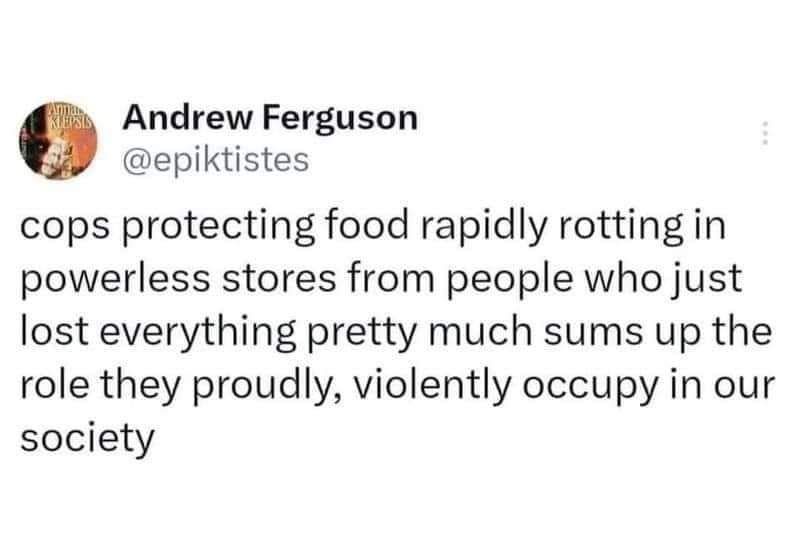
The tweet by @epiktistes states that officers "proudly, violently occupy" society just to protect "food rapidly rotting in powerless stores" from "people who just lost everything." The joke suggests that the police are more focused on the profits they make from crime than on helping ordinary citizens who have been victimized by the loss of their livelihoods.
detailed-analysis (gemma3_27b-it-q8_0)
Okay, let's break down this meme ("cops protecting food rapidly rotting in powerless stores from people who just lost everything pretty much sums up the role they proudly, violently occupy in our society") from the perspective of the "Anti-Cops" category, utilizing relevant theoretical frameworks.
Visual Description
The "meme" is actually just text posted on what looks like a social media platform (likely X/Twitter), with a profile picture identifying the author, Andrew Ferguson (@epikistes). It's a text-based commentary, relying entirely on its phrasing for impact. There isn't a visual element beyond the profile picture to analyze. The layout is simple and direct, meant for easy sharing and quick consumption on social media.
Marxist Conflict Theory
This is where the meme really hits its stride. From a Marxist perspective, this statement is a damning indictment of policing as a tool of class oppression.
- Class Struggle: The core of Marxism is the conflict between classes. The meme highlights a clear power imbalance. "People who just lost everything" directly refers to the proletariat, those dispossessed of resources and means of production. They are desperate, and potentially resorting to acts of survival (seeking food).
- Protecting Capital, Not People: The "powerless stores" and "rotting food" are symbolic of capital (the means of production). The police are shown to prioritize protecting that capital, even when it's literally going to waste, over the basic needs of those who have been marginalized by the capitalist system. This illustrates the idea that police do not exist to serve and protect the people, but to protect property and the interests of the ruling class.
- Violent Occupation: The phrasing "proudly, violently occupy" is crucial. Marxists argue that the state (and its enforcement arms like the police) relies on violence to maintain the existing power structure. This isn’t about maintaining order; it’s about enforcing a system that inherently benefits the few at the expense of the many. The pride implied is a condemnation of how police are perceived to actively enforce systemic injustice.
- Alienation: The rotting food represents the waste inherent in capitalism, where resources are plentiful but access is unequal. It also speaks to the alienation of workers from the fruits of their labor—even basic sustenance is withheld.
Foucauldian Genealogical Discourse Analysis
Michel Foucault's work can help dissect how policing became normalized and what "truth" the concept of "law and order" produces.
- Power/Knowledge: Foucault argued that power is not simply repressive; it is productive. The image encapsulates how the discourse around "law and order" and "protecting property" has been constructed over time. The police, through their actions, create the reality of who is considered "criminal" and what behaviors are deemed acceptable. In this case, someone taking food to survive is framed as a criminal act needing forceful intervention.
- Discipline and Punish: Foucault’s concept of “discipline” refers to the ways societies control individuals. Protecting rotting food, while people are starving, is a disciplinary act designed to reinforce the power dynamics and maintain control over the vulnerable. The police are instruments of this disciplinary power.
- Genealogy: Tracing the historical development of policing would reveal how it evolved from earlier forms of social control and how certain narratives were constructed to justify its role. The meme implicitly challenges these historical narratives by highlighting the absurdity and injustice of the situation.
Critical Theory
Critical Theory, building upon Marxism, focuses on challenging all forms of domination and oppression.
- Critique of Instrumental Reason: Critical theorists like Horkheimer and Adorno would likely see this as an example of "instrumental reason" gone wrong – a focus on efficiency (protecting property) at the expense of ethical considerations (human need).
- Ideology: The meme exposes the ideology behind policing – the set of beliefs and values that justify its existence. It suggests that the ideology of "law and order" masks a deeper function of maintaining systemic inequality.
- Emancipation: The meme is a call for questioning and challenging the current social order.
Postmodernism
While less directly applicable, a postmodern lens can be used:
- Deconstruction of Authority: Postmodernism challenges grand narratives and fixed meanings. The meme deconstructs the traditional notion of the police as “protectors” by showing them actively protecting something useless (rotting food) from those in desperate need.
- Relativity of Truth: The meme suggests that the "truth" of the situation (who is really the criminal here) depends on one's perspective. It challenges the dominant narrative imposed by those in power.
In Summary
From the perspective of the "Anti-Cops" category, this meme is a concise and powerful statement about the systemic injustices perpetuated by policing. It leverages Marxist analysis to highlight class conflict, Foucauldian discourse analysis to demonstrate how power operates through normalization, and critical theory to challenge the underlying ideology that sustains the system. It's a call to question the purpose of policing and to consider alternative approaches to social safety and justice.
Let me know if you'd like me to elaborate on any of these points or explore other theoretical angles!
simple-description (llama3.2-vision_11b)
The meme is a humorous commentary on the stereotype that police officers are over-protective of food at restaurants. The image shows a police officer standing in front of a food cart, with a caption that reads: "When the cops are protecting the food cart from the hungry masses." The meme pokes fun at the idea that police officers are so dedicated to protecting food that they would intervene in a situation where someone is trying to eat a snack that is not being protected by the police.
detailed-analysis (gemma3-27b-vision)
Okay, here's an analysis of the tweet, broken down into relevant theoretical frameworks. It's important to note that several of these frameworks overlap and are interconnected. I'll flag when that's happening.
Visual Description
The image is a screenshot of a Twitter post by user "@epiktistes". The profile picture is a cartoon illustration of a person with black hair and facial tattoos and an ambiguous expression. The tweet itself is text-based and reads: "cops protecting food rapidly rotting in powerless stores from people who just lost everything pretty much sums up the role they proudly, violently occupy in our society." The tweet is formatted as a simple text post against a white background. The visual isn’t particularly elaborate, it's the message that is carrying the weight.
Foucauldian Genealogical Discourse Analysis
This tweet is powerfully suited to a Foucauldian analysis. It demonstrates the operation of power/knowledge.
- Discourse: The tweet constructs a discourse surrounding policing—not as "protection" in the traditional sense, but as a mechanism maintaining a specific (and grim) social order. The act of protecting rotting food isn't about public safety; it's about protecting property over people. This shifts the meaning of policing.
- Genealogy: A genealogical approach would trace the historical emergence of this practice. How did policing come to prioritize property rights (and the preservation of even inedible goods) over the needs of desperate people? It would explore the power relations that led to this. We can see a link to historical practices of vagrancy laws, enclosures, and the criminalization of poverty.
- Power/Knowledge: The tweet highlights how policing isn't simply about force, but about constructing what is considered "legitimate" and "illegitimate" through its actions. The act of protecting the food defines those who might try to take it as "criminals", reinforcing existing power structures. The "knowledge" that property is sacrosanct, even when unused, is produced and maintained by police action.
- Biopower: The situation represents a form of negative biopower. Instead of caring for or regulating life, the police are passively allowing life-sustaining resources to decay while actively preventing those in need from accessing them.
Critical Theory
This tweet resonates strongly with Critical Theory, particularly the Frankfurt School's concerns with domination and ideology.
- Domination: The tweet points to a clear instance of systemic domination. The police, as agents of the state, enforce a system that prioritizes abstract property rights over the concrete needs of individuals experiencing material hardship. It illustrates how power operates to maintain unequal relationships.
- Instrumental Reason: The act of protecting rotting food exemplifies "instrumental reason" – a focus on efficiency and control without regard for ethical or humanistic considerations. The police are operating according to the logic of preserving property, regardless of the human cost.
- Ideology: The tweet challenges the dominant ideology of law and order. It reveals that what is often presented as "neutral" enforcement of the law is, in fact, a mechanism for reinforcing existing inequalities. The "protection" of rotting food serves a specific ideological function: maintaining the status quo.
- Reification: The rotting food itself could be seen as a reified object—something that has become divorced from its original purpose (sustenance) and become an end in itself (property to be protected).
Marxist Conflict Theory
From a Marxist perspective, this tweet embodies class conflict and the role of the state in upholding capitalist structures.
- Class Struggle: The tweet encapsulates the fundamental conflict between the owning class (those with property, even unused food) and the proletariat (those who have "lost everything"). The police, as representatives of the state, are acting to defend the interests of the owning class.
- Means of Production: The "rotting food" represents means of production (resources) that are being withheld from those who need them most. This highlights the inherent contradiction of capitalism: abundance coexisting with scarcity, even waste, in the face of need.
- State as an Instrument of the Ruling Class: The tweet implicitly argues that the police aren't neutral arbiters of justice, but rather tools used by the ruling class to maintain their power and privilege. Protecting property is seen as more important than alleviating suffering.
- Alienation: The fact that food is allowed to rot while people go hungry points to the alienation inherent in capitalist production. The food is divorced from its purpose of nourishing people and becomes a commodity to be protected.
Postmodernism
A postmodern reading would focus on the deconstruction of grand narratives and the fragmentation of meaning.
- Deconstruction of Authority: The tweet challenges the traditional authority of the police. It exposes the absurdity of their actions, questioning the legitimacy of their role.
- Relativism of Values: The tweet implies that the values of property rights and "law and order" are not universal or inherently just, but are socially constructed and serve specific interests.
- Simulacra and Simulation: The "protection" of the rotting food can be seen as a simulacrum—a copy without an original. The police are performing the appearance of protection, but it’s devoid of genuine care or purpose.
- Fragmentation of Meaning: The image of rotting food juxtaposed with the needs of desperate people creates a fragmented and unsettling image, challenging the viewer to question the coherence of the social order.
Queer Feminist Intersectional Analysis (Applicable, but less directly central than others)
While not the primary focus of the tweet, an intersectional analysis could illuminate how the situation disproportionately affects marginalized groups.
- Disproportionate Impact: Those who are most likely to be "lost everything" and facing food insecurity are often people from marginalized communities—particularly people of color, LGBTQ+ individuals, disabled people, and single parents.
- Structural Inequality: The situation is a symptom of broader structural inequalities that create and perpetuate poverty and vulnerability.
- Criminalization of Poverty: The police response can be seen as part of a pattern of criminalizing poverty and disproportionately targeting marginalized groups.
- Care Work: The lack of support for those in need highlights the devaluation of care work and the importance of social safety nets.
I hope this detailed breakdown is helpful! Let me know if you'd like me to elaborate on any specific point or theoretical framework.
simple-description (llama3.2-vision)
This meme is a humorous commentary on the contrast between the ideals of law enforcement and the harsh realities of their work. The text reads: "Cops: protecting and serving. In reality: cops: protecting food, serving drinks, and occasionally shooting people." The image is likely a humorous illustration or a screenshot with a caption or a quote that highlights the disparity between the idealized role of police officers and the harsh realities of their work.