First Seen
2024-10-19T04:57:22.594866+00:00
simple-description (qwen3.5_2b-q8_0)
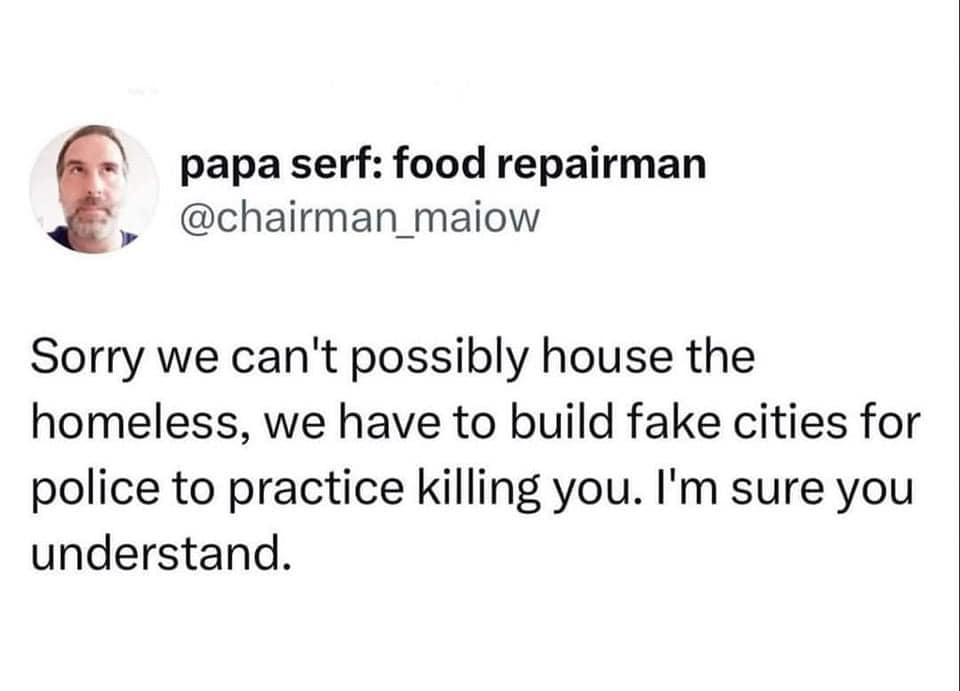
This anti-cops meme relies on the text "Sorry we can't possibly house the homeless, we have to build fake cities for police to practice killing you." The punchline mocks the hypocrisy of government officials who claim to protect the vulnerable while allegedly engaging in violent activities under the guise of "practice." The hashtag "papa serf" further satirizes the political landscape, implying these policies are a form of feudal oppression.
detailed-analysis (gemma3_27b-it-q8_0)
Okay, let's break down this meme through the lens of its categorization as "Anti-Cops," and utilizing the requested theoretical frameworks where applicable.
Visual Description
The meme consists of a screenshot of a Twitter post. The post is by the account "@chairman_maiow" with the username "papa serf". It features a profile picture of a man with dark hair and a beard. The text of the tweet is the core of the meme, a darkly humorous and cynical statement. The minimalist visual design focuses attention solely on the text and implicitly associates it with the persona of the account.
Critical Theory
This meme is deeply rooted in critical theory, specifically challenging the established power structures and ideological justifications presented by those in authority (in this case, police and the state). It’s a critique of the prioritization of policing and "security" over basic human needs like housing.
The statement is a reversal of logic, exposing the absurdity of allocating resources to simulated environments for police training (implying practicing lethal force) instead of addressing the very real social problems that contribute to homelessness and, potentially, the need for police intervention in the first place.
Critical theory aims to expose hidden power dynamics. This meme unveils how resources are deliberately directed toward maintaining the capacity for state violence rather than resolving the systemic issues that create social vulnerabilities. It’s a disruption of the narrative that positions police as simply “keeping us safe.” Instead, it suggests that their primary function, at least in practice, is the maintenance of control through force.
Marxist Conflict Theory
From a Marxist perspective, this meme embodies the conflict between the ruling class (those who control the state and its apparatus, including the police) and the oppressed (the homeless, marginalized communities). The "fake cities" represent a tool of the ruling class to rehearse and perfect its methods of repression.
The meme demonstrates how the state, as an instrument of class rule, prioritizes the means of enforcing its power (police training) over the needs of the working class or those outside the capitalist system (housing for the homeless). The statement highlights a fundamental contradiction: wealth/resources are available to create elaborate training facilities but not to solve a basic societal problem. This is seen as a feature, not a bug, within a system built on inequality and control. The reference to "killing" implies the ultimate consequence of this class conflict.
Foucauldian Genealogical Discourse Analysis
Michel Foucault’s work on power, knowledge, and discourse is highly relevant here. The meme can be understood as challenging the discourse of public safety. The dominant narrative insists that policing is essential for security. This meme disrupts that narrative.
The "fake cities" are spaces where power relations are rehearsed and institutionalized. They are sites where the knowledge and techniques of control are honed. Foucault discussed how power operates not just through repression, but through the production of knowledge, norms, and subjectivities. The meme hints at the production of the “dangerous”/”criminal” subject that necessitates such policing practices in the first place.
The sarcasm and direct language ("I'm sure you understand") suggest a knowing acknowledgement that the logic of this system is understood by those who benefit from it, even if it's never openly admitted. The statement reveals the underlying rationalities driving the allocation of resources and the acceptance of police violence.
Postmodernism
The meme's ironic tone and deconstruction of conventional logic resonate with postmodern thought. The sarcasm undermines the grand narratives surrounding public safety and state authority. The framing is self-aware, it doesn't pretend to offer a solution, but rather exposes the absurdity of the current situation.
The meme’s use of "fake cities" reflects postmodern themes of simulation and hyperreality – the idea that representations of reality have become more real than reality itself. The police are practicing in a constructed environment, preparing for a "real" world that is, in many ways, already shaped by those very practices.
In Conclusion
Overall, the meme functions as a potent critique of policing and state power. It’s a darkly humorous but deeply serious statement about the priorities of a society that seems more concerned with maintaining the capacity for violence than with ensuring the well-being of its most vulnerable citizens. It utilizes irony and rhetorical reversal to expose the underlying logic of a system that prioritizes control over care. It’s a clear statement of anti-police sentiment, informed by various critical perspectives.
simple-description (llama3.2-vision_11b)
This meme is from the category "Anti-Cops" and is a sarcastic commentary on the issue of homelessness. The image shows a photo of a person holding a sign that says "I'm not homeless, I'm just between apartments" and has a caption that says "We're not homeless, we're just temporarily between apartments". The meme is poking fun at the idea that people who are struggling to find affordable housing are being blamed for their situation, and that they are being asked to prove their homelessness is temporary, rather than permanent.
detailed-analysis (gemma3-27b-vision)
Okay, let's break down this disturbing tweet using the requested theoretical frameworks.
Visual Description
The image is a screenshot of a Twitter post. A profile picture, depicting a man with dark hair and a slightly distorted, slightly comical expression, is displayed. Below that is a Twitter handle "@chairman_maioW". Below that is a text post which reads: "Sorry we can’t possibly house the homeless, we have to build fake cities for police to practice killing you. I’m sure you understand." The background is plain white.
Foucauldian Genealogical Discourse Analysis
This tweet is a chilling example of how power operates through discourse, as understood by Michel Foucault. It's not simply a statement of fact, but a production of reality that normalizes extreme violence.
- Genealogy: A Foucauldian genealogy would trace the historical development of the ideas that make this statement thinkable. It would ask how have we arrived at a point where the needs of the vulnerable (housing the homeless) are readily sacrificed to the "training" (euphemism for lethal force practice) of the police? It would examine the evolution of the police state, the militarization of law enforcement, the increasing tolerance of social inequality, and the desensitization to violence.
- Power/Knowledge: The statement conflates a practical problem (homelessness) with the need to hone the skills of law enforcement. This presents the violence inherent in policing as a necessary function, thus reinforcing its legitimacy. The “knowledge” presented (the need for police training) justifies the power dynamic (the disposability of the homeless). The statement relies on the assumption that the police are the ultimate arbiters of safety, thus legitimizing their power over the population.
- Disciplinary Power: The fake cities act as sites of disciplinary power. They are spaces designed not to rehabilitate, but to refine and perfect techniques of control and ultimately, destruction. The homeless are implicitly positioned as the targets of this practice, highlighting their vulnerability and disposability.
Critical Theory
From a Critical Theory perspective (drawing on thinkers like the Frankfurt School), this tweet is indicative of a broader societal pattern of instrumental rationality.
- Instrumental Rationality: The tweet displays a ruthless calculation: the cost of housing the homeless is deemed too high compared to the "benefit" of providing training grounds for police. Human life is reduced to a quantifiable metric in a cost-benefit analysis. There's no consideration of the ethical implications, only of practical "efficiency."
- Domination and Control: The tweet points to a system where power structures (the police, by extension, the state) are concerned with maintaining control rather than promoting genuine social welfare. The homeless are not seen as citizens deserving of care, but as a “problem” to be managed, even through violent means.
- Critique of Enlightenment Reason: The statement is a perversion of Enlightenment ideals. While rationality is supposed to lead to progress, here it leads to a dehumanizing justification of violence.
Marxist Conflict Theory
From a Marxist perspective, this tweet exposes the inherent contradictions and exploitative dynamics of a capitalist system.
- Class Conflict: The statement implicitly frames the homeless as a "surplus population" – a group deemed economically useless and therefore disposable. This is a classic manifestation of class conflict, where the interests of the ruling class (those who prioritize policing and maintaining order) clash with the needs of the marginalized.
- Ideology and False Consciousness: The tweet’s framing – presenting police training as more important than housing – is a form of ideological justification. It obscures the real causes of homelessness (economic inequality, lack of affordable housing, systemic discrimination) and naturalizes the violence inflicted upon the vulnerable. The phrase "I'm sure you understand" attempts to induce passive acceptance of this situation.
- State as an Instrument of Repression: The police, in this context, are seen not as protectors of the public, but as instruments of state repression, used to maintain the existing power structure and suppress any potential challenges to it.
Postmodernism
While less directly applicable than the above frameworks, a postmodern reading can highlight the deconstruction of meaning and the simulation of reality.
- Hyperreality: The “fake cities” represent a move towards hyperreality – a state where simulations replace the real. The training exercises create a simulated world of violence, which then bleeds into the real world, blurring the lines between what is authentic and what is constructed.
- Deconstruction of Authority: The casual tone and the seemingly logical (though abhorrent) justification for the violence undermine the authority of the state. The statement suggests that there are no objective moral principles, only pragmatic calculations.
- Loss of Grand Narratives: The statement rejects any universal claims about human rights or social justice. It prioritizes a narrow, utilitarian logic over broader ethical considerations.
Note: The tweet is deeply disturbing, and these analyses are intended to understand the ideological forces at play, not to excuse or condone the sentiment expressed.
simple-description (llama3.2-vision)
The meme is a humorous response to a hypothetical scenario where a person is asked to fix a broken toaster. The image is a screenshot of a conversation with a "AI Assistant" that has been hacked by a mischievous user. The response reads: "In 2-3 sentences: Describe this meme for someone who cannot see it."
The text within the image reads: "Sorry we can't fix your toaster. But we can help you build a new city. Just give us your address. We'll send a team to... redevelop your property. We have a team of engineers who are experts in demolition. They'll make sure your house is reduced to rubble. It's a small price to pay for a new city. We'll even give you a new address. You can move to the new city. It's called 'Toaster Town'."