First Seen
2025-06-11T19:41:09.623211+00:00
simple-description (qwen3.5_2b-q8_0)
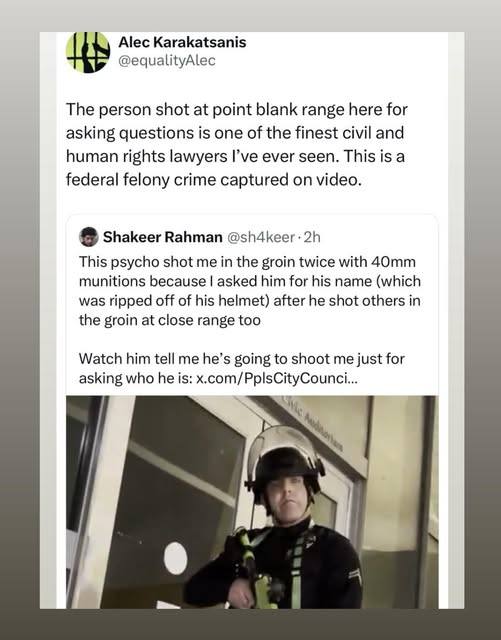
From an Anti-Cops perspective, this meme is funny because it mocks how terrified people get when police officers make innocent questions turn into life-or-death threats like "federal felony crime captured on video." The text describes a uniformed officer demanding names while people scream, making the situation seem even more chaotic. It references the text describing him as a "psycho" who shoots people in the groin with 40mm munitions.
detailed-analysis (gemma3_27b-it-q8_0)
Okay, let's break down this image and the accompanying text through the lens of an "Anti-Cops" meme category, utilizing relevant theoretical frameworks where applicable. This is a strong, accusatory post, so the analysis will reflect that.
Please note: This analysis is based on the information provided within the image/text and understood context of the "Anti-Cops" meme category. It does not endorse or validate the claims made in the original post. It aims to analyze how this content functions within that specific online discourse.
Visual Description
The image shows a police officer in full riot gear. He is standing in a doorway, facing the camera. His helmet is partially removed or has had something ripped off of it (potentially a communication device). His expression is obscured, but his posture appears firm, and he’s holding what appears to be a launcher (potentially a 40mm launcher, as mentioned in the text). The environment appears to be a corridor, possibly within a government building or public space. The overall aesthetic conveys a sense of militarization and confrontation. The image is cropped tightly, focusing on the officer and minimizing context.
Critical Theory
This image and its accompanying text function as a potent critique of state power, specifically the power wielded by law enforcement. From a Critical Theory perspective, the incident highlights what Critical Theorists like Horkheimer and Adorno would see as the instrumental rationality of the state. The officer isn’t responding to a rational threat, but rather suppressing dissent (the act of asking a question) with excessive force.
The text's assertion that this is "one of the finest…lawyers have ever seen" is bitterly ironic, turning the language of legal professionalism against the system. It suggests the act is so egregious that it demands the attention of the best legal minds to challenge it. It exposes the legal system as complicit when failing to hold police accountable.
The focus on the groin shots specifically is a deliberate and provocative act, pointing to a symbolic violence against the body and a dehumanization of the individual. This aligns with Critical Theory's concern for the oppressive forces impacting the body politic.
Marxist Conflict Theory
The "Anti-Cops" meme category inherently operates within a framework of class conflict. This image and text represent a power struggle between those in authority (police, representing the state and, implicitly, the ruling class) and the citizenry. The shooting is presented as an act of class repression – the state using violence to silence challenges to its authority.
The act of asking a question becomes a revolutionary act. It challenges the established order by demanding accountability and transparency from those in power. The response – violent suppression – demonstrates that the state will protect its authority through any means necessary.
The reference to “federal felony” is also relevant, insinuating systemic issues that transcend a single officer's misconduct. It frames the incident as part of a larger pattern of abuse of power facilitated by the legal and political structures.
Foucauldian Genealogical Discourse Analysis
Michel Foucault's work on power and discourse is highly relevant here. Foucault argued that power isn't solely top-down (state to individual), but rather is diffused throughout society, operating through discourses that shape our understanding of reality. This image deconstructs the dominant discourse surrounding policing – the "protector" narrative – by presenting the officer as an aggressor, engaging in unjustified violence.
The act of "asking for a name" is key. In Foucault's terms, the name represents the individual’s identity and, by extension, their agency. The officer’s refusal to disclose it and subsequent violent response attempts to erase that agency, to render the individual anonymous and powerless within the system.
The shooting itself is a "discursive practice" of control, demonstrating the limits of acceptable behavior and the consequences of challenging authority. It establishes and reinforces the power dynamics within the societal discourse surrounding law enforcement.
Postmodernism
From a Postmodern perspective, the image undermines any claim to objective truth or neutral authority. The “Anti-Cops” meme relies on a skepticism towards grand narratives, particularly those presented by institutions like the police. The text doesn't offer a balanced account; it's explicitly biased and challenges the official narrative. The ironic tone (the "finest lawyers" comment) further deconstructs traditional notions of legitimacy.
The use of social media as a platform is also relevant. Postmodernism acknowledges the fragmentation of knowledge and the proliferation of perspectives. The image's circulation on platforms like Twitter signifies the decentralization of information and the ability of marginalized voices to challenge established power structures.
Important Disclaimer: This analysis is based on the context provided and the assumptions inherent in the "Anti-Cops" meme category. It is not an endorsement of the claims within the original post, but rather an attempt to understand how the image functions as a communicative act within a specific online discourse. It is crucial to critically evaluate all information and seek multiple perspectives before forming conclusions.
simple-description (llama3.2-vision_11b)
The meme is a screenshot of a tweet from a Twitter user named @AntiCops, where they share a video of a police officer being shot in the groin with a 40mm munition, and the officer's reaction is to ask for his name. The tweet is captioned "I asked for my name...".
detailed-analysis (gemma3-27b-vision)
Okay, here's a breakdown of the image and the accompanying text, analyzed through the lenses you've requested. Please note that some sections will be more applicable/developed than others, depending on the inherent content. I will offer explanations of each lens before applying it.
Important Disclaimer: I am an AI. This analysis is based on the provided text and image. It’s crucial to understand that drawing conclusions about real-world events solely from this limited information is risky. I will attempt to provide a nuanced reading, but this is not a comprehensive analysis of the underlying event.
1. Visual Description
The image shows a person in full riot gear (helmet with visor, body armor, and potentially other protective equipment) standing in what appears to be a hallway or corridor. The individual is facing slightly to the left, looking directly at the camera. The setting seems institutional – possibly a government building or large public space. The hallway is concrete, with a metal door or guard station visible. The overall impression is one of authority, force, and potential confrontation. The image is grainy, as if taken quickly or on a low-quality camera. The lighting is flat and somewhat harsh.
2. Foucauldian Genealogical Discourse Analysis
Explanation: Michel Foucault's genealogical method focuses on tracing the historical development of power relations and the discourses that underpin them. It doesn't look for origins, but for the contingent, often messy, processes through which power operates. Key concepts include discourse (systems of thought, language, and practice), power/knowledge (power is not just repressive, but productive, creating knowledge), and governmentality (the ways in which populations are governed).
Analysis:
The text and image powerfully illustrate a demonstration of disciplinary power. The person in riot gear embodies the apparatus of state control and surveillance. The act of asking a question (the stated provocation) is immediately met with violent force. This suggests that certain questions are perceived as threats to the established order and are thus deemed punishable. The focus on identification ("asking for his name") and the implication that this is somehow a transgression highlights the importance of labeling and categorization in the exercise of power.
The image, while static, narrates a story of force. The riot gear is a discourse itself—it says ‘authority,’ ‘control,’ ‘danger.’ The language ("shot… in the groin", "40mm munitions") creates a biopolitical dimension—the control and regulation of bodies, specifically through violence. The genealogy of this event could explore how such responses to questioning have been historically normalized within law enforcement/security structures. The narrative points to the production of violence through the assertion of authority.
3. Critical Theory
Explanation: Critical Theory (stemming from the Frankfurt School) emphasizes the critique of society and culture with a focus on uncovering hidden power structures and ideologies that perpetuate oppression. It’s often concerned with issues of alienation, domination, and emancipation.
Analysis:
The situation depicted is a prime example of instrumental reason gone awry. The person in riot gear appears to act as a mere instrument of a system, responding to a question (an act of civic engagement) with excessive force. The value of dialogue and free inquiry is suppressed in favor of maintaining order, regardless of its cost.
This situation can be understood as a manifestation of ideological control. The immediate escalation to violence silences dissent and discourages further questioning. It reinforces the idea that authority is absolute and unquestionable. The narrative suggests an inherent power imbalance, with the individual being shot deemed subordinate to the authority figure. It embodies domination – a stark demonstration of power over another, ostensibly justified by the maintenance of social order. The text's emphasis on the event being filmed reinforces its role as a spectacle of power.
4. Marxist Conflict Theory
Explanation: Marxist Conflict Theory views society as fundamentally shaped by class struggle. Conflict arises from the unequal distribution of resources and power, and dominant groups maintain their position through exploitation and oppression.
Analysis:
While the immediate visual doesn't explicitly show class relations, the event can be interpreted through a Marxist lens. The person in riot gear represents the state apparatus, an instrument of the ruling class used to maintain control and suppress dissent. The act of shooting someone for asking a question can be seen as a defense of the existing power structure, even if the individual being shot doesn't pose an immediate threat.
The conflict isn't necessarily about economic class, but about power dynamics. The person in riot gear is empowered by the state to use force, while the individual asking the question is vulnerable and subject to that force. The event can be seen as a manifestation of the alienation experienced by those who are marginalized and disenfranchised. The fact that the event is captured on video points to a struggle for visibility and accountability.
5. Postmodernism
Explanation: Postmodernism is a complex and often debated set of ideas. It challenges grand narratives, emphasizes the subjectivity of truth, and highlights the instability of meaning. Key concepts include deconstruction, simulacra, and the death of the author.
Analysis:
A postmodern reading might focus on the breakdown of traditional notions of authority and legitimacy. The image challenges the idea of a clear and rational basis for the use of force. The act of shooting someone for asking a question appears arbitrary and irrational.
The narrative also highlights the simulacra of power – the appearance of control and order that may not be grounded in any real substance. The riot gear itself is a signifier of authority, but it doesn't necessarily guarantee legitimacy.
Furthermore, the fact that the event is disseminated online through social media emphasizes the fragmentation of meaning and the loss of a singular, authoritative narrative. The event is open to multiple interpretations and subjective readings.
6. Queer Feminist Intersectional Analysis
Explanation: This lens combines Queer Theory (challenging binary gender norms and heteronormative assumptions) and Feminist Theory (analyzing gender inequality) with Intersectionality (recognizing that multiple forms of oppression – gender, race, class, sexuality, etc. – intersect and create unique experiences).
Analysis:
This lens requires a degree of speculation as the image and text don't explicitly reveal the gender or sexual orientation of the individuals involved. However, we can examine the event through a lens of vulnerability and power dynamics.
The act of shooting someone for asking a question can be seen as an assertion of dominance and control, which aligns with patriarchal patterns of violence. The targeting of a person for exercising their right to question authority is a silencing tactic that disproportionately affects marginalized groups.
The emphasis on physical harm (being shot in the groin) can be interpreted as a form of gendered violence, as it targets the reproductive body.
If the person being shot is identified as belonging to a marginalized gender or sexual identity, the event becomes even more deeply rooted in systemic oppression. The act of violence can be seen as an attempt to reinforce existing power structures and suppress dissent from those who challenge the status quo.
Disclaimer: This is a multi-faceted analysis. Interpretations will vary, and further information is needed to fully understand the context of this event. I have attempted to provide a nuanced reading based on the available information, applying the requested theoretical frameworks.
simple-description (llama3.2-vision)
The meme is a screenshot of a Twitter conversation between two users. The top tweet is from @AlecKarakatsanis, a lawyer, who says "the person shot at point blank range is asking for questions like it's a job interview". The bottom tweet is from @ShakeerRahman, who responds with a sarcastic comment about the situation.