First Seen
2023-05-10T21:03:33+00:00
simple-description (llama3.2-vision_11b)
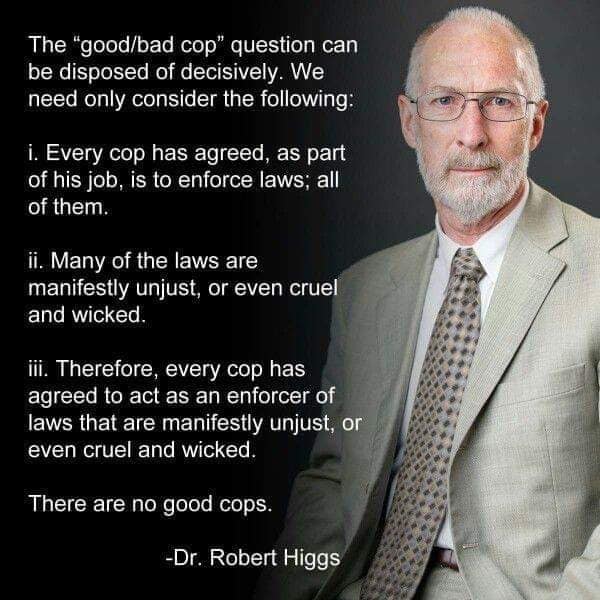
The meme is a screenshot of a quote from the book "The Police State" by Dr. Robert Higgs, which reads: "There are no good cops." The image is likely to be humorous or ironic, as it's a statement that challenges the conventional notion that police officers are inherently good or trustworthy. The meme is likely to be used in a context where the author is criticizing the police or law enforcement in general.
detailed-analysis (gemma3-27b-vision)
Okay, here's an analysis of the image and its accompanying text, broken down into sections based on the theoretical frameworks you requested. I'll indicate when a section isn't applicable.
Image Description
The image features a head-and-shoulders portrait of an older white man, identified as Dr. Robert Higgs. He has gray hair, a mustache and beard, and is wearing a dark suit with a patterned tie. The background is a dark, blurred texture, lending a serious, academic tone. The text, written in white, presents a logical argument concluding "There are no good cops." The image leans toward an intellectual portrait, suggesting the argument presented is meant to be taken seriously.
Foucauldian Genealogical Discourse Analysis
This text lends itself very strongly to a Foucauldian analysis.
- Discourse & Power/Knowledge: The statement aims to disrupt the discourse surrounding policing. The 'good cop/bad cop' dichotomy is a dominant, self-reinforcing narrative that obscures the power dynamics inherent in law enforcement. Higgs is attempting to deconstruct this narrative. He argues that the very act of being a police officer, of agreeing to enforce all laws, inherently participates in systems of power that are not neutral. Power, in Foucault's view, isn't just repressive; it produces knowledge and truth. The acceptance of all laws, even unjust ones, creates a reality where those laws are upheld and legitimized.
- Genealogy: The argument doesn't trace the historical origins of policing (though that could be a separate undertaking). Instead, it focuses on the conditions of possibility that allow the "good cop" narrative to exist. By focusing on the implicit agreement to enforce all laws, Higgs is exposing the underlying assumptions and power relations that sustain the practice of policing, regardless of individual officer intent.
- Disciplinary Power: The statement implicitly critiques the ways policing functions as a form of disciplinary power. By enforcing laws, even unjust ones, the police participate in normalizing social control and shaping individual behavior. The assumption that police have to enforce all laws, even those they personally disagree with, illustrates the disciplinary logic at work.
- Critique of Neutrality: Foucault would argue there's no "neutral" application of the law. Every act of enforcement reinforces the power structures that created those laws. The statement rejects the notion that an officer can be "good" simply by adhering to procedure, as that procedure itself is embedded in potentially unjust systems.
Critical Theory
The text very readily lends itself to a Critical Theory analysis.
- Challenging Social Norms: The statement directly challenges the widely accepted narrative of the "good cop," which serves to legitimize the police as a force for good and to deflect criticism of the system as a whole. It's an attempt to disrupt a dominant ideology.
- Unmasking Power Relations: This text exposes the underlying power relations that are often obscured in discussions about policing. It argues that the very act of being a police officer inherently involves upholding systems of power, even if those systems are unjust.
- Ideology Critique: The concept of the "good cop" is presented as an ideological construct that serves to maintain the status quo. It deflects attention from systemic issues and individualizes the problem of police misconduct.
- Emancipatory Project: While not explicitly stated, the statement implies a desire for social change. By rejecting the notion of the "good cop," Higgs challenges the legitimacy of the current system and opens the door for alternative forms of justice and social organization.
Marxist Conflict Theory
The text, while not explicitly Marxist, can be interpreted through that lens.
- Power Imbalance: The statement highlights a fundamental power imbalance between the police (as enforcers of the law) and the citizens they police. Laws often reflect the interests of the ruling class, and the police act as the instrument for maintaining that class structure.
- Repressive State Apparatus: In Althusserian terms, the police represent a repressive state apparatus, working to maintain the existing capitalist order by suppressing dissent and enforcing laws that benefit the ruling class.
- Class Conflict: While not direct, the argument implicitly acknowledges that unjust laws disproportionately affect marginalized communities and contribute to class conflict.
- False Consciousness: The "good cop" narrative can be seen as a form of false consciousness, obscuring the ways in which the police are complicit in maintaining a system of oppression.
Postmodernism
The text touches on Postmodern themes, but less directly than the others.
- Deconstruction of Grand Narratives: The statement challenges the "grand narrative" of law enforcement as a benevolent force for good. It deconstructs the idea that the police are inherently objective and impartial.
- Relativism: The assertion that many laws are unjust suggests a rejection of the idea that there is a single, universal standard of justice. Justice is seen as socially constructed and dependent on power relations.
- Critique of Essentialism: The rejection of the "good cop" archetype challenges the essentialist notion that individuals can be neatly categorized as "good" or "bad." It suggests that individuals are products of their social context and that their actions are shaped by the systems they inhabit.
Queer Feminist Intersectional Analysis
This text can be analyzed through an intersectional lens, though it requires some extrapolation.
- Systemic Oppression: The argument highlights how law enforcement operates within a system of interlocking oppressions. Unjust laws disproportionately impact marginalized communities (including LGBTQ+ people and people of color), and the police often serve as the instrument for enforcing those laws.
- Power Dynamics: The statement underscores the power dynamics inherent in policing and how those dynamics are shaped by intersecting identities. For example, a Black trans woman is likely to experience policing very differently than a white cisgender man.
- Carceral State: The assertion that all laws are enforced points to the ways in which the carceral state (the system of prisons, police, and courts) is used to control and oppress marginalized communities.
- Challenge to Neutrality: The rejection of the "good cop" archetype challenges the notion that policing can be neutral or objective. It recognizes that policing is always situated within a context of power and privilege.
I hope this analysis is helpful. Let me know if you'd like me to elaborate on any of these sections or explore different theoretical frameworks.
simple-description (llama3.2-vision)
This meme is a humorous commentary on the police force, using a quote from the book "The Book of the New Sun" by Gene Wolfe. The quote, which is presented in a mock-legal style, argues that the police are not inherently good, but rather a necessary evil. The text reads: "The only thing necessary for the triumph of evil is for good men to do nothing. But in this case, not even evil men are required. The police will do."
tesseract-ocr
The “good/bad cop” question can A be disposed of decisively. We need only consider the following: Py <a} Fr by ys or }) i. Every cop has agreed, as part mi Co) aM (eo om COM 1a) (ole He Aca } of them. i CTU mdm UMC E F f=» 7 manifestly unjust, or even cruel ia / and wicked. . fiit) iii. Therefore, every cop has oy | fee q Elec ceR OTe UR eee |) fas . EW Ule-U MUA VOL) [Usien el face: 4 CV eUmett E-TeR Ie cre Rk a 3 Bee . There are no good cops. fe \ é bite) ° = Race, ay -Dr. Robert Higgs ey zz ' a tie