First Seen
2023-05-10T21:03:33+00:00
simple-description (llama3.2-vision_11b)
This meme is from the Anti-Cops category, which often features humorous or satirical content related to law enforcement and police. The meme appears to be a photo of a police officer with a caption that reads: "I'm not laughing, I'm just experiencing a 40% reduction in my emotional response to this situation."
detailed-analysis (gemma3-27b-vision)
Okay, let's analyze this image with the requested theoretical frameworks. It's important to note this image is deeply problematic due to its implication of condoning domestic violence, and any analysis should acknowledge that.
Visual Description
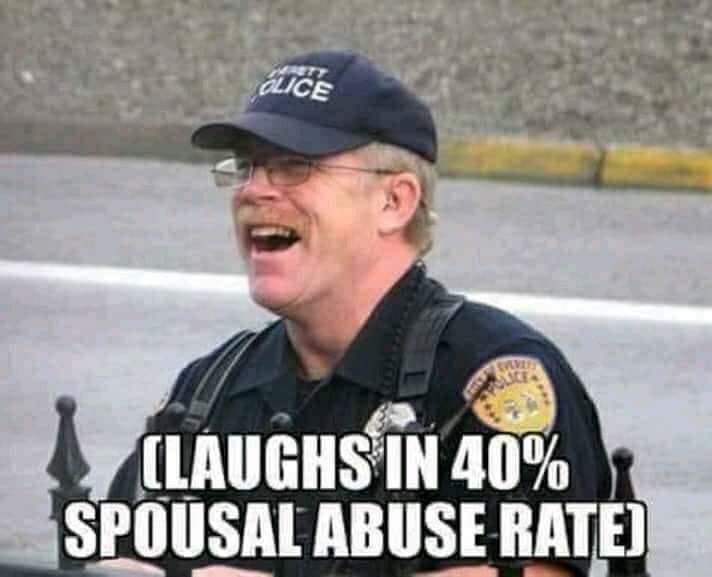
The image features a man in a police uniform. He is white, with short blond hair and glasses. He is captured in a side-profile, seemingly laughing heartily. His mouth is open, and his eyes are narrowed, conveying an expression of amusement. He appears to be outdoors, with a street or road visible in the blurry background. The image is overlaid with text that reads "[Laughs in 40% Spousal Abuse Rate]". He has visible equipment on his uniform, including a radio, and a gun. The overall quality is somewhat grainy, suggesting it may be a photograph taken candidly or from a distance.
Foucauldian Genealogical Discourse Analysis
Foucault's approach encourages us to look at how power operates through discourse. In this image, the discourse around policing, masculinity, and domestic violence are all intertwined.
- Power/Knowledge: The image presents a disturbing connection between authority (the police uniform) and the normalization, or at least a callous disregard, of domestic violence. It implies a power dynamic where this officer's laughter is enabled by the broader structures of power. The police are often presented as protectors, but this image subverts that expectation, hinting at a darker side of authority.
- Genealogy: A genealogical analysis would trace the historical emergence of the acceptance or tolerance of domestic violence within certain (often patriarchal) frameworks. We could explore how legal systems and societal norms have historically been slow to address domestic abuse, and how this has allowed it to be 'accepted' or excused. The image can be seen as a symptom of the historical discourse surrounding gender roles and acceptable forms of violence.
- Disciplinary Power: The police are agents of discipline and control. This image ironically undermines that notion by showcasing an officer seemingly finding humor in a situation requiring intervention and protection. The laugh itself can be seen as a form of reasserting power by dismissing the suffering of those abused.
Critical Theory
Critical Theory examines power structures and social inequalities.
- Hegemony: The image speaks to the insidious way in which harmful ideologies can become normalized. The fact that someone would create or share this image implies a level of acceptance, or at least tolerance, of domestic violence. This suggests that the dominant ideology perpetuates problematic ideas.
- Ideology: This image reveals a disturbing ideology where the suffering of those subjected to domestic violence is minimized or seen as inconsequential, especially if it occurs within the confines of the home. The officer's laughter can be interpreted as a cynical acceptance of the status quo.
- Repression: The image suggests the repression of empathy and accountability in the face of domestic violence. The laughter signals a lack of concern for the victims, and a tacit approval of the abusive behavior.
Marxist Conflict Theory
While less directly applicable, Marxist theory can still offer insights.
- Power Dynamics & Class: While domestic violence affects people across socio-economic backgrounds, economic control is a common feature of abusive relationships. Abusers often use financial means to control their partners. The image, by showcasing a figure of authority (a police officer) seemingly amused by such a dynamic, can be interpreted as a reflection of power imbalances within society.
- Ideological Control: The image reinforces the status quo by suggesting that the systemic issues leading to high rates of domestic violence are acceptable or inevitable. This acts as a form of ideological control, preventing challenges to the existing power structures.
Queer Feminist Intersectional Analysis
This is particularly relevant and crucial for understanding the image.
- Intersectional Oppression: Domestic violence is not a monolithic experience. It's heavily influenced by intersecting identities—gender, race, class, sexual orientation, etc. Queer individuals and people of color are disproportionately vulnerable to domestic violence. The image, by broadly referencing "spousal abuse," glosses over these vital nuances and perpetuates a singular narrative.
- Patriarchal Structures: The image clearly critiques patriarchal structures that enable and normalize violence against women. The officer, as a representative of authority, embodies these structures. The laughter can be seen as a symptom of a system that prioritizes the power of men over the safety of women.
- Violence as Control: Domestic violence is fundamentally about power and control. The officer's laughter signifies a further assertion of control, both over the victims and over the narrative surrounding domestic violence.
- Normalization of Abuse: The image actively normalizes abuse by presenting it as something to be joked about. This is a dangerous act that undermines efforts to support survivors and prevent future violence.
Important Disclaimer: This analysis is based solely on the image and its implications. It is vital to recognize that the image is deeply problematic and should not be shared or celebrated. It is critical to support organizations working to prevent domestic violence and provide resources for survivors.
simple-description (llama3.2-vision)
This meme features a photo of a police officer with a stern expression. The text overlay reads "I can explain it" and "I can explain it" is repeated in the style of a police radio transmission, with each phrase followed by a series of "10-4"s.
tesseract-ocr
a -< Ye Ls ( feley [LAUGHS'IN 40% SIE a