First Seen
2023-05-10T21:03:33+00:00
simple-description (llama3.2-vision_11b)
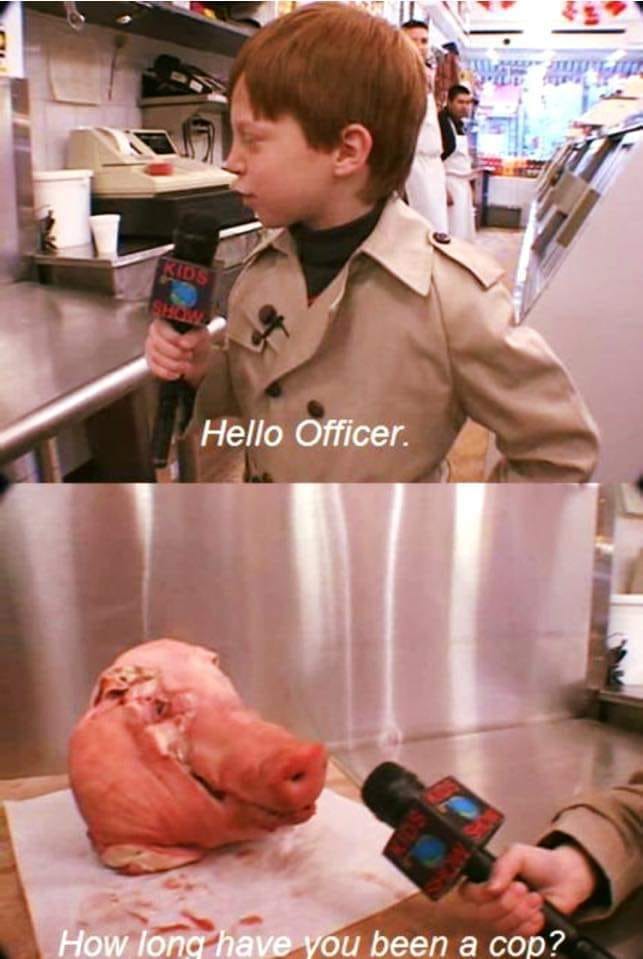
The meme features a young boy dressed as a police officer, holding a microphone and speaking to a pig's head on a table. The boy says "Hello, officer" and the pig's head responds with "How long have you been a cop?" The joke plays on the idea that the pig's head is a clever and sarcastic response, implying that the boy is actually a police officer, but the pig's head is making a humorous comment about the boy's career.
detailed-analysis (gemma3-27b-vision)
Okay, let's break down this image from the early 2000s "Kids Interview" sketch on Jimmy Kimmel Live through the lens of several theoretical frameworks. It's a bizarre and surprisingly rich image.
Visual Description
The image is a two-panel comparison taken from a comedic sketch.
- Panel 1: A young boy, dressed in a trench coat and what appears to be a (poorly disguised) attempt at a police uniform (a badge pinned to the coat), is holding a microphone labelled "KID NEWS". He’s positioned at what looks like a deli counter, adopting a serious, reporter-like stance. The background shows a bright, stainless steel deli environment with customers visible.
- Panel 2: A close-up shot of a large pig’s head—clearly a butchered animal product—displayed on ice at the deli counter. The boy, with the microphone, is now interviewing the pig's head.
The framing suggests a mock news interview. The contrast between the child's serious demeanor and the absurdity of the subject matter creates humor. The lighting is bright and commercial, typical of a deli environment.
Foucauldian Genealogical Discourse Analysis
This image offers fascinating ground for a Foucauldian analysis. Foucault would be interested in how power operates through discourse and in the construction of categories (like "officer," "authority," "animal," "food").
- Power/Knowledge: The child performs the role of an authority figure (an “officer”) through discourse (the interview questions). However, this authority is immediately undercut by the absurdity of interviewing a pig’s head. This highlights how power is not held by a single entity, but is enacted through performance and social context. The child attempts to wield power, but the absurdity negates it. The pig's head, as a silenced object, represents powerlessness.
- Discourse & Regulation: The "officer" role itself is a heavily regulated discourse—a set of rules, expectations, and symbols that define what it means to be a police officer. The child's parody exposes the constructed nature of this role, revealing how it’s a performance rather than an inherent quality. The very act of labeling the pig’s head as an "officer" (even in jest) is an attempt to impose meaning and order onto something that doesn’t fit.
- Genealogy: Examining the "genealogy" of the "officer" role, we see it evolving from historical origins of enforcement, social control, and ultimately power. The child's performance is a twisted reflection of that history, highlighting how the symbols of authority can be manipulated and rendered meaningless. The pig's head itself is a product of a long historical relationship between humans, animals, and food.
Critical Theory
This image speaks to a number of key themes within Critical Theory, particularly regarding the manipulation of language and the exposure of social structures.
- Ideology: The child is deconstructing the ideology of authority. By applying the label “officer” to a pig’s head, he’s challenging the taken-for-granted assumptions about who holds power and legitimacy.
- Commodification: The pig’s head is an object of commodification—reduced to a product for consumption. The interview juxtaposes this objectification with an attempt to imbue it with social status ("officer"). This can be seen as a commentary on the way individuals are also commodified and reduced to their "use value" in capitalist society.
- Exposure of the Absurd: Critical Theory often seeks to expose the inherent contradictions and absurdities of social structures. The interview is fundamentally absurd, revealing the arbitrary nature of power and the constructedness of social roles.
Marxist Conflict Theory
While not immediately obvious, Marxist analysis can be applied by considering the power dynamics at play and how the image relates to the exploitation of labor and commodification.
- Class and Power: The deli itself is a site of economic exchange, where the labor of butchers and other workers is exploited to produce consumable goods (like the pig’s head). The “officer” role, historically associated with maintaining the status quo and protecting property, represents the power of the ruling class. The child's parody can be interpreted as a challenge to that power.
- Commodification of Life: The pig’s head, as a formerly living being, is now a commodity. This exemplifies the Marxist concept of alienation—the separation of individuals from the products of their labor and from each other. The interview further objectifies the pig’s head, reducing it to a mere object of consumption and mockery.
- Ideological Critique: The child’s performance critiques the ideology of authority and the justification of existing power structures. By questioning the pig’s head’s role as an “officer,” he challenges the legitimacy of those in power.
Postmodernism
Postmodernism revels in the absurd, the fragmented, and the dismantling of traditional meaning. This image is a perfect illustration of many Postmodern themes.
- Deconstruction: The image deconstructs the idea of an "officer" by applying the label to an object that fundamentally cannot fulfill that role. This highlights the instability of language and the arbitrary nature of meaning.
- Simulation & Hyperreality: The child is simulating a news interview, creating a hyperreal representation of authority. It is a copy of a copy, divorced from any "real" authority.
- Irony & Parody: The entire sketch relies on irony and parody. The child is not genuinely attempting to interview an officer; he is mocking the very idea of authority through a nonsensical performance.
- Rejection of Grand Narratives: Postmodernism rejects "grand narratives" – overarching explanations of the world. The sketch doesn't offer any profound message; it is simply a playful and absurd juxtaposition of images and ideas.
Queer Feminist Intersectional Analysis
This image is less directly applicable to Queer Feminist Intersectional analysis, but some readings can be made, albeit speculative.
- Power Dynamics & Disruption: The image can be seen as a disruption of expected power dynamics. The child (traditionally positioned as less powerful) takes on the role of interviewer, questioning an object that is utterly incapable of responding. This subverts traditional hierarchies.
- Objectification & Silencing: The pig's head is a silenced object, completely devoid of agency. This can be linked to the historical objectification and silencing of marginalized groups, particularly women and people of color.
- Critique of Masculinity (Stretch): While less direct, the "officer" role is traditionally associated with masculinity. The child's parody could be interpreted as a deconstruction of those traditional masculine symbols, albeit in a highly absurd way.
- Intersections: The humor derives from an unexpected combination (intersection) of a young person playing authority, an animal object, and the setting of a commercial space. The absurdity is created by bringing these very different concepts together.
In conclusion: This seemingly silly image from a kids' show is surprisingly rich in theoretical implications. It offers a fascinating entry point into discussions about power, authority, ideology, language, and social structures. The image’s strength lies in its ability to expose the absurdity of these concepts through a playful and unconventional performance.
simple-description (llama3.2-vision)
The meme features a child interviewing a police officer in a kitchen setting. The child asks the officer, "In 2-3 sentences, describe what you do," and the officer responds, "I uphold the law, protect citizens, and serve my community." The meme then shows the child asking, "In 2-3 sentences, describe what you do," and the officer responding, "I kill pigs and eat ham sandwiches."
tesseract-ocr
a LA =_SSE 3 s/s W va a iy 7 te 7/ gi Hello Off = ie oe P @ ' F 4 ' Na > = SS an a - Pe ay