First Seen
2023-05-10T21:03:33+00:00
simple-description (llama3.2-vision_11b)
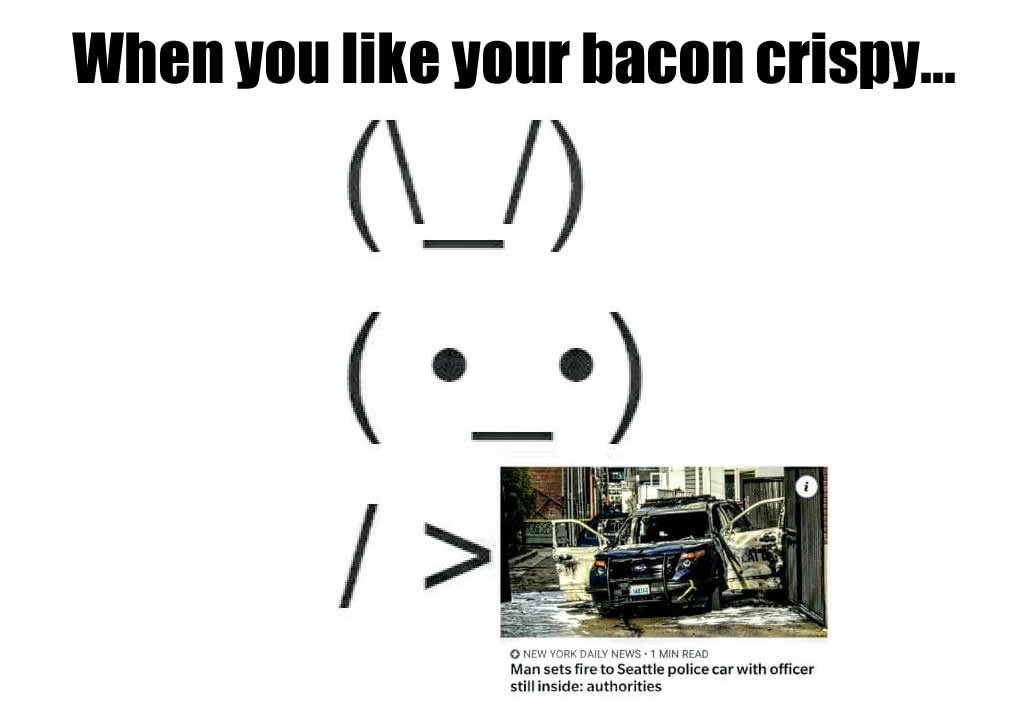
The meme features a picture of a police car with a destroyed front end, accompanied by the text "When you like your cop car a little too much". The image is meant to be humorous and ironic, poking fun at the idea of a cop car being damaged in a way that's relatable to the audience.
detailed-analysis (gemma3-27b-vision)
Okay, let's break down this image, applying the theoretical lenses you've requested where appropriate. It's a deliberately jarring and darkly humorous meme, so the analysis will reflect that.
Visual Description
The image is a meme. The top portion displays a simplistic, emoticon-like face constructed from basic lines and dots. The expression is neutral, almost vacant. Below this is a photograph depicting a severely damaged police vehicle, engulfed in flames, in what appears to be an urban setting. The photo has a caption from the New York Daily News indicating a man set fire to the car with the officer still inside. The text above the image reads "When you like your bacon crispy..." suggesting a darkly ironic comparison between a culinary preference and a violent act.
Foucauldian Genealogical Discourse Analysis
This image provides rich material for a Foucauldian analysis. The juxtaposition of the banal (crispy bacon) with the extreme (police car arson with an officer inside) creates a discourse. Foucault would argue we need to look at the historical formation of the concepts underpinning this meme.
- Power/Knowledge: The meme reveals a complex relationship between power and knowledge. Police, as representatives of state power, are traditionally understood as agents of control. But here, that power is violently disrupted, literally consumed by flames. The image plays on a counter-discourse, suggesting a desire to undo that power through violent action. The meme doesn’t advocate for such actions, but it reflects the discourse about police brutality and abuse of power.
- Discontinuity: The abrupt shift from a lighthearted culinary preference to a depiction of violence showcases the discontinuities inherent in social discourse. The meme is deliberately unsettling because it doesn't offer a smooth transition between these concepts. It forces us to confront the underlying tensions.
- Genealogy: A genealogical approach would trace the historical development of attitudes towards policing, violence, and the expression of anger. What historical events and social conditions contribute to the possibility of someone equating a trivial preference with such a severe act? It's not a simple cause-and-effect, but about tracing the evolution of concepts and their interplay.
Critical Theory
This image aligns with some tenets of critical theory, particularly in its unveiling of societal contradictions.
- Ideology Critique: The meme exposes a potential ideological crisis. On the surface, it seems absurd, yet it taps into a deeply held frustration with authority. The image suggests the limits of normative discourse. The 'crispy bacon' reference trivializes the violence, but that trivialization also reveals the numbness and detachment that can result from constant exposure to systemic injustice.
- Culture Industry: The meme can be seen as a product of the “culture industry.” While not originating from traditional media, it's distributed through online platforms, operating as a form of counter-narrative. It utilizes shock value to gain attention and circulate a message. The meme itself becomes a commodity of attention, circulating on social media platforms.
- Alienation: The image reflects a sense of alienation from authority. The stark contrast and dark humor suggest a profound disconnect between the individual and the institutions meant to protect them.
Marxist Conflict Theory
While the meme isn't overtly about economic class, a Marxist lens can illuminate some underlying tensions.
- Power Dynamics: The arson can be interpreted as an act of resistance against a system perceived as oppressive. The police, as agents of the state, are often seen as upholding the status quo and protecting the interests of the ruling class. The act of setting fire to the car can be seen as a symbolic attack on that power structure.
- Class Conflict (potential): The underlying frustration that motivates such an act often stems from social and economic inequalities. While the meme doesn’t explicitly address these issues, it’s important to recognize that the context of such violence is often rooted in systemic injustice.
- Ideological Struggle: The meme participates in an ideological struggle. It challenges the legitimacy of police authority and offers a counter-narrative to the dominant discourse.
Postmodernism
This image screams postmodernism.
- Irony & Parody: The core of the meme is built on irony and parody. It subverts expectations by juxtaposing the mundane (bacon) with the extreme (arson). This playful yet disturbing combination is a hallmark of postmodern aesthetics.
- Deconstruction: The meme deconstructs traditional notions of authority and violence. It disrupts the binary opposition between "good" (police) and "bad" (arsonist) by presenting them in an absurd and unsettling context.
- Simulacra & Simulation: The meme operates within a realm of simulation. It’s a mediated representation of reality, divorced from its original context. It’s an image about an image, a layer of simulation that further obscures the underlying issues.
- Fragmentation & Discontinuity: The abrupt shift in tone and imagery exemplifies postmodern fragmentation. There’s no attempt to create a coherent narrative; instead, the image relies on shock and disorientation.
Queer Feminist Intersectional Analysis
This is the hardest lens to apply directly, but still potentially relevant.
- Violence & Marginalized Bodies: A queer feminist perspective would draw attention to the ways in which violence, particularly state-sanctioned violence, disproportionately impacts marginalized communities (people of color, LGBTQ+ individuals, those with disabilities). The violence depicted in the image is part of a larger system of oppression.
- Challenging Power Structures: The act of resistance (arson) can be interpreted as a challenge to patriarchal and systemic power structures. It's an assertion of agency, albeit a violent one, in the face of oppression.
- Intersectional Framework: An intersectional analysis would recognize that the factors contributing to such an act are complex and multifaceted, shaped by the intersection of race, gender, class, and other social identities.
Important Considerations:
It's crucial to remember that this image is provocative and disturbing. While theoretical analysis can help us understand its underlying meanings, it does not excuse or condone violence.
I hope this thorough breakdown helps! Let me know if you would like me to elaborate on any particular aspect or theoretical lens.
simple-description (llama3.2-vision)
This meme features a popular image of a cartoon rabbit with a blank expression, known as "Weird Flex" or "Weird Face." The text "When you" is followed by a common internet phrase, "realize your cat is secretly training you." The image is likely being used to express a humorous, ironic, or sarcastic realization.
tesseract-ocr
Wh lik i ( a ) ( — ) | fen E I mm Nt } ei ee ol Hi 7 (es e's z eee 0 gan \— Sa) | — Sb eae ae = rs © NeW vORK DAILY NEWS 1 MIN READ Man sets fire to Seattle police car with officer stillinside: authorities