First Seen
2024-04-05T09:55:50.427963+00:00
simple-description (qwen3.5_2b-q8_0)
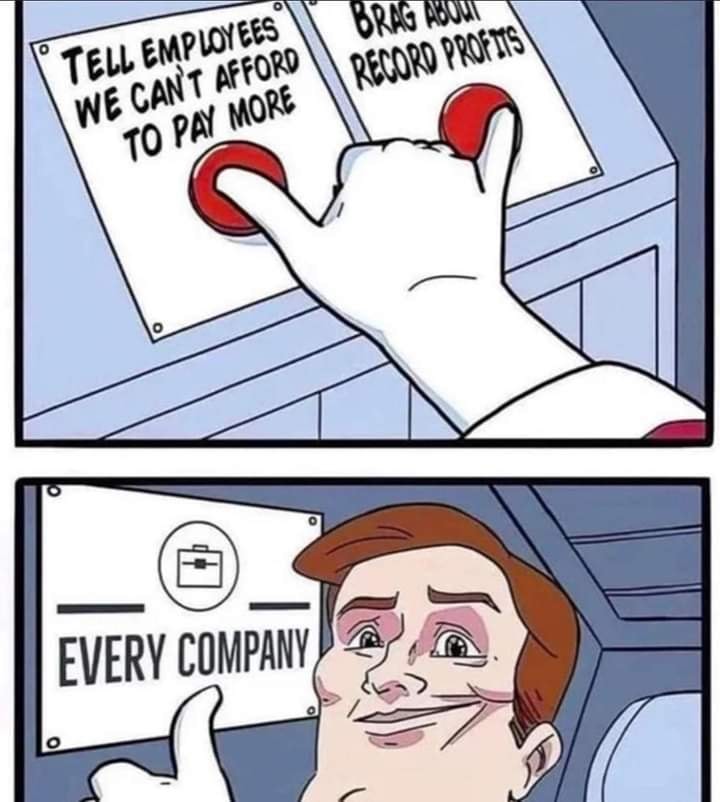
This meme satirizes how corporations mask the truth to keep their money. It shows a control panel with buttons that companies use to hide their real situation. One button says "Tell employees we can't afford to pay more" (which sounds like a lie to hide layoffs), while the other says "Brag about record profits" (which is a lie to hide high costs). The final image shows a thumbs-up next to a sign saying "Every Company," implying that this kind of corporate deception is a universal truth for all businesses.
simple-description (llama3.2-vision_11b)
The meme is a satirical take on the idea of corporations being overly aggressive in their marketing efforts. The image depicts a button that says "I'd like to speak to your manager" being replaced with a button that says "I'd like to speak to your CEO... then speak to my lawyer". The text on the button is a commentary on the common corporate practice of using lawyers to intimidate or silence employees who speak out against the company.
detailed-analysis (gemma3-27b-vision)
Okay, let's break down this meme through a few theoretical lenses. It's a strong image ripe for analysis.
Visual Description
The meme is a two-panel comic strip, rendered in a simplistic, cartoonish style.
Panel 1: Shows a hand reaching toward a telephone. Above the phone, a sign is divided into two sections. One section reads "TELL EMPLOYEES WE CAN'T AFFORD TO PAY MORE." The other section reads "BRAG ABOUT RECORD PROFITS." The implication is that someone is simultaneously delivering this contradictory message—instructing others to claim inability to pay while simultaneously highlighting financial success.
Panel 2: Shows a man with a sly, pleased expression giving a thumbs-up. Below is a screen reading "EVERY COMPANY." This implies a universal condemnation or accusation that all companies act in this manner. The style of drawing exaggerates the man’s expression, emphasizing a sense of malicious glee or smugness.
Foucauldian Genealogical Discourse Analysis
Foucault would approach this meme by examining the discourse surrounding labor, profit, and corporate narratives. The meme highlights a power/knowledge relationship. The "telling" (discourse) of inability to pay is not a reflection of objective economic reality, but a strategic practice employed to maintain power dynamics.
- Genealogy: Foucault would trace the historical emergence of this practice. The meme suggests a pattern of narrative control where companies construct a particular reality (financial hardship) to justify exploitative practices (wage stagnation). This is not a "natural" consequence of economics but a historically contingent power relation.
- Discipline & Control: The narrative of “can’t afford to pay more” disciplines employees, discouraging demands for fair wages. The boast about “record profits” reinforces the company’s power and authority. The meme highlights how discourse creates subjects – disciplined, accepting employees.
- Normalization: The meme’s success comes from its recognition factor. It suggests this contradictory behavior is not an aberration, but a normalized, expected practice within corporate structures. It suggests a system where blatant hypocrisy is accepted as standard.
Critical Theory
This meme is a strong example of how Critical Theory would approach the analysis of power structures and dominant ideologies.
- Ideology: The meme exposes an ideological function at play. The discourse of financial constraints is used to mask the real power dynamic: the concentration of wealth in the hands of corporations. The "can't afford to pay" narrative is a justification for maintaining that concentration of wealth.
- False Consciousness: The practice suggests a level of "false consciousness," where employees are led to believe the company's limitations are real, preventing them from recognizing their own agency or demanding better conditions.
- Rationalization & Instrumental Reason: The meme subtly critiques the modern tendency towards rationalization and instrumental reason. Corporations prioritize profit maximization as an end in itself, even if it requires deceptive or exploitative practices. The goal is not fair compensation, but the relentless pursuit of financial gain.
- Domination: The meme ultimately illustrates a system of domination. Corporations exploit labor, maintain power through narrative control, and prioritize profit over the well-being of their employees.
Marxist Conflict Theory
This meme is fundamentally aligned with Marxist Conflict Theory.
- Class Struggle: The image embodies the inherent conflict between the capitalist class (the companies) and the working class (the employees). The "can't afford to pay" statement is a clear attempt to suppress wages and maintain the capitalist’s control over the means of production.
- Exploitation of Labor: The image illustrates the core Marxist concept of the exploitation of labor. The record profits are generated by the labor of employees, yet those employees are denied a fair share of the wealth they create.
- Surplus Value: The profits represent “surplus value” – the difference between the value of the goods produced by labor and the wages paid to the workers. The company is maximizing this surplus value by keeping wages low.
- Alienation: The image hints at the alienation of labor. Employees are reduced to mere cogs in a profit-driven machine, their contributions undervalued, and their needs ignored.
Postmodernism
While not a perfect fit, some postmodern readings are possible.
- Hyperreality & Simulation: The meme could be interpreted as a commentary on the increasing disconnect between reality and representation. The “can’t afford to pay” narrative is a simulation of economic hardship, designed to maintain a particular image and control perceptions.
- Deconstruction of Grand Narratives: The meme implicitly rejects the “grand narrative” of economic progress. The image suggests that profit, rather than equitable distribution, is the primary driving force behind corporate behavior, regardless of societal well-being.
- Irony & Parody: The meme relies heavily on irony and parody. It exaggerates the hypocrisy of corporate behavior to expose the absurdity of the system.
Important Note: Applying theoretical lenses is always interpretive. There’s no single “correct” reading. Different theoretical frameworks will highlight different aspects of the image and offer different insights.
Let me know if you'd like me to explore any of these angles in more detail!
tesseract-ocr
Ten eH ARs ROY \ a> {| EVERY comPant? Ja ' ine (1) = = 7 EE gf
simple-description (llama3.2-vision)
This meme is a humorous illustration of a person's reaction to a sign that says "I'm not arguing, I'm just explaining why I'm right." The image shows a person's face with a smug expression, accompanied by a caption that reads "I'm not arguing, I'm just explaining why I'm right." The meme is a lighthearted way to poke fun at the tendency to justify one's own opinions as "explanations" rather than actual arguments.