First Seen
2024-06-26T22:33:22.098987+00:00
simple-description (qwen3.5_2b-q8_0)
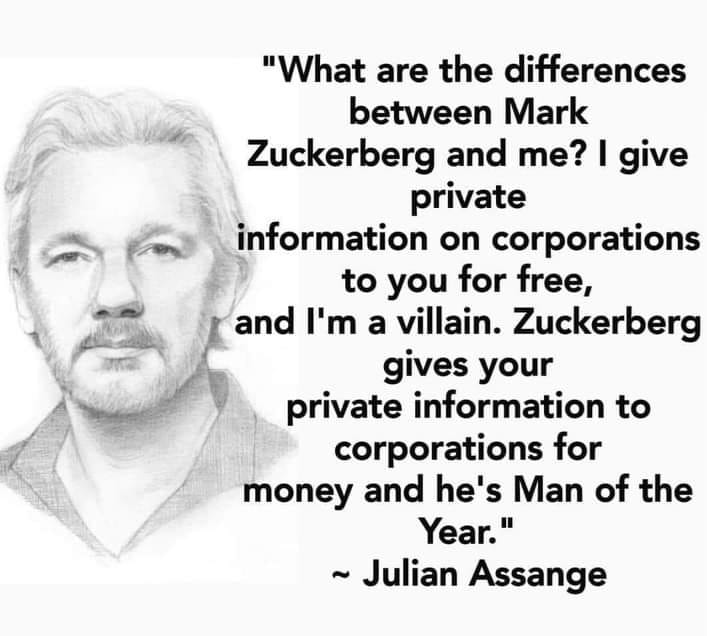
This anti-corporation meme features a sketch of Julian Assange and a quote that frames his work as altruistic. The text claims that Assange "gives your private information to corporations for money," implying that Zuckerberg is a "villain" simply because he is a billionaire. It suggests that his company is so wealthy that it doesn't matter if he steals your data, as the money makes him a "Man of the Year."
simple-description (llama3.2-vision_11b)
This meme is a humorous take on the perceived contrast between the public personas of Mark Zuckerberg and Julian Assange. The image juxtaposes a quote from Julian Assange, implying that Zuckerberg is a villain, with a statement that mocks the idea of Zuckerberg's philanthropic efforts.
detailed-analysis (gemma3-27b-vision)
Okay, here's an analysis of the image and its statement, broken down into the requested sections. I’ll only include sections where the theoretical framework meaningfully applies.
Visual Description
The image is a black and white pencil sketch portrait of Julian Assange. He is depicted in a medium close-up, showing his head and shoulders. He appears to be in profile, looking towards the left. The style is fairly realistic but has a slightly rough, sketch-like quality. The image is overlaid with text, a direct quote attributed to Assange comparing himself to Mark Zuckerberg. The text is in a fairly standard serif font, contrasting with the organic feel of the sketch. The overall impression is one of deliberate framing – presenting Assange as a thoughtful, even austere, figure making a pointed comparison.
Foucauldian Genealogical Discourse Analysis
This image and quote are highly amenable to Foucauldian analysis. The central claim revolves around the discourse of information, privacy, and power. The statement isn't simply about facts, but about how those facts are circulated and who benefits.
- Power/Knowledge: Foucault would highlight how the statement demonstrates the interconnectedness of power and knowledge. Assange positions himself as revealing information, thus challenging existing power structures. Zuckerberg, conversely, is framed as a figure who controls the flow of information for profit, reinforcing power dynamics. The claim of being a “villain” is crucial: it reveals how power operates through labeling and the construction of “otherness.”
- Genealogy: A genealogical approach would trace the history of the ideas underpinning this claim. It would examine how concepts of privacy, surveillance, transparency, and corporate control have evolved historically. This comparison between Assange and Zuckerberg doesn’t emerge from a vacuum. It's a product of the specific historical context of the early 21st century, characterized by the rise of digital technologies and the increasing commodification of personal data.
- Disciplinary Power: Zuckerberg's actions (selling data) can be seen as an example of disciplinary power – the subtle, pervasive ways in which power operates through normalization and control. Data collection and monetization are presented as "normal" business practice, even as they exert control over individuals’ lives.
Critical Theory
This statement aligns significantly with the Frankfurt School’s critical theory, particularly its analysis of the “culture industry.”
- Commodification of Information: The core argument is about the commodification of information. Zuckerberg is portrayed as an exemplar of a system where even private information is turned into a product to be sold. Critical theory would see this as a symptom of a broader trend – the reduction of all aspects of life to exchange value.
- Ideology: Assange’s framing implicitly suggests that Zuckerberg’s actions are supported by an ideology that prioritizes profit over privacy and individual rights. The “Man of the Year” label is ironic – it implies that society celebrates this exploitative system.
- Loss of Autonomy: The critique suggests a loss of individual autonomy in the digital age. The sale of private information undermines individuals’ ability to control their own lives and make informed decisions.
Marxist Conflict Theory
This comparison is ripe for analysis through a Marxist lens. The statement highlights the inherent conflict between different classes and power structures in the digital age.
- Class Conflict: Assange positions himself as an opponent of the capitalist system, challenging the power of corporations like Facebook (represented by Zuckerberg). The quote emphasizes the exploitation inherent in the selling of personal data, framing it as a form of surplus value extracted from individuals.
- Means of Production: Facebook (and other social media platforms) control the means of communication in the 21st century. This control allows them to extract value from users’ data.
- Ideological Struggle: The framing of Assange as a “villain” is part of an ideological struggle – an attempt by the dominant class to discredit those who challenge the existing order. This is precisely why he highlights the perceived hypocrisy of Zuckerberg being lauded as “Man of the Year” while actively participating in data exploitation.
Postmodernism
A postmodern reading might focus on the deconstruction of grand narratives and the blurring of boundaries.
- Challenge to Authority: Assange's statement challenges the authority of established institutions (corporations, the media, the “Man of the Year” award). It suggests that these institutions are not neutral arbiters of truth but are implicated in systems of power and control.
- Relativity of Truth: Postmodernism would emphasize the relativity of truth. The statement suggests that what is presented as “truth” (e.g., Zuckerberg as a successful innovator) is often a product of power dynamics and ideological framing.
- Hyperreality and Simulation: The image touches on the idea of hyperreality, where the lines between reality and simulation become blurred. Social media, in particular, is a space where curated identities and manufactured narratives can dominate.
Let me know if you'd like me to elaborate on any of these points or explore other theoretical frameworks!
simple-description (llama3.2-vision)
This meme features a quote from Julian Assange, a figure known for his involvement in the world of information and data. The quote itself is a cleverly worded statement that appears to be an attack on Mark Zuckerberg. The quote is followed by a punchline that references Mark Zuckerberg as "Man of the Year" in a satirical manner, suggesting that he is not as innocent as he seems. The image is meant to be humorous and satirical, using wordplay and cleverness to make a point about the subject. The overall tone of the image is one of irony and commentary on the subject.