First Seen
2023-05-10T21:03:33+00:00
simple-description (llama3.2-vision_11b)
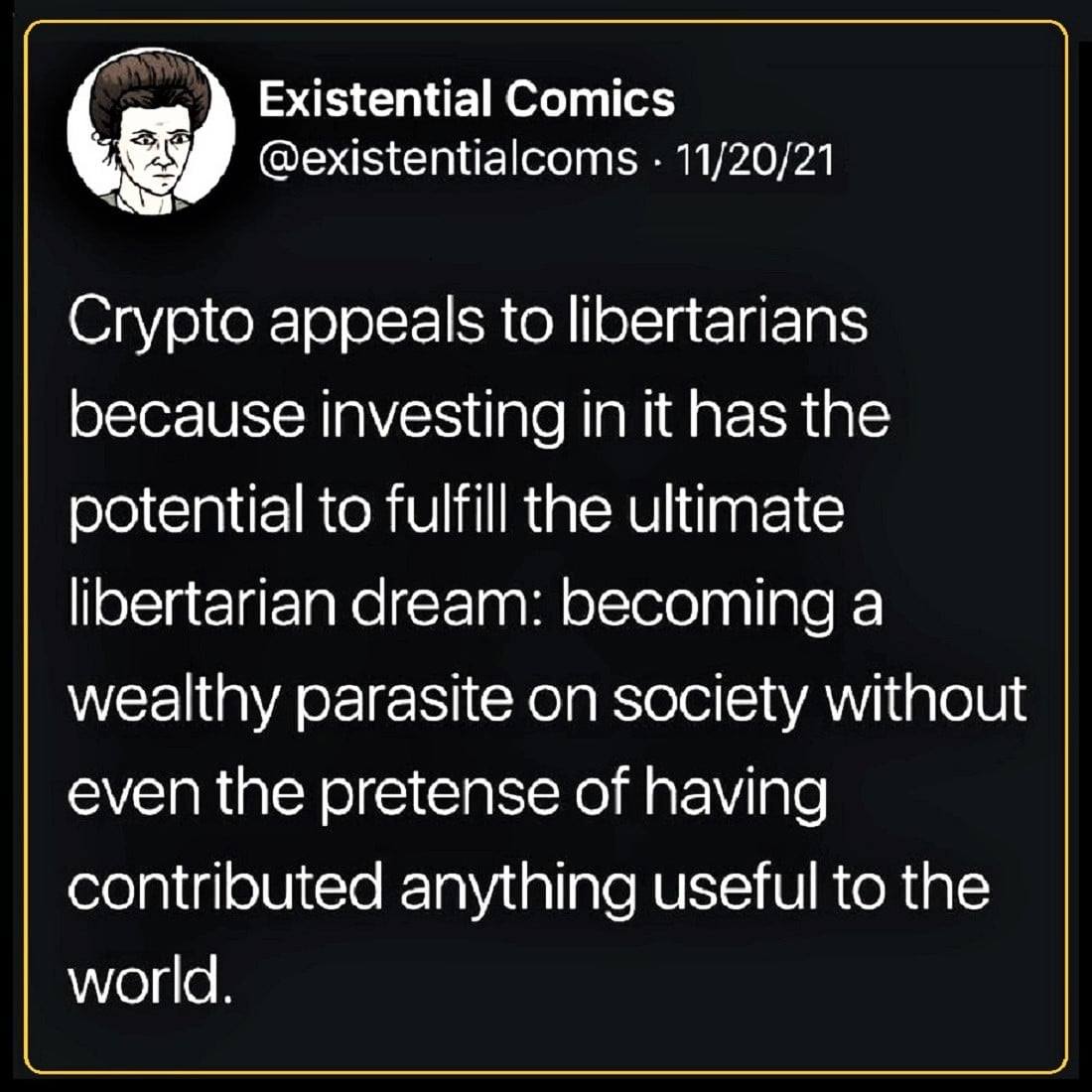
This meme is a humorous critique of cryptocurrency, specifically Bitcoin, from an anti-crypto perspective. The image shows a cartoon character with a skeptical expression, captioned with a quote that implies cryptocurrency is a "libertarian dream" that only benefits the wealthy, while the rest of the world is left with financial instability. The text reads: "Crypto is a libertarian dream: becoming a wealthy parasite on society without contributing anything useful to the world."
detailed-analysis (gemma3-27b-vision)
Okay, let's break down this image/text as requested, focusing on applicable theoretical frameworks. It's important to note that the text is a pointed critique, so analysis will reflect that.
1. Visual Description
The image is a screenshot of a post from the social media account “Existential Coms” with an avatar of a man with curly hair. The post date is November 20, 2021. The background is solid black. The text is white and legible. The visual design is simple and stark, prioritizing the message over aesthetics. The format (social media post) suggests a conversational, perhaps deliberately provocative, tone.
2. Critical Theory
This post is a classic example of critical theory in action. It’s not simply describing a phenomenon (the appeal of cryptocurrency to libertarians), but critiquing the underlying ideology and its potential consequences.
- Ideology Critique: The core claim is that the pursuit of wealth through cryptocurrency within the libertarian framework leads to a fundamentally parasitic relationship with society. It argues that this isn’t a bug in the system, but a feature. The aspiration, within the system, is not to contribute to a common good, but to extract wealth without contributing, which is presented as the 'ultimate libertarian dream.'
- Power Dynamics: The text implies a power dynamic. Those who invest in crypto (within the defined ideological context) are positioned as benefiting from a system at the expense of others (the broader 'society').
- Frankfurt School Influence: The critique of ideology and the focus on the negative consequences of unchecked capitalism have strong roots in the Frankfurt School of Critical Theory (e.g., Adorno, Horkheimer).
3. Marxist Conflict Theory
This post fits neatly within a Marxist framework.
- Class Conflict: The text implicitly highlights class conflict. The 'parasite' analogy suggests a ruling class (those benefitting from crypto) extracting value from the working class (society) without contributing to its upkeep.
- Exploitation: The 'parasitic' relationship describes a form of exploitation where wealth is accumulated through speculative means, rather than through productive labor or socially beneficial activities.
- Capital Accumulation: Cryptocurrency, within this analysis, is framed as a vehicle for capital accumulation for a specific segment of the population, potentially exacerbating wealth inequality.
- Base and Superstructure: The analysis implies that the ideological 'superstructure' of libertarianism justifies and enables the exploitative 'base' of speculative finance.
4. Postmodernism
While not the dominant framework, elements of postmodernism are present.
- Deconstruction of Ideology: The post deconstructs the libertarian ideal of self-reliance and free markets. It argues that this ideal, in practice, can lead to a detached, exploitative, and ultimately destructive relationship with society.
- Meta-Narrative Critique: The critique challenges the libertarian "grand narrative" of individual freedom and economic prosperity, exposing its potential to mask social inequality and exploitation.
- The "Subject": The post suggests that the “libertarian subject” isn’t a rational, contributing member of society, but a self-interested actor prioritizing individual gain over collective well-being.
5. Foucauldian Genealogical Discourse Analysis
A Foucauldian approach would focus on the discourse surrounding cryptocurrency and libertarianism.
- Power/Knowledge: How the discourse of "financial freedom," "decentralization," and "self-sovereignty" (common in crypto circles) functions as a mechanism of power. It constructs a particular understanding of the world that legitimizes wealth accumulation for a select few.
- Genealogy: A genealogical analysis would trace the historical origins of the ideas linking libertarianism and speculative finance, examining how these ideas have evolved and become normalized.
- Discipline and Surveillance: Cryptocurrency and blockchain technologies, while often presented as liberating, also create new forms of discipline and surveillance (e.g., through transaction tracking). This aspect is less directly addressed in the post but could be expanded upon.
- Normalisation of parasitic behavior: The text suggests that the promotion of such behavior through discourse is seen as commonplace and acceptable.
In Conclusion
The image/text is a potent critique of cryptocurrency and libertarianism, framing them as enabling a form of social parasitism. It draws upon several critical theoretical frameworks – particularly Marxist conflict theory and critical theory – to expose the power dynamics, ideological underpinnings, and potential consequences of this phenomenon. The post challenges the dominant narratives surrounding these concepts, inviting viewers to question the values and consequences of unchecked wealth accumulation.
simple-description (llama3.2-vision)
The meme is a humorous comparison between cryptocurrency (specifically Bitcoin) and a 19th-century French philosopher, Charles Baudelaire. The text reads: "Crypto is like Baudelaire's 'The Raven' but instead of a raven, it's a blockchain that's always tweeting 'nevermore'."
tesseract-ocr
‘e) Existential Comics 1s @existentialcoms - 11/20/21 Crypto appeals to libertarians because investing in it has the potential to fulfill the ultimate libertarian dream: becoming a wealthy parasite on society without even the pretense of having contributed anything useful to the world.