First Seen
2023-05-10T21:03:33+00:00
simple-description (llama3.2-vision_11b)
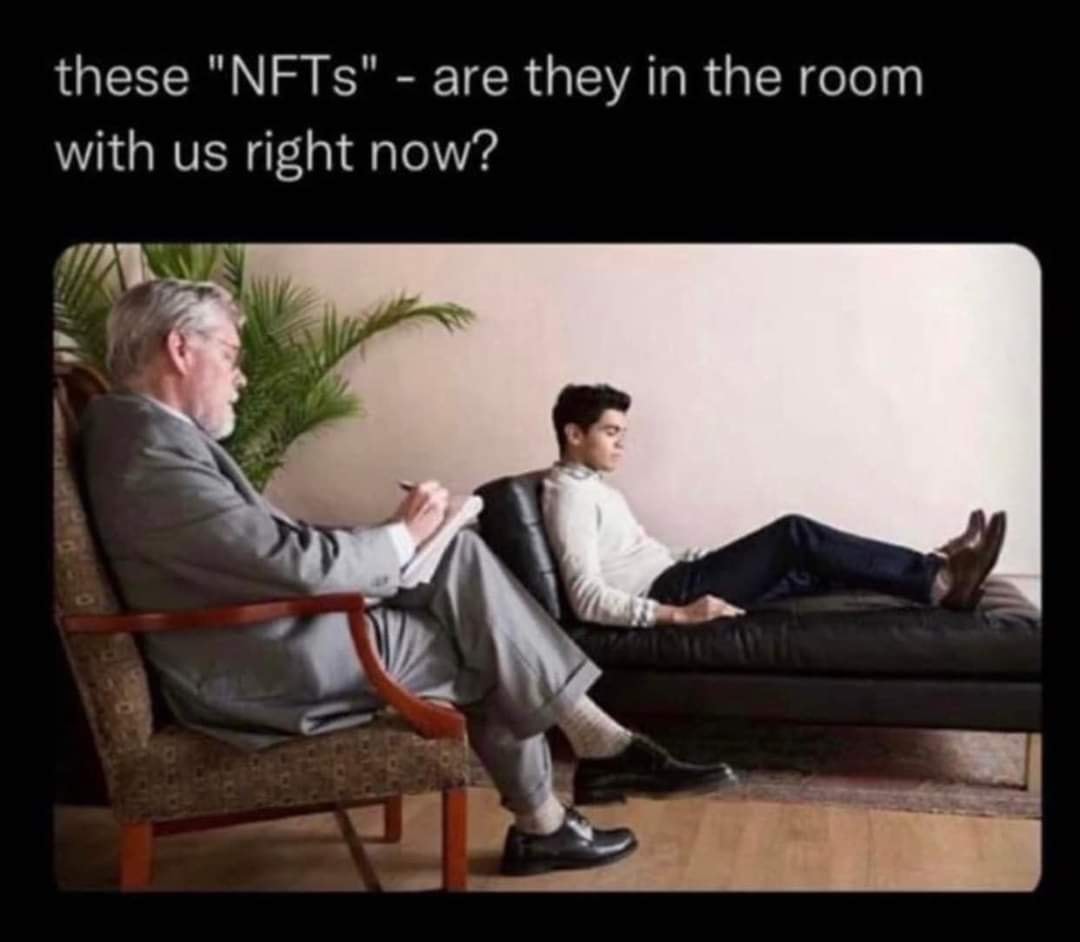
The meme is a satirical commentary on the current state of cryptocurrency and the NFT (Non-Fungible Token) market. The image shows a therapist's couch with a patient lying on it, while the therapist sits in a chair, looking at a notepad. The patient is not speaking, but the therapist is writing in the notepad, "These NFTs... are they in the room with us right now?" The meme pokes fun at the absurdity of the NFT market, implying that even the therapist is confused by the concept of these digital assets.
detailed-analysis (gemma3-27b-vision)
Okay, here's an analysis of the image and its caption, broken down into sections based on the theoretical frameworks you requested. I will only include sections where the framework feels relevant to understanding the image and its implied meaning.
Visual Description
The image depicts a scene reminiscent of a therapy session. An older, formally dressed man sits in a patterned armchair, holding a pen and notepad, looking at a younger man who is reclined on a black couch. The younger man appears distressed, lying with his head in his hands and legs extended, exposing bare feet. The room is neutral, possibly an office or therapy space, with a large green plant visible in the background. The lighting is soft and even. The caption reads: "these 'NFTs' - are they in the room with us right now?". The use of quotation marks around "NFTs" suggests a playful skepticism or mockery towards the subject.
Foucauldian Genealogical Discourse Analysis
This image lends itself well to a Foucauldian analysis. The scene is a clear enactment of the therapeutic setting – a modern "confessional," if you will. Foucault explored how modern institutions like psychiatry and therapy create discourses that define "normality" and "abnormality".
- Discourse and Power: The image implicitly questions the discourse surrounding NFTs. The very act of bringing the abstract concept of NFTs into a therapeutic context suggests an anxiety or unease about their presence in contemporary life. The question ("are they in the room?") isn't literal; it's a metaphor for how pervasive and all-consuming NFTs have become – a feeling that they're psychologically "present" even when not explicitly discussed.
- Genealogy: A genealogical analysis could trace the historical development of concepts like "value" and "ownership" and how those concepts are being redefined by NFTs. NFTs challenge traditional notions of scarcity and authenticity, and the therapy session implies a search for meaning and grounding in a world where these concepts are becoming destabilized. The therapist, in this reading, represents the attempt to analyze and categorize this new phenomenon within existing frameworks.
- Subjectivation: The reclined figure embodies a "subject" struggling to articulate their anxieties around NFTs. The therapy setting becomes a space where the subject tries to make sense of the complex power dynamics and subjective experiences generated by this technology.
Critical Theory
The image taps into several critical theory themes. The setting of therapy is itself a social construction, part of a system meant to manage and diagnose individual anxieties within a broader societal framework.
- Culture Industry: The obsession with NFTs, and the anxiety it generates as depicted in the image, can be seen as a product of the culture industry. The relentless promotion of NFTs as a status symbol or investment opportunity contributes to a state of anxiety and alienation.
- Alienation: The slumped posture and distressed expression of the younger man suggest a feeling of alienation from traditional sources of meaning and value. NFTs, as a speculative and often intangible asset, may exacerbate this feeling. The question, “are they in the room?” suggests the impossibility of escape from this system.
- Commodification: NFTs represent an extreme form of commodification, extending it into the realm of digital art, collectibles, and even personal identity. The therapy session can be read as an attempt to cope with the psychological consequences of living in a society where everything is potentially a commodity.
Postmodernism
The image reflects several core tenets of postmodern thought:
- Simulation and Hyperreality: NFTs are essentially digital tokens representing ownership of something that may or may not have any intrinsic value. This challenges the notion of "authenticity" and blurs the line between reality and simulation. The anxiety portrayed in the image could be a response to this increasingly simulated environment.
- Deconstruction of Value: NFTs challenge traditional notions of value and ownership. The question in the caption implies a questioning of what constitutes value in a digital age. Is it the art itself? The underlying technology? Or simply the hype and speculation?
- Fragmentation of Meaning: The image suggests a sense of disorientation and fragmentation. The traditional structures of meaning (art, ownership, value) are being disrupted, leading to a sense of anxiety and uncertainty.
Let me know if you'd like me to elaborate on any of these points, or to consider the image through a different theoretical lens!
simple-description (llama3.2-vision)
This meme is a humorous take on the current state of online communities, particularly those focused on NFTs (non-fungible tokens). The image depicts a therapist's office, where a patient is saying "these NFTs - are they in the room with us?" as if questioning the therapist about the presence of digital assets. The caption is a play on the common phrase "are they in the room with us?" which is a therapy session question, but in this case, it's applied to the concept of NFTs being a part of online culture.
tesseract-ocr
these "NFTs" - are they in the room with us right now? UL ® ’ oi" { ven | ae " | _ > . —e 7 7 fa