First Seen
2023-05-10T21:03:33+00:00
simple-description (llama3.2-vision_11b)
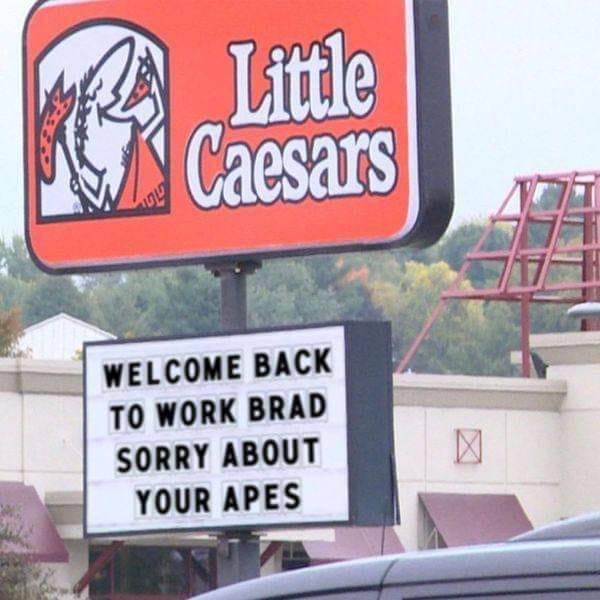
The meme is a photo of a sign outside a Little Caesars pizza restaurant with a typo in the "Welcome to Little Caesars" sign. The sign reads "Welcome to Little Caesars" but has a typo in the word "Caesars" and is actually spelled "Caesar's" with an "s" instead of a "z".
detailed-analysis (gemma3-27b-vision)
Okay, here's an analysis of the image, broken down into the requested sections, including notes on applicability (some sections will be brief or noted as not applicable).
Visual Description
The image depicts a Little Caesars pizza restaurant sign. The main sign features the company's logo – a Roman gladiator's helmet – alongside the "Little Caesars" branding in bold lettering. Below this is a changeable letter board sign with the message: “WELCOME BACK TO WORK BRAD SORRY ABOUT YOUR APES.” The photograph is taken outdoors in daylight, and part of a vehicle (a car's roof and windshield) is visible in the foreground, along with a blurred background of building rooftops and trees. The overall impression is one of casual, somewhat unrefined signage, suggesting a quick, improvised message. The lighting appears flat, suggesting a cloudy day or diffuse light.
Foucauldian Genealogical Discourse Analysis
This message demonstrates a micro-power dynamic at play. Foucault's concept of discourse helps to understand this. The sign isn't simply a greeting; it’s a performance of power. The manager (or whoever posted the message) is asserting authority over "Brad" through a public display, framing a personal matter ("apes" likely referring to pets) as something relevant to the workplace. This is disciplinary power in action, shaping Brad's behavior through a subtle form of public shaming.
The genealogy would look at how the convention of workplace signage came to be. Originally it was about advertising and information, but it has broadened to include informal communication, personal jabs, and (as here) power assertions. The message isn't inherently oppressive, but the context – the workplace, the public display – makes it a tool for control. It’s not a grand, top-down edict, but a local, everyday instance of power operating through language. The ambiguity of "apes" is also significant – it’s deliberately vague, adding to the discomfort and potentially requiring Brad to explain or justify himself.
Critical Theory
The sign can be examined through the lens of the Frankfurt School’s critical theory, specifically focusing on the culture industry. While Little Caesars is a mundane commercial entity, the sign contributes to the broader normalization of casual, potentially aggressive interpersonal communication. The message reflects a shift in workplace culture where personal boundaries are blurred and a degree of public shaming or teasing is accepted, or even encouraged.
This also points to a weakening of traditional power structures. It’s not a formal reprimand from HR, but a direct, informal message from a peer (or superior) – illustrating a shift toward more decentralized forms of control and a more fluid, less structured workplace hierarchy. This message contributes to the “instrumental rationality” that Horkheimer and Adorno described – a focus on efficiency and control, even at the expense of empathy or respect.
Marxist Conflict Theory
While not a direct illustration of class struggle, the message hints at power imbalances within the capitalist system of employment. Brad is subject to the will of his employer (or a manager acting on behalf of the employer). The message, however seemingly frivolous, underscores the inherent inequality in the employer-employee relationship. Brad is dependent on his job for survival and is therefore subject to the whims of those in authority.
The sign can be seen as a microcosm of exploitation: the manager derives amusement or asserts dominance at the expense of an employee’s emotional comfort. The informal, public nature of the message demonstrates a disregard for Brad’s dignity. In a Marxist framework, this is seen as a manifestation of the dehumanizing effects of capitalism, where individuals are often treated as commodities.
Postmodernism
This image exemplifies several tenets of postmodern thought. The message is meta, in that it draws attention to itself as a communication. It’s not about the pizza; it’s about the act of communicating about Brad and his pets. This is a self-referential gesture.
The ambiguity of "apes" is also crucial. The message deliberately avoids a clear definition, embracing a fluid, unstable meaning. This is characteristic of postmodern deconstruction – destabilizing traditional meanings and challenging fixed interpretations. The sign lacks grand narratives or universal truths; it's a localized, fragmented communication that defies easy categorization. The casual, almost playful tone further embodies a postmodern rejection of seriousness and authority.
Queer Feminist Intersectional Analysis
This section is less directly applicable. While gender or sexuality isn't explicit in the message, an intersectional analysis could consider how power dynamics might shift depending on Brad's identity. If Brad were a member of a marginalized group (e.g., a person of color, LGBTQ+), the message could be interpreted as a microaggression or a form of subtle discrimination.
The casual cruelty of the message also speaks to broader patterns of interpersonal aggression. Feminist theory highlights how seemingly innocuous acts of aggression can contribute to a culture of intimidation and control. Intersectionality emphasizes that this effect is exacerbated for individuals who are already marginalized by other factors, like race, class, or sexual orientation. In short, the message, while seemingly harmless, could be seen as a manifestation of broader patriarchal and power structures.
I hope this detailed analysis is helpful! Let me know if you'd like me to elaborate on any specific section.
simple-description (llama3.2-vision)
This meme is a humorous image of a "Now Hiring" sign from a fictional "Little Caesars" restaurant, with a twist. The sign originally reads "We're hiring! Apply in person" but has been altered to say "We're hiring! Apply in person... or die".
tesseract-ocr
ne i i NOES ay ie were ‘ F i i a nie = Ne TO WORK BRAD Tay . SORRY ABOUT NM oe _YOUR APES | _