First Seen
2023-05-10T21:03:33+00:00
simple-description (llama3.2-vision_11b)
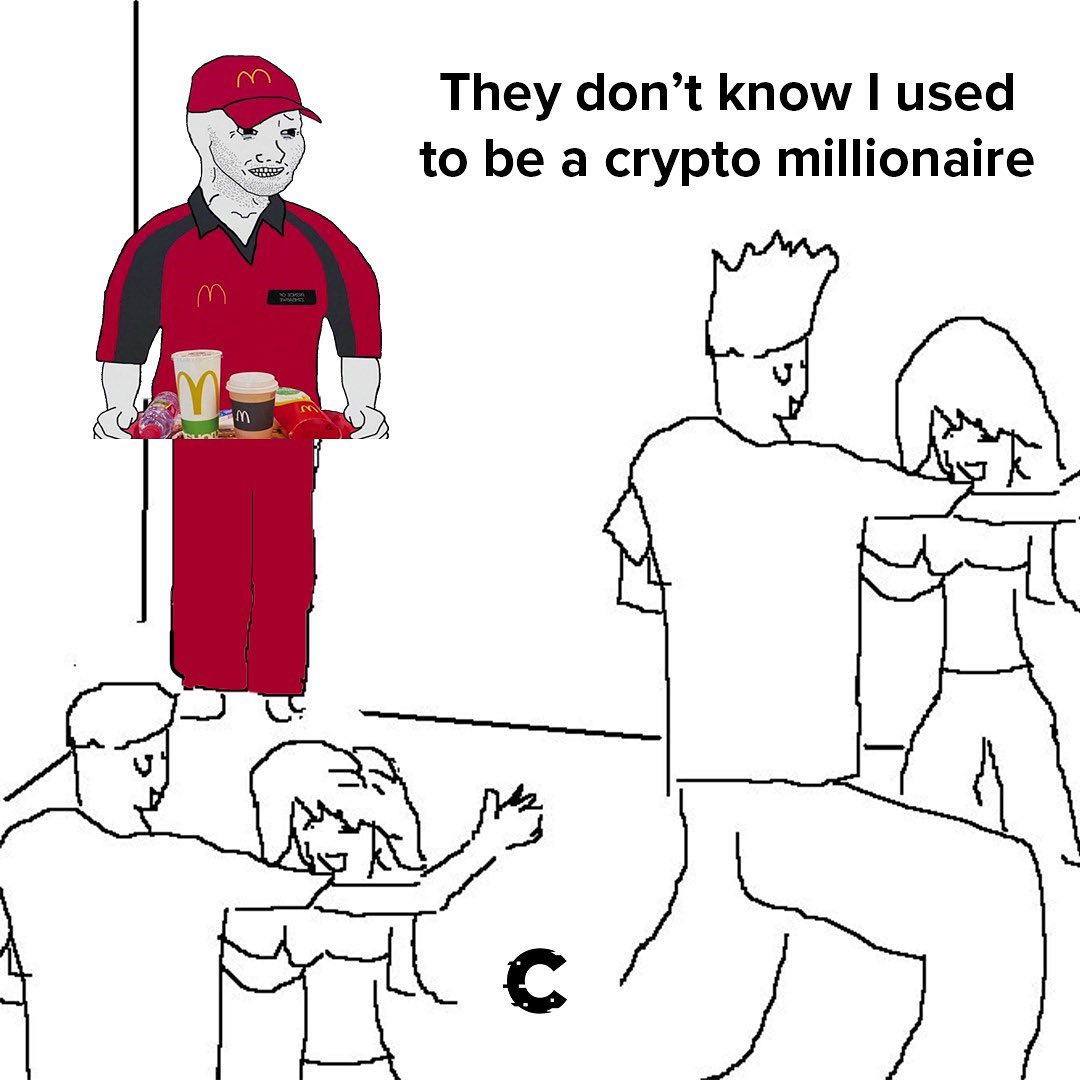
This meme is a commentary on the absurdity of people's expectations of getting rich quickly through cryptocurrency. The image shows a McDonald's worker, a symbol of a low-wage job, holding a tray of food with a caption "They don't know I'm a crypto millionaire". The text is ironic, implying that the worker is secretly wealthy from cryptocurrency investments, but the reality is that they are still working at McDonald's, highlighting the disconnect between their actual life and the fantasy of being a millionaire.
detailed-analysis (gemma3-27b-vision)
Okay, let's break down this image using the requested theoretical lenses. It’s a loaded image, so we’ll aim for a comprehensive analysis.
Visual Description
The image is a black and white, crude line drawing done in the style of "NPC" or Wojak meme aesthetics. It depicts a fast-food worker (presumably at McDonald's, indicated by the hat and uniform) holding a tray of food. The worker’s expression is smug and self-satisfied. Above the worker's head is the text “They don’t know I used to be a crypto millionaire.” The background shows several other figures in varying states of distress – one crying into their hands, another appearing defeated, and a couple in a more upright but seemingly strained conversation. There's a small, circular "C" watermark on the bottom right corner of the image. The style is deliberately low-resolution and intentionally simplified, common to the digital meme-scape. The focus is on a stark contrast between the perceived status of the worker and the implied past status, and the distress of the background characters.
Foucauldian Genealogical Discourse Analysis
This image offers fertile ground for a Foucauldian analysis. The "crypto millionaire" narrative is a discourse constructed around wealth, success, and the idea of self-made men. The image isn’t about a literal fall from riches; it’s about the way we talk about wealth and its relationship to identity.
- Power/Knowledge: The worker’s statement asserts a power dynamic. He knows something others don’t. This knowledge isn't just factual; it's a marker of a certain type of expertise and past belonging to a specific power structure (the world of high finance/crypto). The background figures represent those who are outside that knowledge system.
- Genealogy: The genealogy of this image traces back to narratives of the "self-made man" in capitalism, amplified by the more recent phenomena of crypto speculation. It speaks to the belief that individual agency and risk-taking can lead to boundless wealth, regardless of systemic factors. The image deconstructs this by showing the failure of that promise, but the belief in it remains embedded within the worker’s self-perception.
- Disciplinary Power: The image evokes a sense of ironic self-discipline. The worker’s past status is contrasted with his present subjugation to the fast-food industry. It subtly illustrates how economic systems can discipline individuals, forcing them into positions of subservience even after moments of perceived success.
Marxist Conflict Theory
This image is strongly aligned with Marxist concepts:
- Class Struggle: The contrast between the worker and the background figures represents a stark illustration of class conflict. The worker, despite his fall from wealth, still holds a degree of superiority (knowing his past status) and is performing alienated labor in the service of capital. The background figures are likely a depiction of the proletariat, experiencing the alienation and suffering inherent in the capitalist mode of production.
- Alienation: The worker is alienated from the fruits of his labor (and perhaps even from his own potential). He’s reduced to serving others, while being secretly resentful of their lack of awareness of his “true” former status.
- Commodification: Everything within the image is commodified: the worker’s labor, the food he serves, and even his sense of self (defined by his past wealth). He’s a commodity like any other, subjected to the demands of the market.
- False Consciousness: The worker’s smugness could be interpreted as a form of false consciousness – a belief in his own superiority that obscures the underlying systemic forces at play. He sees his situation as a personal failing or a temporary setback, rather than a consequence of the inherent contradictions of capitalism.
Postmodernism
Postmodern themes are present in the image’s deconstruction of narratives and questioning of authenticity:
- Simulacra & Simulation: The worker's identity is built on a constructed narrative – the "crypto millionaire" persona. This narrative may have little connection to lived reality, functioning as a simulacrum. The image suggests that identity itself is fluid and performative, rather than fixed and authentic.
- Death of the Author/Grand Narratives: The image rejects the grand narratives of wealth and success. The worker’s fall undermines the idea of a linear progression toward prosperity.
- Irony & Pastiche: The image is heavily ironic. The worker’s smugness is juxtaposed with his lowly position, creating a sense of absurdity. The visual style itself is a pastiche of internet meme aesthetics.
- Fragmentation of Identity: The worker appears to be torn between his past and present selves. His identity is fragmented, marked by a sense of loss and disillusionment.
Critical Theory
The image lends itself to analysis through the lens of Critical Theory, specifically regarding issues of power and domination:
- Domination and Subordination: The image highlights the power dynamics inherent in capitalist society. The worker is subordinated to the demands of the fast-food industry, despite his past financial success. The background figures represent those who are even more deeply entrenched in a system of domination.
- Ideology: The worker’s smugness reinforces a specific ideology – the belief in individual agency and the possibility of upward mobility. This ideology obscures the systemic barriers that prevent many people from achieving financial success.
- Rationalization and Disenchantment: The image captures a sense of rationalization and disenchantment. The worker's past wealth has been stripped away, leaving him with a feeling of emptiness and meaninglessness. This reflects the broader trend of modernization and the loss of traditional values.
In conclusion, this image, though simple in its visual execution, is incredibly rich in meaning. It provides ample ground for analysis from a variety of critical perspectives, offering insights into issues of power, class, ideology, and the changing nature of identity in the 21st century.
simple-description (llama3.2-vision)
This meme is a play on the phrase "they don't know I used to be" and replaces "I used to be" with "I used to be a crypto millionaire". The image features a character from the popular video game "Rick and Morty" (also known as "Wubba Lubba Dub Dub") in a McDonald's uniform, holding a tray of food, with the phrase "They don't know I used to be a crypto millionaire" written above it.
tesseract-ocr
They don’t know | used to be a crypto millionaire {| ey ee a AL (Se oh ae , Sle)’ 7