First Seen
2025-03-27T23:02:19.003724+00:00
simple-description (qwen3.5_2b-q8_0)
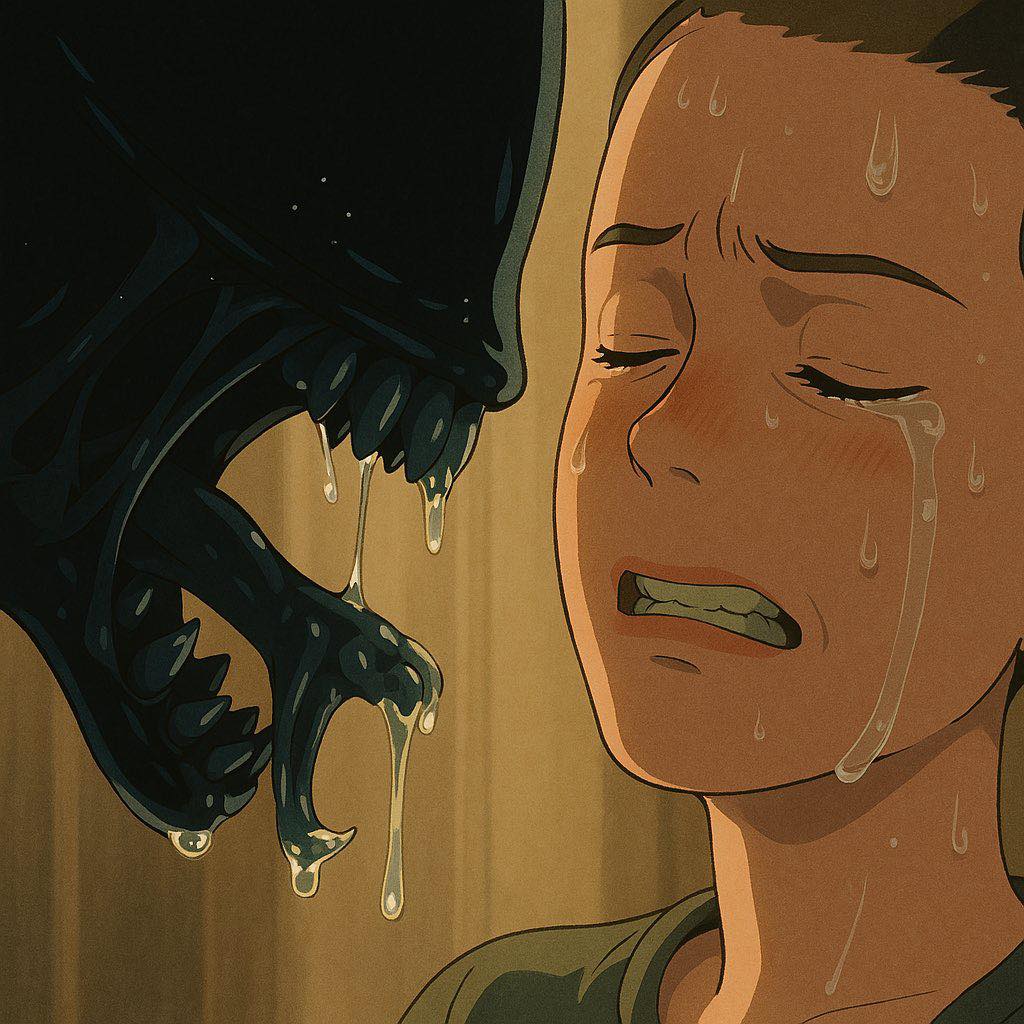
The "Doom NighT" meme depicts a terrifying, alien-like monster reaching for a person's face, intending to grab their skin. The humor relies on the joke that this is actually a "normal" human face, implying that the person saying the joke is just being "Dork" (meaning scared) rather than a terrifying entity. Note that there is no written text visible on the image itself.
detailed-analysis (gemma3_27b-it-q8_0)
Okay, let's break down this meme through the lens of an "Anti-DNC" category, utilizing the requested theoretical frameworks where applicable. Given the meme's imagery, several of these analyses will be quite pertinent.
Overall Category Context: This meme operates within the framework of deep skepticism and opposition to the Democratic National Committee (DNC) and, by extension, the modern Democratic Party. The "Anti-DNC" stance is generally predicated on accusations of the party being controlled by corporate interests, moving away from its historical working-class base, prioritizing identity politics over economic concerns, and being insufficiently challenging to existing power structures. The meme uses a shocking visual to evoke feelings of fear, violation, and a sense of being overwhelmed – metaphors for the feeling of being 'consumed' by the DNC's perceived agenda.
1. Visual Description
The image depicts a close-up, highly detailed illustration. A figure, likely a young man, is in a state of abject terror. He's sweating profusely, with tears streaming down his face, and his expression is one of pure anguish. The source of his fear is immediately apparent: directly confronting his face is the head of the Xenomorph from the Alien franchise. The Xenomorph's mouth is open, revealing multiple rows of teeth and a dripping, saliva-like substance, suggesting an imminent, brutal attack. The art style is reminiscent of comic book illustration or graphic novel work, lending a hyper-realism to the scene. The color scheme is muted with earth tones, adding a sense of bleakness and desperation.
The visual is starkly not about a literal alien invasion. It's heavily symbolic. The Xenomorph represents something else – the perceived predatory nature of the DNC. The man’s distress represents the fear and disillusionment felt by people who believe they are betrayed or consumed by the DNC.
2. Foucauldian Genealogical Discourse Analysis
Michel Foucault’s work on power, discourse, and knowledge is highly relevant here. The meme operates through a re-framing of existing discourses.
- Power/Knowledge: Foucault argued that power is not simply a top-down force but is dispersed throughout society, operating through discourse – the ways we talk and think about things. The DNC, according to Anti-DNC perspectives, wields power by controlling the discourse around political issues. This meme suggests that this discourse is not benevolent but rather predatory, actively seeking to subsume individuals.
- Genealogy: A Foucauldian genealogy would trace the historical development of the “Democratic Party” discourse. Anti-DNC thinkers might argue the party has historically presented itself as the champion of the people (the working class, minorities, etc.). However, they’d trace a shift where this discourse changed – becoming more aligned with corporate interests, neoliberal policies, and a focus on identity rather than material conditions. The Xenomorph represents the result of that shift – the true, underlying power structure hidden beneath the rhetoric.
- Discipline and Punishment: The Xenomorph’s impending attack is a metaphor for the ways the DNC “disciplines” dissent. Those who step out of line with the party’s narrative, the argument goes, are ostracized, labelled, or even economically penalized. The image suggests the consequences of questioning the dominant discourse are devastating.
3. Critical Theory (Frankfurt School)
The meme aligns with themes explored by the Frankfurt School – particularly concerning the “culture industry” and the manipulation of consciousness.
- Culture Industry: The DNC, from this perspective, is part of the culture industry – a system that produces standardized, commodified cultural products to maintain the status quo. The party’s messaging, branding, and political rituals are seen as designed to pacify and control the population, preventing critical thought.
- False Consciousness: The meme implies that many Democrats are suffering from “false consciousness” – a state of being unaware of the true nature of their exploitation. They are led to believe the DNC represents their interests, while in reality, it serves the interests of the elite. The Xenomorph represents the hidden reality that shatters this illusion.
- Instrumental Reason: The DNC is seen as embodying 'instrumental reason' - a form of rationality focused purely on efficiency and achieving ends (power, profit) without consideration for ethical or human consequences. The cold, predatory nature of the Xenomorph embodies this ruthless, unfeeling logic.
4. Marxist Conflict Theory
This meme is deeply rooted in Marxist ideas of class struggle.
- Bourgeoisie vs. Proletariat: The DNC is positioned as representing the interests of the bourgeoisie (the capitalist ruling class), while the individual in the image represents the proletariat (the working class). The Xenomorph is the embodiment of the exploitative relationship between these classes. It is a force that threatens to consume and destroy the individual’s autonomy and agency.
- Alienation: The image conveys a sense of alienation – the feeling of being disconnected from one's own labor, from society, and from oneself. The man's helplessness in the face of the Xenomorph symbolizes the powerlessness of the working class in the face of systemic oppression.
- False Hegemony: The DNC, from this view, maintains its power through “false hegemony” – the process of winning the consent of the governed through ideology and manipulation. The meme suggests that this hegemony is a form of deception, masking the underlying class conflict.
5. Postmodernism
While seemingly contradictory given the strong imagery, postmodernism can be seen at play in the deconstruction of the DNC’s image.
- Deconstruction of Grand Narratives: Postmodernism challenges "grand narratives" – overarching explanations of history and society. Anti-DNC sentiment rejects the liberal narrative of progress and inclusivity offered by the party, exposing its contradictions and hypocrisies. The meme is a direct assault on that narrative.
- Simulacra and Simulation: Jean Baudrillard’s concept of simulacra and simulation could be applied. The DNC, according to this view, is increasingly a simulation of a political party – a hyperreal representation that has lost touch with any underlying reality. The Xenomorph represents the terrifying truth that lies beneath the surface of this simulation.
- Rejection of Objectivity: The subjective and emotional nature of the image itself highlights a postmodern rejection of objective truth. The experience of "being consumed" by the DNC is a deeply felt experience, rather than a factually provable one.
6. Queer Feminist Intersectional Analysis
While not the primary lens of the meme's construction, an intersectional analysis reveals potential layers. Often, critiques within the Anti-DNC space argue that the party's identity politics are performative – used to deflect from economic inequalities.
- Commodification of Identity: The DNC's focus on identity (race, gender, sexuality) can be seen as a way to commodify these identities, turning them into marketing tools without addressing the root causes of oppression. The Xenomorph can be read as a symbol of this commodification – a predatory force that exploits vulnerability for its own gain.
- Intersectional Oppression: The individual in the image could be interpreted as representing someone from a marginalized group (though gender and race are ambiguous), whose identity is being weaponized and exploited by the DNC. The Xenomorph represents the intersection of various forms of oppression.
- Critique of "Saviorism": The DNC's self-portrayal as a "savior" of marginalized groups is challenged. The image suggests the party is not a savior, but a predator.
In conclusion, this meme is a powerful and layered piece of political commentary. It leverages a visually striking image to convey a deep sense of distrust and resentment towards the DNC, employing a range of theoretical frameworks to articulate a complex critique of its power, ideology, and impact on individuals and society.
simple-description (llama3.2-vision_11b)
The meme is an image of a person crying, with the caption "When you realize the only thing stopping the Alien from killing you is a 30-year-old movie script." The image is a play on the classic horror movie "Aliens," where a character's life is saved by a script error, implying that the movie's writers are the only thing keeping the character alive. The meme is humorous and ironic, poking fun at the idea that a script error can be the only thing saving someone's life in a high-stakes situation.
detailed-analysis (gemma3-27b-vision)
Okay, here's an analysis of the image, broken down into sections relevant to the requested theoretical frameworks. I'll indicate when a section is not applicable. It’s a strong, disturbing image, so the analyses will reflect that.
Image Description:
The image depicts a close-up scene referencing the iconic “chestburster” moment from the film Alien. A terrified, androgynous person is shown from the side, eyes clenched shut, face contorted in pain and horror. Streams of liquid, presumably blood and/or alien fluids, cascade down their face and neck. The most prominent feature is the dark, organic, and vaguely mechanical form of the alien creature emerging from their chest. The alien's "hand" or appendage is sharply defined, with visible claws, suggesting a brutal, invasive action. The background is a warm, golden-brown, which, instead of offering comfort, serves as a striking contrast to the horror unfolding, creating an unsettling, claustrophobic atmosphere. The art style is illustrative, almost graphic novel-like, with strong outlines and a stylized rendering of anatomy.
Foucauldian Genealogical Discourse Analysis
This image is a potent example of how power operates through the biopolitics of the body. The alien's invasion isn’t merely physical violence; it's a disruption of the very boundaries that define the individual. Foucault argued that power isn't simply repressive, but productive – it creates categories, defines normalcy, and controls populations through definitions of health, illness, and deviance.
Here, the alien represents a force outside the established systems of control (medical, social, etc.), utterly disrupting those systems by violating the integrity of the human body. The chestburster isn't just an attack; it's a reconfiguration of the body into something else, a monstrous hybrid.
A genealogical analysis would trace the historical conditions that allowed this scenario to become a cultural symbol. The anxiety surrounding bodily autonomy, reproductive fears, and the perceived threats from the "other" (aliens representing anxieties about the unknown and the foreign) all contribute to the image's power. The image isn’t merely about a monster; it's about the vulnerability of the body and the ever-present threat of forces that can redefine our very existence.
Critical Theory
From a Critical Theory perspective, the image is a powerful representation of alienation. The person in the image is utterly violated and subsumed by an external force. This can be interpreted as a metaphor for the experiences of individuals under oppressive systems – be they capitalist, patriarchal, or colonial.
The alien doesn’t simply harm; it becomes part of the person, demonstrating a complete loss of selfhood. This resonates with themes of commodification (the body as property), and dehumanization. The individual is no longer seen as a subject with agency but as a vessel for something else.
Moreover, the image can be viewed as a critique of rationality and the idea of control. The alien represents the chaotic, irrational forces that lie beneath the surface of everyday life, and the image reveals the fragility of our attempts to impose order on a fundamentally unpredictable universe. The image underscores the limitations of human control and the ever-present threat of the unknown.
Marxist Conflict Theory
While not immediately apparent, a Marxist reading can be applied. The alien, representing a force outside of human control, can be seen as analogous to the exploitation inherent in capitalist systems. The host body is "used" by the alien for its own reproductive purposes, mirroring the exploitation of labor under capitalism, where workers are treated as mere instruments for the accumulation of profit.
The image can also be seen as symbolizing the alienation of labor. The person's body is no longer their own; it's a site of production, not for their benefit, but for the alien’s. This highlights the loss of control over one's own body and the commodification of human life. The horror doesn't come from the monster itself, but from the loss of agency.
Postmodernism
From a postmodern perspective, the image deconstructs the notion of a stable, unified self. The alien’s intrusion obliterates the boundaries between inside and outside, self and other, human and alien. This challenges the idea that the self is a coherent entity with fixed characteristics.
The image also embodies the postmodern concept of simulacra and simulation. The alien isn’t “real” in any traditional sense; it’s a constructed image, a hyperreality that challenges our understanding of what is authentic and what is fabricated. The terror is not simply from the creature, but from the realization that reality itself is unstable and open to interpretation.
The ambiguity of the figure’s gender further supports a postmodern reading, rejecting binary oppositions and challenging traditional notions of identity.
Queer Feminist Intersectional Analysis
This is where the image becomes particularly compelling. The chestburster scene has long been interpreted as a deeply unsettling representation of forced penetration and childbirth. The image powerfully speaks to the historical and ongoing anxieties surrounding female bodies, reproduction, and control over one’s own sexuality. The figure's androgynous appearance throws those readings into sharper relief.
An intersectional analysis recognizes that these experiences are shaped by multiple, intersecting forms of oppression. The violation of the body can be seen as a metaphor for the systemic violence experienced by marginalized groups—including women, queer and trans individuals, and people of color. The image demonstrates how bodies are often perceived as sites of control, ownership, and invasion.
Furthermore, the alien's intrusion disrupts traditional notions of boundaries and bodily autonomy, which are central to feminist and queer struggles for liberation. The image challenges the idea of a "pure" or "intact" body and embraces the fluidity and ambiguity of lived experience. The loss of agency and selfhood is profoundly resonant with the experiences of those who are subjected to systemic oppression.
Let me know if you’d like me to elaborate on any of these points or explore other theoretical frameworks.
simple-description (llama3.2-vision)
The meme is a screenshot from the movie "Aliens" where a character is screaming in terror as a deadly alien creature is about to attack her. The text "When you finally get a good Wi-Fi signal" is overlaid on the image, implying that the character's fear is equivalent to the frustration of getting a reliable internet connection. The meme is a humorous take on the common experience of struggling with internet connectivity.