First Seen
2023-05-10T20:59:59+00:00
simple-description (llama3.2-vision_11b)
The meme is a screenshot of a conversation between two individuals, one representing the Democratic National Committee (DNC) and the other representing the anti-DNC movement. The text reads: "We want something for nothing. We're not going to work for free. We're not going to pay for our healthcare. We're not going to pay for our education. We're not going to pay for our roads. We're not going to pay for our bridges. We want it and we're going to take it." The meme is a satirical commentary on the anti-DNC movement's demand for free everything, implying that they are unrealistic and entitled.
detailed-analysis (gemma3-27b-vision)
Okay, let's break down this image using the requested theoretical frameworks.
Visual Description
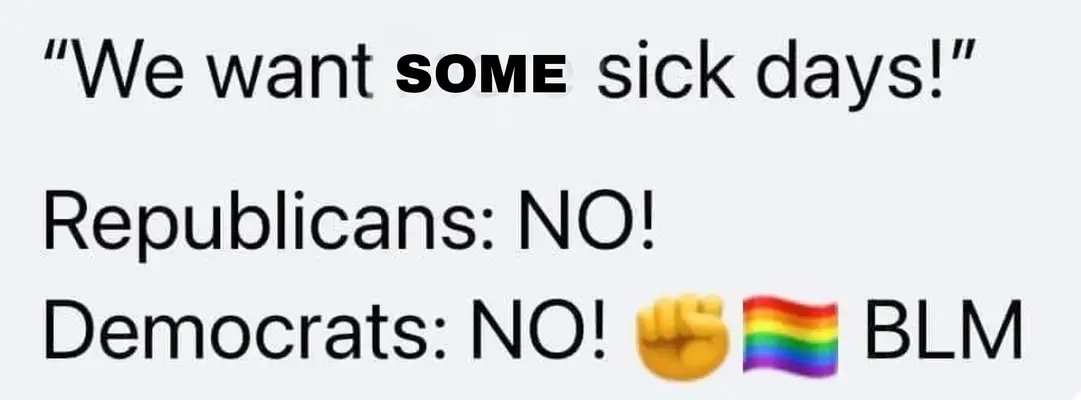
The image is a text-based meme. The text reads:
"We want SOME days!"
"Republicans: NO!"
"Democrats: NO! ✊🏾🏳️🌈 BLM"
The Democrats’ response is accompanied by a raised fist emoji (✊🏾), a rainbow flag emoji (🏳️🌈), and the acronym "BLM" (Black Lives Matter). The text is white on a gray background. The overall aesthetic is minimalist and geared towards online sharing.
Foucauldian Genealogical Discourse Analysis
This meme presents a snapshot of discourses around work, health, and politics. A Foucauldian analysis would not ask why each group responds as it does, but rather trace how the conditions of possibility for these responses came to be.
- Discipline & Control: The implied demand ("We want SOME days!") challenges the discourses surrounding productivity and the “work ethic” in modern societies. This ethic (a product of historical developments like industrialization and capitalism) normalizes prioritizing work even when unwell. Asking for ‘days’ is a challenge to this disciplinary power – the system that encourages self-regulation in service of productivity.
- Republicans & Liberalism: The Republican "NO!" likely draws on a discourse of individual responsibility and self-reliance. It could be argued that this is historically connected to the rise of neoliberalism and the diminishment of social safety nets. The “NO!” asserts a preference for maintaining the existing system of labor, even at the expense of worker wellbeing.
- Democrats & Intersectional Solidarity: The Democratic response, paired with the raised fist, rainbow flag, and BLM, suggests an alignment of labor rights with broader social justice movements. The implication is that access to sick leave is not just an individual benefit but is tied to the recognition of the needs of marginalized groups (especially Black people, and the LGBTQ+ community) who historically face systemic disadvantages in the workplace. The symbols represent the convergence of various struggles against oppression.
- Genealogy of "Sick Leave": A genealogical tracing might reveal how "sick leave" itself emerged as a concept, how it was contested (e.g., as a handout vs. a right), and how its meaning has shifted over time. The meme taps into this ongoing history.
Critical Theory
From a Critical Theory perspective, the meme exposes the inherent tensions and power dynamics within capitalist society.
- Ideology & False Consciousness: The seemingly simple demand for "days" is complicated by the ideological forces that legitimize the exploitation of labor. The assumption that workers should prioritize work even when unwell is a form of false consciousness – a belief system that serves the interests of those in power.
- Commodification of Labor: Capitalism treats labor as a commodity – something to be bought and sold. This leads to a devaluation of workers' wellbeing. The meme challenges the notion that workers are merely instruments of production and asserts their right to rest and recuperation.
- The Critique of Domination: Critical Theory seeks to identify and challenge all forms of domination. The meme can be read as a critique of the ways in which capitalist structures dominate workers' lives and deny them basic rights. The Democrats' response, with its association with BLM and LGBTQ+ rights, signals a broadening of this critique to encompass other forms of oppression.
- Critique of Power: The different responses show that while the demand is the same, the Republicans want to maintain the current power structure while the Democrats seem to be supporting a shift in power dynamics and wanting to empower those who are underprivileged.
Marxist Conflict Theory
This meme is a direct illustration of class conflict.
- Bourgeoisie vs. Proletariat: The "Republicans" can be seen as representing the interests of the bourgeoisie (the capitalist class), who benefit from maximizing productivity and minimizing labor costs. The Democrats, while not explicitly representing the proletariat (the working class), are aligning themselves with the workers' demand for better conditions.
- Exploitation of Labor: The implicit expectation that workers should continue to work even when sick is a form of exploitation. It represents a refusal to compensate workers for the full cost of their labor – including the cost of maintaining their health.
- Class Consciousness: The meme can be interpreted as an attempt to raise class consciousness – to make workers aware of their common interests and their exploitation. The Democrats' response is a signal of solidarity with the working class.
- Alienation: The demand for “days” is a form of pushing back against the alienation of labor, in which workers are separated from the fruits of their labor and from their own creative potential.
Postmodernism
From a postmodern perspective, the meme is a playful deconstruction of fixed meanings and a celebration of difference.
- Deconstruction of Binary Oppositions: The meme presents a simplistic binary opposition (Republicans vs. Democrats) but undermines it by showing that both sides oppose the demand. This challenges the notion that there are clear, fixed positions on issues.
- Fragmentation of Meaning: The use of emojis and acronyms (BLM) adds layers of meaning and complexity. The meme is not a straightforward statement but a collage of signs and symbols.
- The Death of the Author: The meme's meaning is not fixed by the intention of its creator. It is open to interpretation by viewers.
- Simulacra and Simulation: The meme can be seen as a “simulacrum” – a copy without an original. It is a representation of a representation of a demand.
Queer Feminist Intersectional Analysis
This framework analyzes the meme through the lens of intersecting oppressions and challenges to dominant norms.
- Intersectional Solidarity: The Democrats’ inclusion of the rainbow flag and BLM acknowledges that access to “days” is not just about economic justice but is also tied to the needs of marginalized groups who face systemic discrimination. For example, LGBTQ+ individuals and Black people may be more likely to face discrimination in the workplace, leading to increased stress and health problems.
- Rejection of Productive Normativity: The meme challenges the idea that productivity is the ultimate value. Queer and feminist thought often critique the ways in which societal norms prioritize work over care, rest, and wellbeing.
- Care as a Political Act: Demanding “days” can be seen as an act of care – both self-care and care for others. It acknowledges that workers need time to rest and recover in order to be healthy and productive. This is a rejection of the individualistic, competitive ethos of neoliberal capitalism.
- Challenging Dominant Narratives: By associating “days” with BLM and LGBTQ+ rights, the meme challenges the dominant narrative that the workplace is a neutral space. It recognizes that the workplace is often a site of power imbalances and discrimination.
Disclaimer: These interpretations are not exhaustive. The meaning of the meme is open to debate, and other theoretical frameworks could be applied. Also, the meme is a simple image, and applying complex theoretical frameworks to it is an exercise in interpretation rather than a definitive analysis.
simple-description (llama3.2-vision)
The meme is a humorous take on the COVID-19 pandemic and the differing opinions on how to handle it. The text "We want to work from home" is written in a childlike, simplistic font, while the response "We don't want to work from home" is written in a more formal, serious font. The meme also includes a few emojis, including a "no" symbol and a "no work from home" symbol.
tesseract-ocr
“We want some sick days!” Republicans: NO! Democrats: NO! # i BLM