First Seen
2023-11-04T06:35:04+00:00
simple-description (qwen3.5_2b-q8_0)
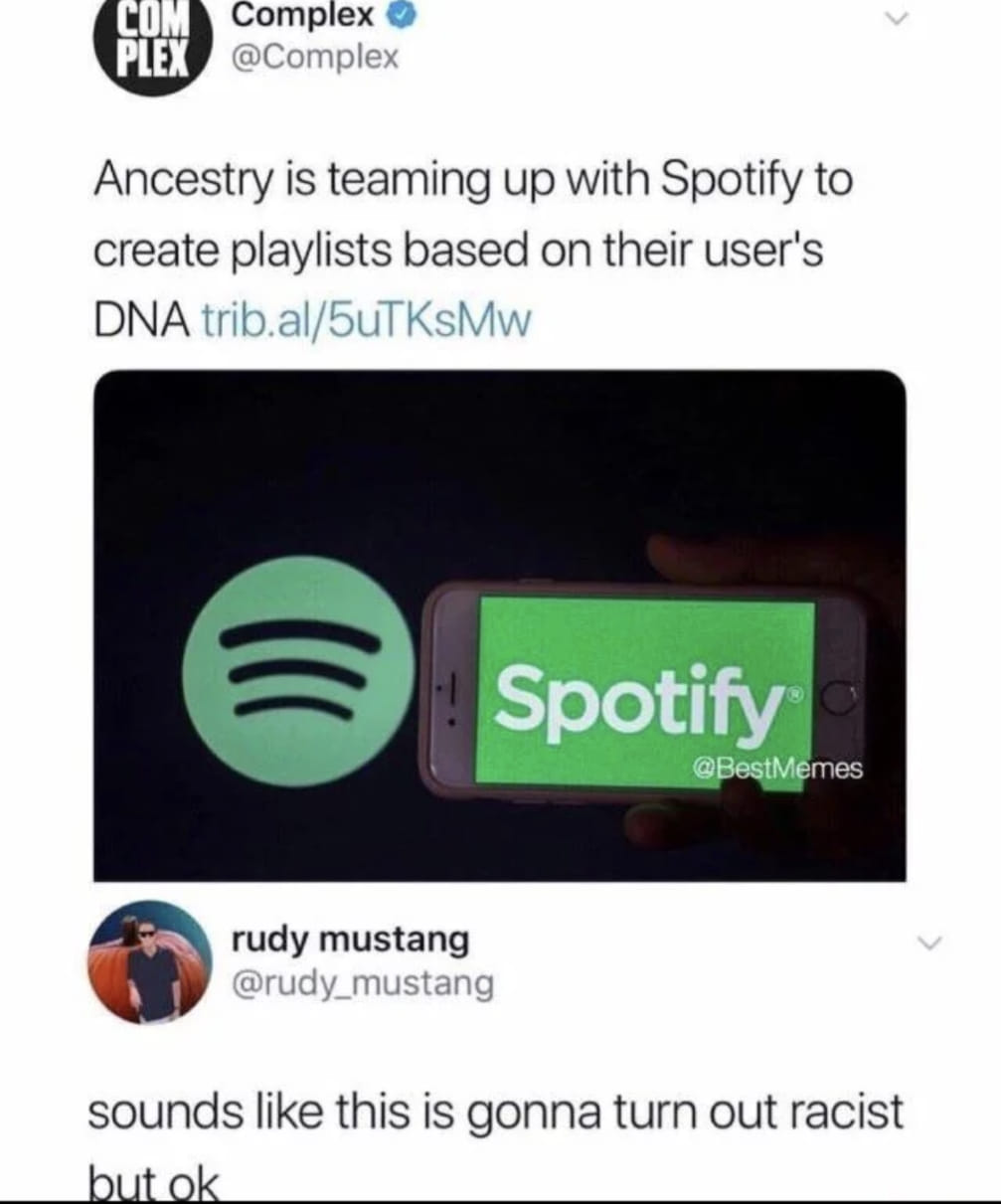
This meme, from the verified account Complex, humorously suggests that "Ancestry" (a DNA testing company) is teaming up with Spotify to create personalized playlists based on user DNA data. Below the main image, a user named Rudy Mustang comments that it sounds "racist."
From a perspective of Anti-Eugenics, this meme highlights a dangerous premise. It suggests that a person's biological makeup (DNA) should be the sole determinant of their lifestyle and cultural tastes (like what music they listen to). This parallels eugenic ideologies which hold that a person's physical or genetic traits are the primary factor in their social standing, quality of life, and even who they interact with. The joke mocks the idea that science can categorize a person's destiny or habits based entirely on their hereditary code.
simple-description (llama3.2-vision_11b)
This meme is a commentary on the resurgence of anti-eugenics, a pseudoscientific ideology that advocates for the elimination of "undesirable" individuals. The meme uses a screenshot of a Twitter post from the "Anti-Eugenics" account, which is a parody of the "Anti-Vaxx" movement. The text "I am not a doctor, but I play one on Twitter" is a play on the classic "I'm not a doctor, but..." phrase, implying that the account's followers are not experts, but rather armchair scientists.
detailed-analysis (gemma3-27b-vision)
Okay, let's break down this social media post through various critical lenses.
Visual Description
The image is a screenshot of a Twitter post from the account "@Complex." It announces a collaboration between Ancestry.com and Spotify to create personalized music playlists based on user DNA. A mock-up graphic shows the Spotify logo layered over a smartphone screen, rendered in green, hinting at the connection to genetic data. Below this is a response tweet from @rudy_mustang stating “sounds like this is gonna turn out racist but ok”. The lighting is low and creates a dramatic effect on the phone screen, and the post itself has a simple and direct layout.
Foucauldian Genealogical Discourse Analysis
This collaboration is rife with power dynamics, as analyzed through Foucault's genealogical lens. The project isn’t simply about offering a personalized music experience. It's about constructing identity through DNA, and then linking that constructed identity to musical taste. This is a discourse that defines who people are based on a biological essentialism.
Here's how it works:
- Power/Knowledge: Ancestry.com and Spotify wield power through their control of genetic data and musical distribution. They are establishing a new ‘truth’ about identity – that musical taste can be predetermined by genetic ancestry.
- Disciplinary Practices: The playlists function as a kind of soft discipline. By categorizing people based on DNA-determined musical preferences, they subtly reinforce categories of identity and potentially limit people's engagement with music outside of those categories.
- Historical Contingency: The notion of using genetics to define cultural preferences is a distinctly modern idea. This isn’t an inherent truth, but a product of a specific historical moment where genetics and data science have gained such prominence.
The implication of @rudy_mustang’s response is a recognition of this inherent power dynamic and potential for control and categorization.
Critical Theory
This collaboration falls squarely within the realm of the Culture Industry, a key concept in Critical Theory.
- Commodification of Identity: The project takes something inherently personal – genetic ancestry and musical taste – and turns it into a commodity. It’s about data extraction and creating a product (playlists) that can be sold and consumed.
- Standardization & Mass Culture: The implication is that people with similar ancestral backgrounds will be assigned similar playlists, reinforcing a homogenized "culture" based on ancestry, which can stifle individual expression and diverse musical tastes.
- False Consciousness: Users might perceive this as an empowering personalized experience, unaware of the ways in which their identities are being constructed and manipulated by the algorithm and the corporations behind it.
The response "sounds like this is gonna turn out racist but ok" indicates an understanding of the potential for a reductive, essentialized notion of culture being imposed on individuals.
Marxist Conflict Theory
From a Marxist perspective, this collaboration highlights the exploitation of data as a new form of capital.
- Means of Production: Ancestry.com and Spotify control the means of production of both genetic data and musical content.
- Exploitation of Labor: Users unknowingly provide their genetic data as "labor" (the raw material) for the creation of these playlists, which then generate profit for the companies.
- Class Division: This venture likely targets a demographic with both the means to afford DNA testing and a subscription to a streaming service, potentially exacerbating existing class divisions.
- Capitalist Expansion: The collaboration represents a further expansion of capitalist logic into the realm of personal identity and cultural expression.
The tweet’s skepticism signals an awareness of the profit motive underlying this seemingly innocuous venture.
Postmodernism
A postmodern reading focuses on the dissolving boundaries between identity, biology, and culture.
- Simulacra and Simulation: The playlists are not a “real” reflection of ancestral culture, but a simulation of it, constructed by an algorithm. The "authentic" connection between ancestry and music is lost in the process of data analysis and algorithmic curation.
- Deconstruction of Identity: The project attempts to fix and essentialize identity based on genetics, but postmodernism questions the very notion of a fixed, stable self. It suggests that identity is fluid, performative, and constructed through discourse.
- Hyperreality: The algorithm creates a hyperreal version of ancestral culture, a simulation that may become more "real" than the actual lived experiences of people with that ancestry.
@rudy_mustang’s response can be interpreted as a rejection of this attempt to essentialize identity and a recognition of the artificiality of the connection being created.
Queer Feminist Intersectional Analysis
This collaboration brings forth issues of representation and the potential for exclusion.
- Essentialism and Identity: The implication that genetics determine musical preferences is a form of biological essentialism, which can be particularly harmful when applied to marginalized groups. It risks reinforcing stereotypes and erasing the diversity within communities.
- Data Privacy & Surveillance: Data collection and analysis raise privacy concerns, particularly for marginalized groups who may be more vulnerable to surveillance and discrimination.
- Intersectional Exclusion: The algorithms may be biased based on the data they are trained on, leading to the exclusion of certain musical genres or cultural traditions from the playlists.
- Commodification of Culture: The commercialization of ancestral culture can be seen as a form of cultural appropriation, particularly if the project fails to acknowledge the origins and significance of the music.
I hope this detailed analysis is helpful! Let me know if you'd like me to elaborate on any of these points.
simple-description (llama3.2-vision)
This meme is a screenshot of a Twitter conversation between two users, @Complex and @Rudy, where @Complex shares a joke about using the Ancestry.com DNA testing service to create playlists based on a user's DNA. The image shows a tweet from @Complex with the text "Ancestry is teaming up with Spotify to create playlists based on your DNA" and a screenshot of a Spotify playlist with the title "DNA-based playlists". The tweet also includes a screenshot of a Reddit comment from @Rudy, which says "Sounds like this is gonna turn out racist but okay".
tesseract-ocr
C9 Complex DComplex Ancestry is teaming up with Spotify to create playlists based on their user's DNA trib.al/S5uTKsM ® rudy mustang sounds like this is gonna turn out racist — butok eee