First Seen
2023-05-10T21:03:33+00:00
simple-description (llama3.2-vision_11b)
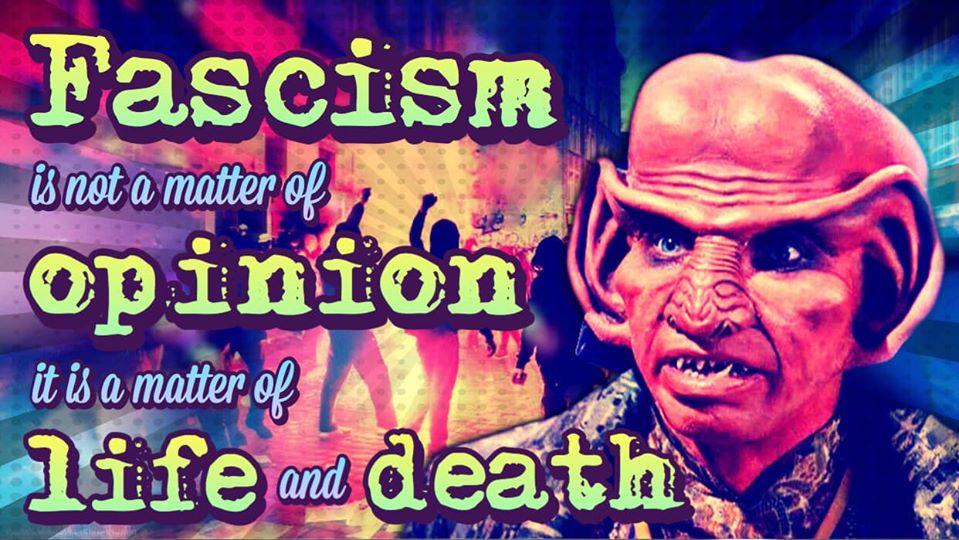
This meme is a commentary on the concept of fascism, using the iconic character from Star Trek: The Next Generation, as a humorous way to illustrate the absurdity of fascist ideologies. The image features the character's quote "Fascism is a matter of opinion" with the phrase "It is a matter of life and death" in response, implying that fascism is not just a matter of opinion, but a serious threat to life and death.
detailed-analysis (gemma3-27b-vision)
Okay, let's break down this image with analysis using the frameworks you requested. It's a powerful and disturbing piece, so a multi-layered examination is fitting.
Visual Description
The image depicts a highly distorted, expressive portrait of a man who appears to be modeled on Benito Mussolini. His face is rendered in a dramatic, almost grotesque style, with exaggerated features, heavy shadows, and intense eyes. He is wearing a military style cap. The color palette is dominated by dark reds, purples, and greens, creating a somber and unsettling mood. Overlaid on this portrait is bold, stylized text that reads: "Fascism is not a matter of opinion, it is a matter of life and death." The background is blurred, suggesting a crowded, urban environment. The overall aesthetic suggests propaganda or a political poster with strong emotional intent.
Foucauldian Genealogical Discourse Analysis
This image is a clear instance of a discourse attempting to establish the absolute truth and urgency of anti-fascist sentiment. Foucault would analyze this as an attempt to construct a specific understanding of Fascism. The claim that fascism is not a matter of "opinion" is a crucial move. It attempts to remove Fascism from the realm of subjective debate and position it as an objective reality with existential consequences. The phrase, "life and death," is a power/knowledge pairing. It asserts that understanding and resisting fascism is not merely intellectual exercise, but a matter of survival.
The image's stark visual style (distortion, dramatic coloring) operates as a discursive practice. It performs the idea that Fascism is a dangerous, monstrous force, rather than simply stating it. Foucault would be interested in how this image contributes to the historical construction of "Fascism" as a specific problem needing a specific response, and the power relations embedded in that construction. We see the construction of an "us" vs. "them", and the necessity of taking a stand.
Critical Theory
From a Critical Theory perspective (particularly drawing on the Frankfurt School), this image can be seen as an example of "enlightenment rationality turned oppressive." The claim to absolute truth ("not a matter of opinion") evokes the dangerous side of rationalism, where the pursuit of objective truth can be used to justify domination and violence. The image positions Fascism as a threat to the very foundations of a rational, democratic society.
The use of stark imagery and emotive language is intended to bypass critical thinking and trigger an emotional response, thus bypassing the 'rational actor' and leading to a specific (anti-fascist) action. Critical Theory would see this as a potential form of manipulation, even if the intention is noble. The image assumes a shared understanding of what constitutes "life" and "death," potentially masking power imbalances in determining those definitions.
Marxist Conflict Theory
From a Marxist lens, the image highlights the fundamental class conflict underlying political ideologies like Fascism. The assertion that Fascism is about "life and death" emphasizes the very real material consequences of political struggle. Fascism, historically, is linked to the defense of capitalist interests against socialist or communist movements. The image suggests that the struggle against Fascism is not merely an intellectual or moral battle, but a battle for control of material resources and the means of production.
The implied "us vs. them" dynamic in the image can be interpreted as a representation of class struggle. Those who oppose Fascism are implicitly positioned as allies of the oppressed, fighting for a more equitable society. The image aims to mobilize collective action by emphasizing the stakes of the conflict – literally, life and death.
Postmodernism
A Postmodern critique would challenge the image’s claim to absolute truth. The statement "Fascism is not a matter of opinion" would be deconstructed as a power play designed to silence dissent and impose a particular narrative. Postmodernism argues that truth is always relative, constructed through language and discourse, and always situated within specific power relations.
The image's dramatic visual style could be seen as a form of simulacra – a representation that has become detached from any underlying reality. The intensity of the imagery and the starkness of the message serve to create a hyperreality that eclipses any nuanced understanding of Fascism. The attempt to define Fascism as an absolute is seen as an attempt to totalize understanding, which Postmodernism resists.
Queer Feminist Intersectional Analysis
This framework highlights how Fascism uniquely impacts marginalized groups, especially LGBTQ+ individuals and women. Fascism historically sought to reinforce traditional gender roles and suppress non-normative sexualities.
The image’s framing of Fascism as a matter of “life and death” resonates strongly with the lived realities of those targeted by Fascist regimes. For LGBTQ+ people and women, Fascism represented an existential threat – a denial of their right to exist, to love, and to express their identities.
Intersectionality emphasizes that the impact of Fascism is not uniform. The experience of a queer person of color under a Fascist regime would be different from that of a white, heterosexual man. The image, while potentially mobilizing, could be criticized for lacking nuance and failing to acknowledge the specific ways in which Fascism intersects with other forms of oppression.
I hope this multi-layered analysis provides a useful and thought-provoking interpretation of the image. Let me know if you'd like me to elaborate on any of these perspectives.
simple-description (llama3.2-vision)
This meme features a quote from the 1984 film "The Empire Strikes Back" in a playful, ironic way. The text reads: "Fascism is not the opposite of fascism, it is fascism." However, the quote is actually from a character named Admiral Motti, who says "Fascism is not the opposite of fascism, it is fascism" in the movie.
tesseract-ocr
Bee hae COG, I ces glo TTD f P ee as sel” (-