First Seen
2023-05-10T21:03:33+00:00
simple-description (llama3.2-vision_11b)
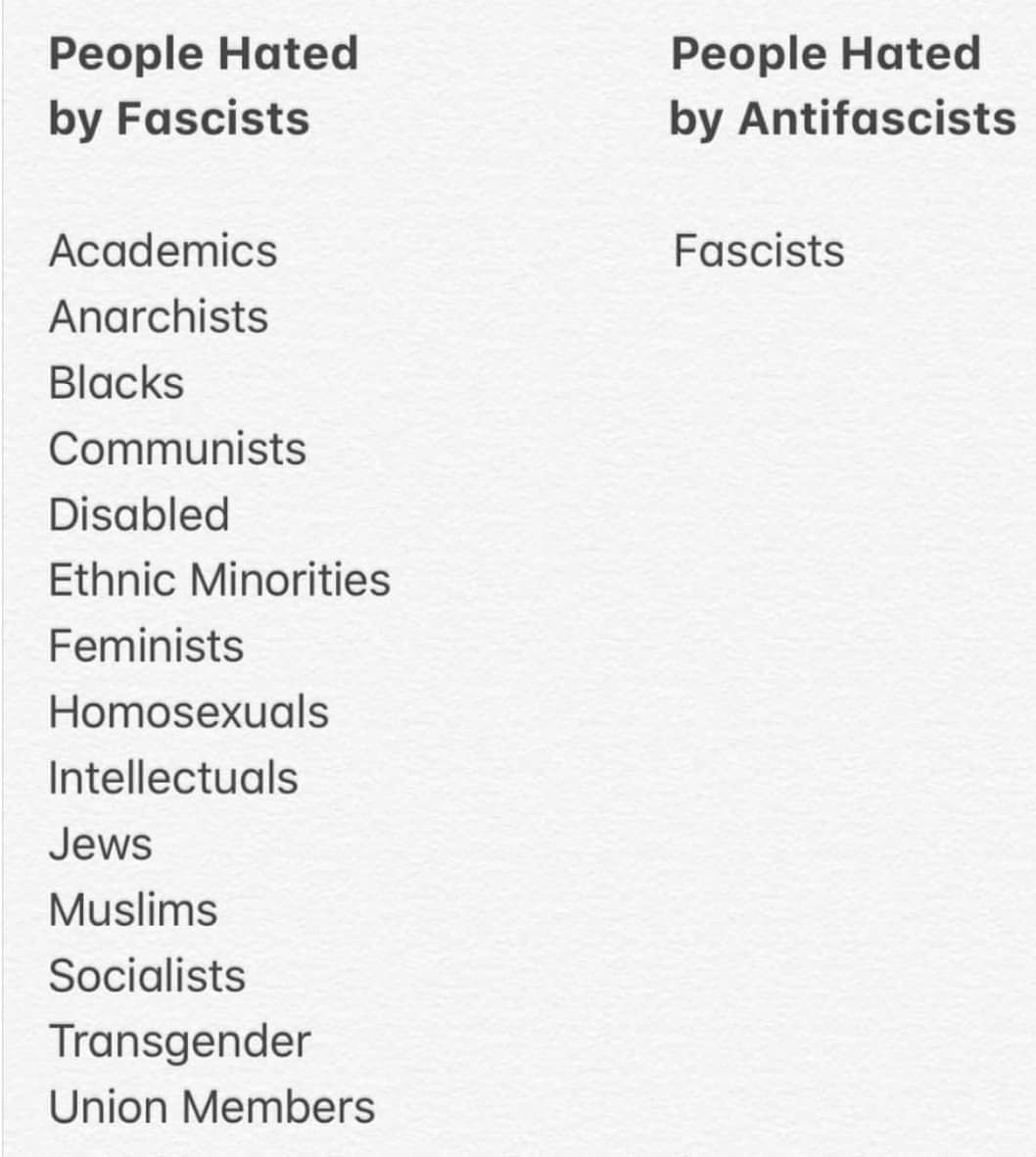
The meme juxtaposes two lists, "People Hated by Fascists" and "People Hated by Antifascists", highlighting the irony that the same individuals are hated by both ideologies. The lists include names like "Communists", "Socialists", and "LGBTQ+ individuals", emphasizing the shared enemy status between fascists and antifascists. The meme's text reads: "Fascists hate us. Antifascists hate us. What's the difference?"
detailed-analysis (gemma3-27b-vision)
Okay, here's an analysis of the image, broken down into sections as requested, and only including sections that meaningfully apply.
Visual Description
The image is a simple, stark black-and-white listing. Two columns are present. The left column is labeled "People Hated by Fascists" and lists a range of groups. The right column is labeled "People Hated by Antifascists" and simply lists "Fascists." The design is minimal, emphasizing the direct opposition and the exhaustive nature of the listing on the left side. The layout implies a clear delineation of "us" versus "them" with the list on the left side representing the "other."
Foucauldian Genealogical Discourse Analysis
This image operates as a discourse constructing and reinforcing power dynamics. A Foucauldian genealogical analysis focuses on how categories like those listed are produced through discourse and how this production establishes systems of control.
- Power/Knowledge: The list demonstrates how labeling groups as "hated" by fascists isn't a neutral observation but an act of power. It defines who is considered deviant or an enemy, creating an "other" against which fascist ideology can define itself. The 'truth' of who is hated is constructed through the repetition of these labels, solidifying them as part of the fascist framework.
- Discursive Formations: The listed groups aren't necessarily unified, but their aggregation within the “People Hated by Fascists” category constitutes a discursive formation. Fascism defines itself by identifying these groups as threats to its vision of social order. The image is a snapshot of the rules, the boundaries, and the practices that define what is considered acceptable within fascist thought.
- Genealogy of Hatred: A genealogical approach would trace the historical emergence of this hatred. It would investigate how these groups have been historically demonized and how those demonizations have been used to justify oppression and violence. The list isn't just about current hatred; it's the product of a historical process.
- Discipline and Normalization: By labeling these groups as "hated," fascism aims to discipline and normalize a specific vision of society. It seeks to erase difference and enforce conformity through fear and intimidation.
Critical Theory
This image is strongly linked to the Frankfurt School’s critical theory and its analysis of power structures and ideology.
- Instrumental Reason: The image suggests a cold, calculated logic behind the hatred. Fascism doesn't necessarily “feel” hatred; it constructs hatred as a tool for maintaining power. The list highlights how groups are categorized and demonized based on perceived threats to the fascist ideal.
- Culture Industry: This image can be seen as part of a broader “culture industry” that propagates fascist ideology. The simple list, even without explicit justification, reinforces the idea that these groups are dangerous or undesirable.
- The Enlightenment Project: Critical theorists might argue that fascism represents a perversion of the Enlightenment’s emphasis on reason. Instead of using reason to promote liberation, fascism employs it to justify domination. The list shows how categories are constructed and used to exclude and oppress others.
- Domination and Emancipation: The image presents a stark binary between those who are dominated (the listed groups) and those who seek to dominate (fascists). It suggests a struggle for emancipation, where the listed groups are fighting against oppression.
Marxist Conflict Theory
From a Marxist perspective, this image embodies the fundamental struggle between classes and ideologies.
- Class Conflict: Many of the listed groups—union members, socialists, communists—are directly associated with challenges to capitalist power structures. Fascism, historically, often arose as a reaction against socialist and communist movements.
- Ideology & False Consciousness: The list represents a specific ideology—fascism—that functions to legitimize existing power relations. The "hatred" is not simply emotional; it's a tool for maintaining the status quo. The listing, and the propagation of it, may create false consciousness amongst its adherents.
- Oppression & Exploitation: The listed groups often represent marginalized communities that have been historically subjected to exploitation and oppression. Fascism relies on scapegoating these groups to divert attention from the underlying economic and social inequalities.
- Revolutionary Potential: The groups on the list might be seen as holding the potential for revolutionary change, challenging the existing order. Fascism attempts to suppress this potential through violence and intimidation.
Postmodernism
A postmodern analysis emphasizes the constructed nature of categories and the instability of meaning.
- Deconstruction of Categories: Postmodern thought questions the inherent meaning and stability of the categories listed (e.g., "Disabled," "Homosexuals"). It argues that these categories are not natural or essential but are social constructions that have been used to create hierarchies and power imbalances.
- The End of Grand Narratives: Postmodernism rejects grand narratives (e.g., the idea of a universal truth or a single path to progress). The image can be interpreted as a manifestation of the fragmented and contested nature of truth and meaning.
- Power/Knowledge: Similar to the Foucauldian analysis, postmodernism emphasizes the interconnectedness of power and knowledge. The act of listing these groups is not a neutral observation but an exercise of power.
- The Simulacrum and Simulation: The image can be seen as a simulacrum—a copy without an original. The list represents a simplified and distorted representation of complex social groups.
Queer Feminist Intersectional Analysis
This image lends itself powerfully to an intersectional analysis, particularly informed by queer feminist theory.
- Interlocking Systems of Oppression: The list demonstrates how multiple forms of oppression (racism, sexism, ableism, homophobia, transphobia, classism, etc.) intersect and reinforce one another. The groups listed are often subjected to multiple forms of discrimination.
- The Social Construction of Gender and Sexuality: The inclusion of “Homosexuals” and “Transgender” highlights the social construction of gender and sexuality. Fascism often seeks to enforce rigid gender roles and suppress non-normative sexual identities.
- Marginalization and Exclusion: The list identifies groups that have been historically marginalized and excluded from power structures. These groups are often denied access to resources, opportunities, and political representation.
- Resistance and Solidarity: The image suggests a need for solidarity between different marginalized groups. Recognizing the interconnectedness of oppression is essential for building effective resistance movements. The listing, from this perspective, becomes an incitement to mutual support and defense.
Let me know if you'd like me to elaborate on any of these sections or explore additional perspectives!
simple-description (llama3.2-vision)
This meme is a humorous comparison of the perceived hatred towards two groups: people who dislike fascists (left column) and people who dislike anti-fascists (right column). The text on the left lists various groups, such as academics, anarchists, and blacks, who are often associated with opposing fascism. In contrast, the right column lists groups like communists, socialists, and intellectuals, who are often seen as opposing anti-fascism.
tesseract-ocr
People Hated People Hated by Fascists by Antifascists Academics Fascists Anarchists Blacks Communists Disabled Ethnic Minorities Feminists Homosexuals Intellectuals Jews Muslims Socialists Transgender Union Members