First Seen
2023-05-10T21:03:33+00:00
simple-description (llama3.2-vision_11b)
The meme features a screenshot of a character from the Star Trek franchise, specifically Deanna Troi, with a caption "I'm not a lawyer" overlaid. This meme is a play on the classic phrase "I'm not a doctor" and is used in the context of anti-fascism to convey a sense of skepticism or distrust towards those who claim to be experts in a particular field, often in a humorous or ironic way.
detailed-analysis (gemma3-27b-vision)
Okay, let's break down this image with the requested analytical frameworks. It's a complex image, and applying these theories will require interpretation. I will preface this by stating that the addition of the text "ANTIFA" dramatically shifts the interpretation. I'll address this at the beginning.
Initial Note on "ANTIFA" Overlay: The text "ANTIFA" is a significant addition. It positions the image, whatever its original context, within contemporary political discourse, specifically associating it with anti-fascist movements. This immediately prompts a reading focused on power dynamics, resistance, and potential conflict. It fundamentally changes how we might approach the image without that text.
1. Visual Description
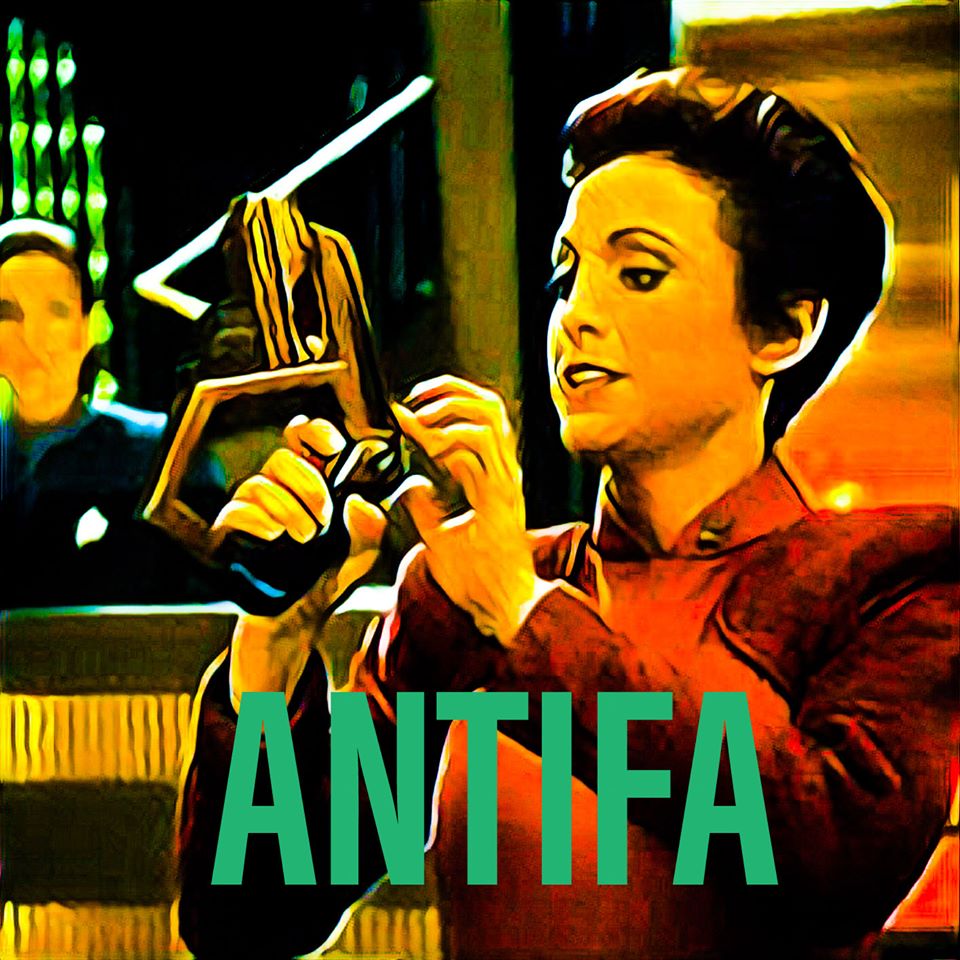
The image appears to be a still from an older film or television show, possibly from the mid-20th century. It's a close-up shot of a woman, likely a newscaster or speaker, with her head tilted and speaking, gesturing with her hands. The lighting is dramatic, with strong highlights and shadows, and there is use of color washes and dramatic angles. She has dark hair styled in a classic manner. The background includes what appears to be a newsroom set with outdated technology, including screens and microphones. To the left is a blurred image of a man in a suit. The image has been manipulated with filters or color grading to create a surreal and somewhat unsettling effect. Large teal text superimposed over the image says "ANTIFA".
2. Foucauldian Genealogical Discourse Analysis
- Power/Knowledge: Michel Foucault's concepts of power/knowledge are central here. The woman in the image represents a form of institutionalized power – she is a broadcaster, a disseminator of information. Her role is to construct and legitimize certain narratives, shaping public understanding. The text "ANTIFA" suggests a challenge to that established power. ANTIFA, as a movement, represents a counter-discourse, a disruption of the dominant narrative. It's an attempt to reclaim the power to define reality.
- Discourse & Genealogy: A genealogical analysis would trace the history of how the discourse surrounding media, authority, and resistance has evolved. How did the role of the newscaster come to be seen as an authority? What historical conditions led to the emergence of movements like ANTIFA, and what language and tactics do they employ?
- Discipline & Surveillance: The newscaster's role can also be seen as part of a disciplinary regime – a system of social control that regulates behavior through information and narrative. The image, with the overlay, highlights the potential for resistance against this control. It implies an act of surveillance and intervention.
3. Critical Theory
- The Culture Industry: The image fits into the Frankfurt School's critique of the "culture industry." The woman represents mass media, a tool used to manufacture consent and maintain the status quo. The image's manipulation and the addition of "ANTIFA" could be interpreted as a critique of this process, a disruption of the homogenous cultural product.
- Ideology: The image can be seen as embodying ideological structures. The newscaster, through her position and presentation, reinforces certain values and beliefs. The “ANTIFA” text presents a direct challenge to these values, an attempt to expose the underlying power dynamics that maintain them.
- Hegemony: Gramsci's concept of hegemony is relevant. The newscaster represents a hegemonic force—a dominant ideology accepted as "common sense." “ANTIFA” signals resistance to that hegemonic order, a struggle for alternative narratives.
4. Marxist Conflict Theory
- Class Struggle: While not immediately obvious, the image can be interpreted through the lens of class struggle. The newscaster, as part of the establishment media, can be seen as representing the interests of the ruling class. The “ANTIFA” text aligns with a counter-movement seeking to challenge that power structure, representing the interests of the oppressed or marginalized.
- Superstructure & Base: The image highlights the relationship between the superstructure (institutions like the media) and the base (economic relations). The media shapes public opinion, which in turn supports the existing economic order. “ANTIFA” represents a challenge to that structure.
- False Consciousness: The image can be seen as a representation of the "false consciousness" that Marxist theory describes—the way the ruling class uses ideology to obscure the true nature of exploitation. The “ANTIFA” text suggests an attempt to break through that illusion and raise awareness.
5. Postmodernism
- Simulacra & Hyperreality: The image's manipulation and the overlay of text contribute to a sense of artificiality. It blurs the line between reality and representation, potentially reflecting a postmodern condition where images and signs have become detached from their referents. The “ANTIFA” text can be read as a deliberate intervention within this hyperreal landscape.
- Deconstruction: The image can be "deconstructed" to reveal the underlying assumptions and power dynamics embedded within it. The “ANTIFA” text disrupts the traditional meaning of the image, forcing a re-evaluation of its underlying message.
- Fragmentation & Loss of Grand Narratives: The image, with its altered form and political overlay, reflects the postmodern skepticism towards overarching narratives and universal truths. It suggests a fragmented and contested reality.
6. Queer Feminist Intersectional Analysis
- Intersectionality: This analysis requires us to consider how systems of power (like patriarchy, capitalism, white supremacy, and heteronormativity) intersect to create unique forms of oppression. The figure of the female newscaster in a traditionally patriarchal media landscape is relevant here.
- Challenging Hegemonic Representation: The intersectional lens asks: who is not represented in this image? How does the media historically marginalize certain groups? The addition of "ANTIFA" could represent a reclaiming of space and a rejection of dominant narratives that erase or oppress marginalized identities.
- Resistance & Counter-Hegemony: ANTIFA, as a movement, often centers the struggles of marginalized communities. The placement of the text on this image can be seen as a symbolic act of resistance against oppressive power structures. It signals a solidarity with those who are historically silenced or oppressed.
Conclusion:
The image, particularly with the "ANTIFA" text, is ripe for multiple interpretations. The theoretical frameworks provide a lens for understanding the power dynamics, ideologies, and historical context embedded within the image. It can be seen as a critique of the media, a symbol of resistance, or a commentary on the fragmented nature of contemporary reality. The meaning, ultimately, is open to interpretation and depends on the reader's own perspective and theoretical framework.
Disclaimer: These interpretations are based on the image as presented and the chosen theoretical frameworks. Different readings are possible, and the interpretations are not definitive.
simple-description (llama3.2-vision)
This meme features a screenshot of a character from the TV show Star Trek: The Next Generation, specifically Deanna Troi, with a puzzled expression. The text "I find your lack of faith disturbing" is written on the screen, but it's actually a quote from a different character, Darth Vader. The meme is a play on words, using the phrase "I find your lack of faith disturbing" but replacing "faith" with "faith" to create a pun on the character's name.
tesseract-ocr
Wed Weeg ei) f in =. —" ¥ 7 a eS wy . | =. a a el Ua