First Seen
2023-05-10T21:03:33+00:00
simple-description (llama3.2-vision_11b)
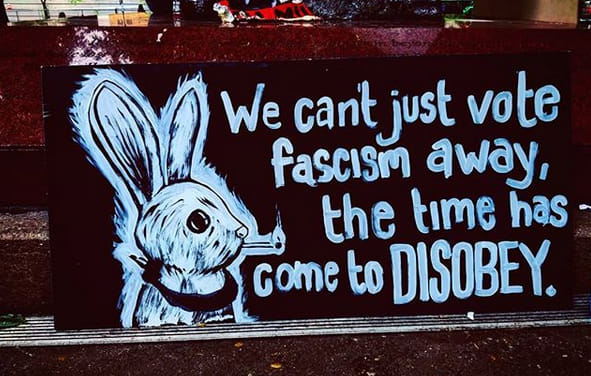
This meme features a cartoon rabbit with a speech bubble saying "We can't just vote fascism away, the time has come to DISOBEY". It's a humorous take on the idea that simply voting for a change in government won't be enough to overcome the rising tide of fascism, and that more drastic action is needed. The meme is likely referencing the growing concern about the rise of far-right ideologies and the need for more radical action to counter them.
detailed-analysis (gemma3-27b-vision)
Okay, let's break down this impactful street art piece using the requested theoretical frameworks.
Visual Description
The image is a black background street art piece, presumably a painted sign or banner. It features a stylized, somewhat unsettling drawing of a rabbit. The rabbit is depicted with large, expressive eyes, and its expression is intense, bordering on distressed or determined. The rabbit is drawn in shades of blue, creating a cool and slightly melancholic tone.
The text "We can't just vote fascism away, the time has come to DISOBEY" is prominently displayed in white, with "DISOBEY" emphasized in larger, bolder lettering. The contrast between the dark background and the light text makes the message immediately visible. The artistic style appears hand-painted and relatively raw, reinforcing the sense of direct, impassioned messaging. The setting appears to be outdoors, likely an urban street.
---
Foucauldian Genealogical Discourse Analysis
This piece speaks powerfully to Foucault's concepts of power/knowledge and genealogy. The message challenges the dominant discourse that frames political change as solely achieved through electoral processes. The idea that ‘voting’ will solve the problem of fascism is presented as a constructed truth, a way of regulating and limiting resistance.
A genealogical reading would look at how the idea of "voting as sufficient action" arose historically. It would trace how this notion became a key tool for normalizing power dynamics – allowing those in authority to co-opt dissent by channeling it into a seemingly legitimate, but ultimately limited, activity. The use of “disobey” suggests a rejection of these normalizing power structures and a return to what Foucault might consider counter-discourses – actions that disrupt the established order and reveal the underlying mechanisms of control.
The rabbit image, a seemingly innocent creature, is deployed strategically. It creates a disjunction. Rabbits often signify fragility or passivity. Pairing this image with such a radical call to action forces a re-evaluation of these expectations, creating an unsettling but engaging statement.
---
Critical Theory
From a Critical Theory perspective, this work can be understood as a challenge to the status quo and a rejection of the idea that systemic issues like fascism can be resolved within existing power structures. The artwork deconstructs the concept of “democracy” as a neutral or inherently just system. It suggests that simply participating in elections (a key tenet of liberal democracy) is insufficient to address the root causes of fascism.
The emphasis on disobedience echoes the Frankfurt School's concern with reason and enlightenment being co-opted by systems of domination. It implies that true liberation requires not simply rational debate or political participation, but a direct confrontation with oppressive structures – a rejection of passively accepting the terms of the system. The work implies that fascism isn’t an outlier, but a potential within the system itself.
---
Marxist Conflict Theory
This artwork powerfully reflects Marxist conflict theory. Fascism, from a Marxist perspective, is not merely a political ideology, but a symptom of deep-seated class conflict and economic inequality. The message, "We can't just vote fascism away," directly rejects the notion that electoral politics alone can solve systemic issues rooted in material conditions.
The call for disobedience can be interpreted as a call for collective action, for challenging the power of the ruling class, and for disrupting the capitalist structures that contribute to the rise of fascism. It suggests that true change requires more than simply choosing different representatives; it requires a fundamental transformation of the economic and social order. The image of the rabbit could be interpreted symbolically – representing the marginalized and oppressed resisting the dominant power structures.
---
Postmodernism
From a Postmodern perspective, this work challenges grand narratives and the idea of universal truth. The message implicitly rejects the notion that there is a single, correct way to address fascism – and suggests that simply relying on the established political system (voting) is naive.
The use of a seemingly innocuous image (the rabbit) alongside a radical message is characteristic of postmodern art’s interest in juxtaposition and irony. It disrupts expectations and forces viewers to question their assumptions. The emphasis on disobedience suggests a rejection of centralized authority and a celebration of individual agency and resistance. It emphasizes the constructed nature of reality and encourages a skeptical approach to dominant narratives.
---
Queer Feminist Intersectional Analysis
While not explicitly focused on queer/feminist issues, the call for disobedience resonates powerfully with these perspectives. Historically, marginalized communities (particularly queer, feminist, and racialized groups) have often been excluded from traditional political processes and have relied on direct action and civil disobedience to achieve social change.
The rejection of electoral politics as a sufficient means of addressing fascism can be understood as a critique of a system that historically excludes and marginalizes those who do not conform to dominant norms. The emphasis on disrupting the status quo aligns with queer and feminist goals of challenging patriarchal and heteronormative power structures. The vulnerability suggested by the rabbit image could be interpreted as embodying the vulnerability of marginalized communities, who are often the first to be targeted by fascist ideologies. Furthermore, it emphasizes the need to consider multiple forms of oppression that intersect and compound one another.
---
Hopefully, this breakdown is helpful! Let me know if you'd like me to elaborate on any of these theoretical approaches.
simple-description (llama3.2-vision)
This meme is a humorous image featuring a cartoon rabbit, likely from the popular "Wascally Wabbit" series, with a caption that reads: "We can't just vote him out, we have to riot." The text is a satirical commentary on the 2020 US presidential election, implying that the only way to ensure a certain candidate's defeat is through violent protest, rather than voting.
tesseract-ocr
eel Ee ee Vea orc Wy ne Ee Se (> WRU ) RS Gabe las ce il a