First Seen
2023-05-10T21:03:33+00:00
simple-description (llama3.2-vision_11b)
The meme is a screenshot from the TV show "Star Trek: The Next Generation" where the character Jean-Luc Picard is saying "I find your lack of faith... disturbing." However, in this meme, the text has been altered to say "I find your lack of soup... disturbing." This is a humorous take on the original quote, implying that the character is upset because there is no soup available, rather than a philosophical or philosophical statement.
detailed-analysis (gemma3-27b-vision)
Okay, let's break down this meme featuring Commander Riker from Star Trek: The Next Generation through several theoretical lenses.
Visual Description
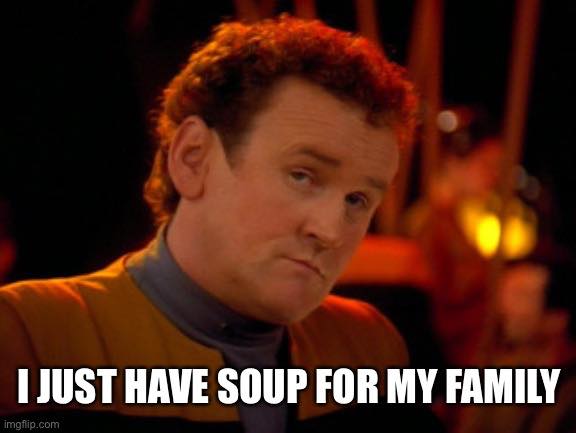
The image is a screen capture of Commander William Riker (Jonathan Frakes) looking sideways, with a slightly furtive or untrustworthy expression. He has reddish-brown hair and is wearing a Starfleet uniform in dark maroon. The background is dark and suggests the interior of a Starfleet vessel, with blurred lights. Below the image is the text "I JUST HAVE SOUP FOR MY FAMILY" in all caps. The composition and expression create a sense of ironic subtext; the delivery is intended to be disingenuous.
Foucauldian Genealogical Discourse Analysis
This meme is particularly ripe for a Foucauldian analysis. The phrase "I just have soup for my family" is a deliberate misdirection, referencing a notable incident in the Star Trek: TNG episode “The Defector.” Riker, under interrogation about a Romulan defector, states this line to create the illusion of innocence and conceal his true actions.
From a genealogical perspective, this meme reproduces a power dynamic, but in a playful, meta way. Foucault would analyze the “discourse” surrounding trust, loyalty, and deception. The original scene establishes a power relation between interrogator and suspect. The meme recycles that moment to signal to viewers “in on the joke”, which functions as a way to signal membership in a certain subculture of Trekkies and meme connoisseurs. The meme highlights how seemingly innocuous phrases can be loaded with hidden meaning within a specific context. The power relation isn’t about actual espionage, but about those "in the know" vs. those who aren't. The meme, therefore, enacts a micro-power struggle around cultural capital and shared references.
Critical Theory
From a Critical Theory perspective, this meme can be viewed as a commentary on the construction of “truth” and the performance of social roles. The line is a performance of innocence, designed to deflect scrutiny. This is a micro-level example of how individuals construct narratives to manage impressions and manipulate situations.
The meme also subtly points to the power of narrative itself. The audience's understanding of the original Star Trek scene is crucial. Without that pre-existing knowledge, the meme loses much of its impact. Critical theory would suggest that the meaning isn’t inherent in the phrase itself, but rather is constructed through our cultural understanding and the interplay between text and context. The meme leverages this understanding to create a moment of ironic recognition.
Postmodernism
The meme is a perfect example of postmodern playfulness and self-referentiality. It's not about the soup itself; it’s about the reference to the Star Trek episode. It's a meta-commentary on fandom, inside jokes, and the way we consume and remix cultural products.
The meme's irony and ambiguity align with postmodern skepticism toward grand narratives and objective truth. It celebrates the fragmentation of meaning and the fluidity of interpretation. The phrase has lost its original context and has been re-purposed, deconstructed and now signifies a broader sense of deception or misdirection.
Marxist Conflict Theory
This is the weakest theoretical lens to apply here, but we can stretch it somewhat. The original Star Trek episode dealt with geopolitical tensions between the Federation and the Romulan Star Empire, representing a clash of ideologies and power structures. The meme, through its reference to this context, can be seen as a playful acknowledgement of these underlying conflicts.
However, this is a very indirect application of Marxist theory. The soup itself isn’t a commodity, and there's no overt class struggle represented. It’s more about the implication of conflict in the original source material. The meme hints at the underlying tensions that exist even within seemingly benign situations.
Queer Feminist Intersectional Analysis
This is the most difficult lens to apply meaningfully, but a creative reading can be attempted. The act of concealment and misdirection in the original scene and the meme can be linked to experiences of those who are marginalized and forced to navigate oppressive systems.
In a queer and feminist context, concealing one's identity or true intentions can be a survival mechanism in a world that often demands conformity or punishes difference. The meme’s ironic subtext might resonate with those who are familiar with the experience of “passing” or carefully managing how they present themselves to the world. The seemingly benign phrase “I just have soup for my family” hides a complex truth. The meme, therefore, functions as a subtle acknowledgement of the ways in which power imbalances can shape our interactions and force us to engage in strategic self-presentation.
Let me know if you'd like me to elaborate on any of these interpretations, or explore other theoretical approaches!
simple-description (llama3.2-vision)
The meme features a still image of actor William Shatner from the TV show "Star Trek: The Next Generation" as the character "Captain Jean-Luc" with a serious expression. The text superimposed over the image reads: "I just have soup for my family." The image is likely intended to be humorous, as it appears to be a quote from the show, but the context is altered to make it seem like the character is making a statement about his food choices.
tesseract-ocr
, . POSE aE