First Seen
2023-05-10T21:03:33+00:00
simple-description (llama3.2-vision_11b)
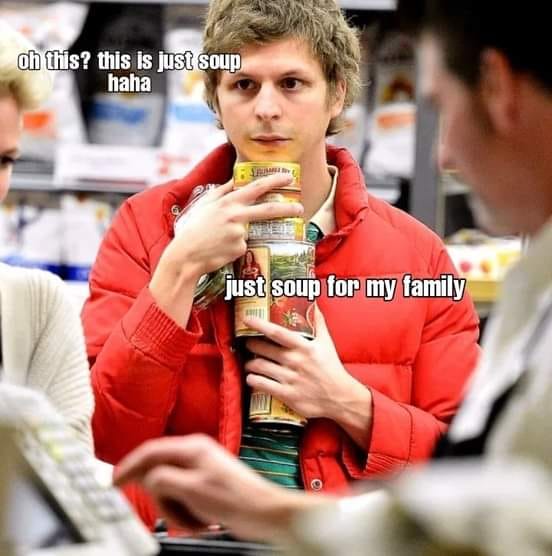
The meme is a screenshot of a person in a grocery store, holding a can of soup, with a caption "Oh, this? This is just soup. Ha ha ha. Just soup for my family. Just soup." The meme is a humorous take on a common grocery store interaction, poking fun at the idea of a person trying to make a simple soup sound like a complex, high-brow culinary experience.
detailed-analysis (gemma3-27b-vision)
Okay, let's break down this image of John Ducey with a jar of Prego sauce, captioned with the now-famous "It's Pasta Sauce, Frank!" meme, through several critical lenses.
Visual Description
The image shows actor John Ducey, looking directly at the camera with a somewhat unsettling, self-aware smirk. He's in what appears to be a grocery store aisle. He is holding a jar of Prego pasta sauce, with the label clearly visible. Overlaid text reads "oh this? this is just soup haha" above him and "just soup for my family" under the jar. The composition focuses on Ducey's face and the jar, drawing attention to the disconnect between his assertion ("soup") and the visible reality ("pasta sauce"). The backdrop is blurry, suggesting a mundane, everyday setting. The color palette is dominated by the bright red of his jacket, contrasting with the jar's colors and the neutral tones of the store.
Foucauldian Genealogical Discourse Analysis
This image, seen through a Foucauldian lens, reveals how the very category of “soup” and “pasta sauce” is constructed through discourse. The meme plays on a disruption of this established categorization. Frank’s insistence that it’s “soup” isn’t about the literal content of the jar, but an attempt to exert a power/knowledge relationship. Frank, as a character, is attempting to define reality through his own assertion, rejecting the standardized categorization established through commercial branding, culinary practices, and everyday language.
The genealogy would trace the historical development of these categories—how ‘soup’ and ‘pasta sauce’ came to be recognized as distinct entities, and how they are tied to specific social and cultural contexts. Frank’s denial is a discursive interruption, a moment where a normalized order of things is challenged. It’s not about the liquid in the jar, but about who gets to define what it is. The meme's popularity derives from the inherent unsettling feeling that some power dynamic is off, or some category is not what we are told it is.
Critical Theory
From a broad Critical Theory perspective, the image highlights the manufactured nature of consumer culture and the ways in which everyday objects (like pasta sauce) become laden with symbolic meaning. The scene takes place in the sterile, artificial environment of a grocery store, exemplifying the alienating aspects of capitalist society.
The meme itself is a form of social commentary. Frank's absurd denial can be interpreted as a rejection of the norms and expectations imposed by consumer culture. He refuses to participate in the established system of categorization and labeling. This, in turn, evokes a sense of unease, as it suggests that even seemingly straightforward things like ‘soup’ or ‘pasta sauce’ are not as objective or natural as we might believe.
Marxist Conflict Theory
Through a Marxist lens, the image can be seen as a subtle representation of class conflict, or at least the alienation inherent in capitalist production. The grocery store is a site where commodities are exchanged, and the act of buying pasta sauce is part of this process. Frank's declaration, while comical, can be read as a rejection of the commodified reality.
The meme suggests a rebellion against the capitalist system's need for categorization and labeling—things are not what they seem. This can be seen as a symbolic rejection of the exploitative nature of capitalism. The conflict is subtle—it isn't a violent uprising—but it reflects a deep-seated frustration with the alienation and dehumanization inherent in the system.
Postmodernism
The meme is a prime example of postmodern playfulness and deconstruction. It actively disrupts meaning and challenges the stability of language. The phrase "It's pasta sauce, Frank!" is a metacommentary on categorization itself. It questions the very act of labeling and defining things, highlighting the arbitrary nature of meaning.
The image embodies the postmodern notion that reality is constructed, not discovered. The meme's absurdity suggests that we can't rely on stable categories or objective truths. It points to the subjectivity of experience and the inherent instability of meaning. It’s the absurdity itself that is the point, rather than a statement of objective reality.
Queer Feminist Intersectional Analysis
While not explicitly central to the image, a queer feminist intersectional reading can explore the disruption of expected narratives and the subversion of conventional roles. Frank's behavior is intentionally strange and unsettling. He is rejecting the expected social script of a normal grocery shopper. This can be interpreted as a subtle disruption of heteronormative expectations, a rejection of the "normal" way of doing things.
The meme plays with subtext, hinting at something 'off' without explicitly stating it. This ambiguity allows for multiple interpretations and can be seen as a way of challenging rigid social categories. Frank's seemingly illogical statement is a refusal to conform, a rejection of the expectations placed upon him as a "normal" consumer.
Let me know if you'd like me to elaborate on any of these analyses or explore a different theoretical framework.
simple-description (llama3.2-vision)
This meme features a still of actor Michael C. Hall from the TV show "Dexter" holding a can of soup. The image is captioned with two lines of text: "oh this? this is just soup" and "haha just soup for my family". The meme is meant to be humorous, as it appears to be a moment of casual conversation between people in a grocery store, but the words "haha" and "just" are replaced with words that sound similar but have a different meaning, creating a comical effect.
tesseract-ocr
cE et fonithis? this\is just{soup be q haha a = . a x. & * ; —— a. he Enrrengey / - ae y . ” . yp ao i/ \ o~ ‘ ™ ' Se ~~. e