First Seen
2023-05-10T21:03:33+00:00
simple-description (llama3.2-vision_11b)
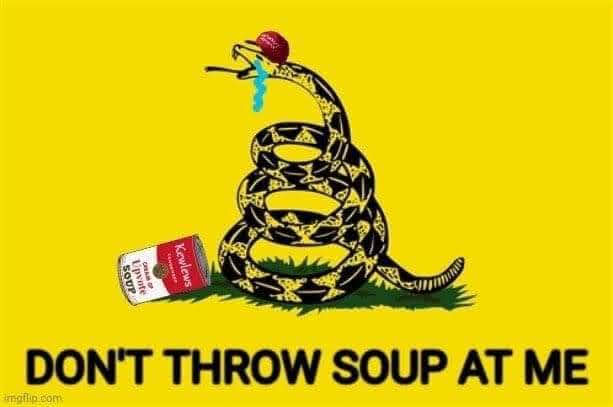
The meme is a play on the classic "Don't Tread on Me" Gadsden flag, but with a humorous twist. The image features a snake with a can of soup, a reference to the popular meme "I can smell the soup" from the video game " Portal". The text "Don't Tread on Me" is replaced with "Don't Tread on Me (Soup)" and the image is captioned "Don't Tread on Me (Soup)".
detailed-analysis (gemma3-27b-vision)
Here's an analysis of the image, broken down into sections as requested. Note that not all categories apply equally, or at all, and I’ll explain why where relevant.
Visual Description
The image is a digital manipulation combining the imagery of the "Don't Tread on Me" Gadsden flag with a can of Campbell's tomato soup. The flag's coiled rattlesnake, typically depicted as a symbol of American liberty and resistance to oppression, is shown with a stream of tomato soup (presumably from the opened can lying on the grass) coming out of its mouth. The vibrant yellow background of the flag remains. Below the image, in bold white letters, is the text "DON'T THROW SOUP AT ME."
The visual juxtaposition is strikingly absurd and humorous. The image subverts the original meaning of the Gadsden flag and replaces a message of political resistance with a nonsensical request related to culinary projectiles.
Foucauldian Genealogical Discourse Analysis
This image is a prime example of how power and discourse are constantly reshaped through playful remixing. Let’s consider how a Foucauldian genealogical approach can unpack it.
- The Original Discourse: The Gadsden flag originally represented a specific political discourse – revolutionary defiance, individual liberty, and a warning against perceived tyranny. This discourse was rooted in a historical context (the American Revolution) and was tied to power relations.
- Disruption & Re-Contextualization: The image disrupts this established discourse by substituting “oppression” with “soup.” This act of re-contextualization doesn't erase the original meaning entirely, but it drastically alters it. It questions the very conditions under which this “warning” applies.
- Power/Knowledge: Foucault argues that power and knowledge are inseparable. Here, the original flag carried the "knowledge" of resistance, enforcing particular power relations (nationalism, libertarianism, etc.). The image fractures this knowledge by applying it to something utterly mundane, destabilizing the power structures built upon it.
- Genealogical Trace: By tracing the image back to its origin (the flag, the soup can – an iconic Pop Art reference to Warhol), we see how meaning has shifted and mutated over time. The image is not a simple copy, but a modification that reflects a different set of concerns (perhaps irony, absurdity, or a critique of the flag’s modern usage).
Critical Theory
From a critical theory perspective (particularly drawing on the Frankfurt School), this image can be interpreted as a commentary on the commodification of rebellion and the erosion of authentic political protest.
- Culture Industry: The soup can, referencing Warhol’s Campbell’s Soup Cans, ties the image into the realm of mass culture and the "culture industry" that Adorno and Horkheimer critiqued. It suggests that even symbols of resistance can be reduced to commodities, stripped of their original meaning, and consumed as entertainment.
- False Consciousness: The absurd juxtaposition might point to a "false consciousness" where serious political messages are diluted and trivialized in a saturated media environment. People may be so accustomed to irony and parody that they struggle to discern genuine political urgency.
- Critique of Ideology: The image can be read as a critique of the ideology embedded in the Gadsden flag itself. It may question the assumptions about liberty, freedom, and resistance that the flag typically promotes.
Marxist Conflict Theory
Applying Marxist conflict theory, the image could be seen as a subtle commentary on class and consumerism. The contrast between the potentially revolutionary symbolism of the flag and the mundane, commercially-produced soup can highlight the ways in which capitalist consumer culture penetrates and co-opts even expressions of resistance.
- Commodity Fetishism: The soup can, as a commodity, embodies the concept of "commodity fetishism" – where value is attributed to objects rather than to the labor that produced them. By placing this commodity alongside the symbol of rebellion, the image questions the relationship between consumerism and political action.
- Class Conflict: The Gadsden flag is often associated with libertarian and anti-government sentiments. However, its appropriation by various social groups, combined with the image’s absurdity, could be interpreted as a commentary on the ways in which class interests are often obscured or misrepresented in political discourse.
Postmodernism
This image is deeply rooted in postmodern principles:
- Pastiche & Intertextuality: The image is a clear example of pastiche – a blend of different styles and references. It combines the historical imagery of the Gadsden flag with the Pop Art aesthetic of Warhol’s soup cans.
- Irony & Parody: The absurdity of the image relies heavily on irony and parody. It subverts the original meaning of the flag for humorous effect, questioning the seriousness of political symbols.
- Deconstruction of Meaning: The image destabilizes the traditional meaning of the flag by juxtaposing it with something completely unrelated. This deconstruction of meaning is a hallmark of postmodern thought.
- Simulation & Hyperreality: In a hyperreal world dominated by images, this meme becomes just another layer of simulation, where the boundary between reality and representation is blurred.
Queer Feminist Intersectional Analysis
While this image doesn’t explicitly engage with queer feminist concerns, it's possible to consider it through an intersectional lens:
- Subversion of Masculine Symbolism: The Gadsden flag is often associated with masculine ideals of strength, independence, and resistance. The image’s absurdity— the snake spitting soup— destabilizes this hyper-masculinity and could be seen as a subtle critique of patriarchal power structures.
- Playfulness as Resistance: Queering traditionally serious symbols like the flag through playful subversion is a strategy employed by queer artists to reclaim space and challenge dominant norms. The image's humor can be seen as a form of playful resistance.
- Intersection of Identities: While the image doesn't explicitly address issues of race, class, or gender, it reminds us that political symbols are always interpreted through the lens of multiple, intersecting identities. The image can be received differently by various individuals and groups based on their lived experiences and social positions.
Important Note: The intersectional reading is more interpretive, as the image doesn’t directly engage with these themes. It is possible to read them into the image through a critical lens, but it requires a degree of speculation.
I hope this breakdown is helpful and provides a comprehensive analysis of the image from various theoretical perspectives.
simple-description (llama3.2-vision)
The meme features a snake eating a can of soup, with the snake's body forming the shape of the Gads
tesseract-ocr
i 5 ss be ‘ ej 4 .