First Seen
2023-05-10T21:03:33+00:00
simple-description (llama3.2-vision_11b)
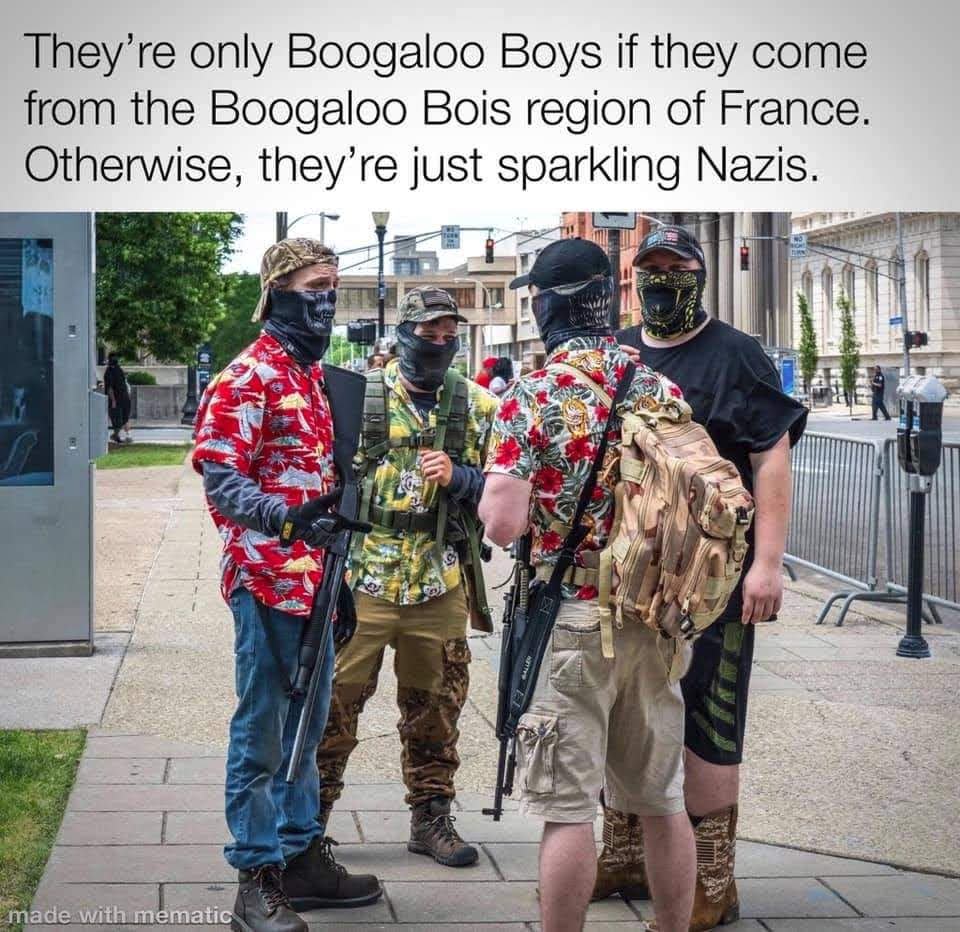
The meme is a humorous commentary on the online culture of extremist groups, specifically the "Boogaloo Bois" (a neo-fascist movement). The image shows a group of people in a park, but the text "They're only Boogaloo Bois if they come from the Boogaloo Bois region of France" is a satirical reference to the absurdity of the Boogaloo Bois' supposed connection to France, implying that they are actually just a bunch of fascist nationalists with a bizarre sense of identity.
detailed-analysis (gemma3-27b-vision)
Okay, here’s a breakdown of the image and the accompanying text, broken down into sections using the headings you requested. It's a complex image loaded with symbolism, and the analysis will reflect that. I'll also indicate where a particular theoretical framework doesn't readily apply.
Please Note: This analysis delves into potentially sensitive and disturbing themes. It is for the purpose of academic examination and does not represent endorsement of any of the ideologies involved.
1. Visual Description
The image shows a group of four men standing in front of a stately building (likely a courthouse or government building) that appears to be in Washington D.C. They are heavily armed with rifles and dressed in a mix of tactical gear and unusual clothing.
- Attire: One man wears a brightly patterned Hawaiian shirt and tactical pants. Another wears camouflage shorts and a camouflage bandana covering his face. The other two wear a mix of camo and neutral colors.
- Weapons: All four men carry rifles, visible and displayed openly.
- Masks/Bandanas: They all wear face coverings – bandanas or masks – obscuring their identities.
- Setting: The setting – in front of a government building – suggests a protest or demonstration. The presence of a metal barrier hints at a pre-existing security or confrontation context.
- Overall Impression: The visual impact is one of deliberate provocation, a strange juxtaposition of tropical leisure wear and serious, even threatening, weaponry. It’s a visually discordant image that immediately draws attention.
2. Foucauldian Genealogical Discourse Analysis
Foucault’s genealogical method would focus on the history of power relations embedded in the image and the associated text. The statement "They're only Boogaloo Boys if they come from the Boogaloo Bois region of France. Otherwise, they're just sparkling Nazis" is rich in power dynamics.
- Discourse & Classification: The statement constructs a specific categorization of these men. It attempts to control the meaning of their identity by assigning meaning based on a (likely fabricated) geographic origin ("Boogaloo Bois region of France"). It defines who is an "acceptable" member of the Boogaloo movement, and who isn't, through arbitrary criteria. This is a key Foucauldian move - how discourse shapes and limits what is considered legitimate.
- Power/Knowledge: The statement subtly wields power through its "knowledge." It posits a conditional criteria for legitimacy, framing the distinction as an inherent truth. This is about how knowledge is used to control and categorize. The implication is that origin (geographic, cultural) is the defining factor, not ideology or action.
- Genealogy of the "Boogaloo Boy": Tracing the history of the "Boogaloo" label reveals its origins in internet subcultures and a specific set of anxieties about government overreach. Examining its evolution would reveal the power relations that shaped its meaning and the ways it was co-opted. The statement in the image intentionally distorts this history.
- The "Sparkling Nazi" Category: The comparison to "Nazis" is a significant power play. It relies on the strong historical and cultural associations with Nazism to demonize those who don’t meet the arbitrary criteria. It's a form of labeling designed to silence and discredit.
3. Critical Theory
Critical Theory, particularly in the Frankfurt School tradition, would analyze the image in terms of societal structures of domination and the ways they are reproduced and challenged.
- Culture Industry & Spectacle: The image itself can be seen as a product of the "culture industry." It’s a constructed spectacle designed to grab attention and provoke a reaction. The bizarre juxtaposition of Hawaiian shirts and weaponry is a deliberately shocking element.
- Ideology & False Consciousness: The statement on the image participates in ideological work. It attempts to normalize the presence of armed groups and create a narrative that justifies their actions, potentially obscuring the underlying power dynamics and the threat they pose.
- Authoritarian Personality: The image could be interpreted as an expression of authoritarian tendencies. The display of force, the masking of identities, and the rigid categorization reflect a desire for control and a distrust of others.
- Critique of Rationality: The seemingly irrational combination of elements (Hawaiian shirts, rifles, geographical criteria) could be seen as a critique of the Enlightenment’s emphasis on rationality. It suggests a breakdown of logical thought and a turn towards emotional appeals and symbolic gestures.
4. Marxist Conflict Theory
From a Marxist perspective, the image represents a manifestation of class struggle and the defense of existing power structures.
- Class & Social Control: The armed group could be interpreted as a self-appointed defense force of the ruling class, protecting its interests against perceived threats from marginalized groups.
- State & Violence: The setting in front of a government building suggests a confrontation with the state. The group's armed presence challenges the state’s monopoly on legitimate violence.
- Ideological Justification: The statement on the image provides an ideological justification for the group's actions. It frames them as protectors of freedom and defenders of traditional values.
- Reproduction of Capitalist Relations: While not directly visible, the image could be seen as contributing to the reproduction of capitalist relations by reinforcing hierarchies and suppressing dissent.
5. Postmodernism
A postmodern analysis would focus on the image’s deconstruction of meaning and its rejection of grand narratives.
- Simulacra & Hyperreality: The image presents a hyperreal spectacle – a distorted and exaggerated representation of reality. The juxtaposition of elements creates a sense of unreality and artificiality.
- Deconstruction of Identity: The statement on the image deconstructs the concept of identity by challenging fixed categories and highlighting the arbitrary nature of classification. It suggests that identity is fluid and contingent.
- Rejection of Metanarratives: The image rejects any attempt to construct a grand narrative about the group’s motivations or goals. It embraces ambiguity and contradiction.
- Parody & Irony: The image could be interpreted as a form of parody or irony. It mocks the seriousness of political activism and embraces absurdity.
6. Queer Feminist Intersectional Analysis
This is the most difficult framework to directly apply, but it can offer important insights.
- Patriarchal Violence & Masculinity: The display of weaponry and the hyper-masculine presentation of the men reinforce patriarchal norms and contribute to a culture of violence.
- Control & Body Politics: The masking of faces and the control over weaponry represent attempts to control bodies and restrict agency. This control is amplified for marginalized groups.
- Intersectional Oppression: The image implicitly excludes and marginalizes groups who are already vulnerable to violence and oppression, such as LGBTQ+ individuals, people of color, and people with disabilities.
- Queering the Narrative: A queer feminist analysis would attempt to disrupt the dominant narrative and expose the underlying power dynamics that shape the image. It would challenge the notion of a fixed and stable identity and embrace diversity and difference.
In conclusion, the image and its text are a complex cultural artifact that can be analyzed from multiple theoretical perspectives. Each framework offers unique insights into the image’s meaning and its relationship to broader social and political forces. The image is a powerful example of how meaning is constructed, contested, and deployed in the digital age.
simple-description (llama3.2-vision)
The meme features an image of four men, all wearing similar outfits, including Hawaiian shirts, camouflage, and facial masks. The text above the image reads: "They're only Boogaloo Boys if they come from the Boogaloo Bois region of France. Otherwise, they're just Sparkling Nazis." The image is meant to be humorous, as it satirically compares a group of men who are known for their extreme right-wing views to a specific region of France, while also using a term that is meant to be humorous and ironic. The text is meant to be humorous and satirically compares the group to a specific region of France, while also using a term that is meant to be humorous and ironic.
tesseract-ocr
They’re only Boogaloo Boys if they come from the Boogaloo Bois region of France. Otherwise, they’re just sparkling Nazis. POS os a ley fm mS o.oo! Wh | ee sl 5 :) *ee 2S) qY ny fo; SN “eq By - sree ee = al Es ES ae phy , "= ao oh aw iy Ts ie i) eR ae = 5 > 4 “—- j F hie ey 7c) y : / f — | ae aa ae @ ; —" \ Se Ses