First Seen
2023-05-10T21:03:33+00:00
simple-description (llama3.2-vision_11b)
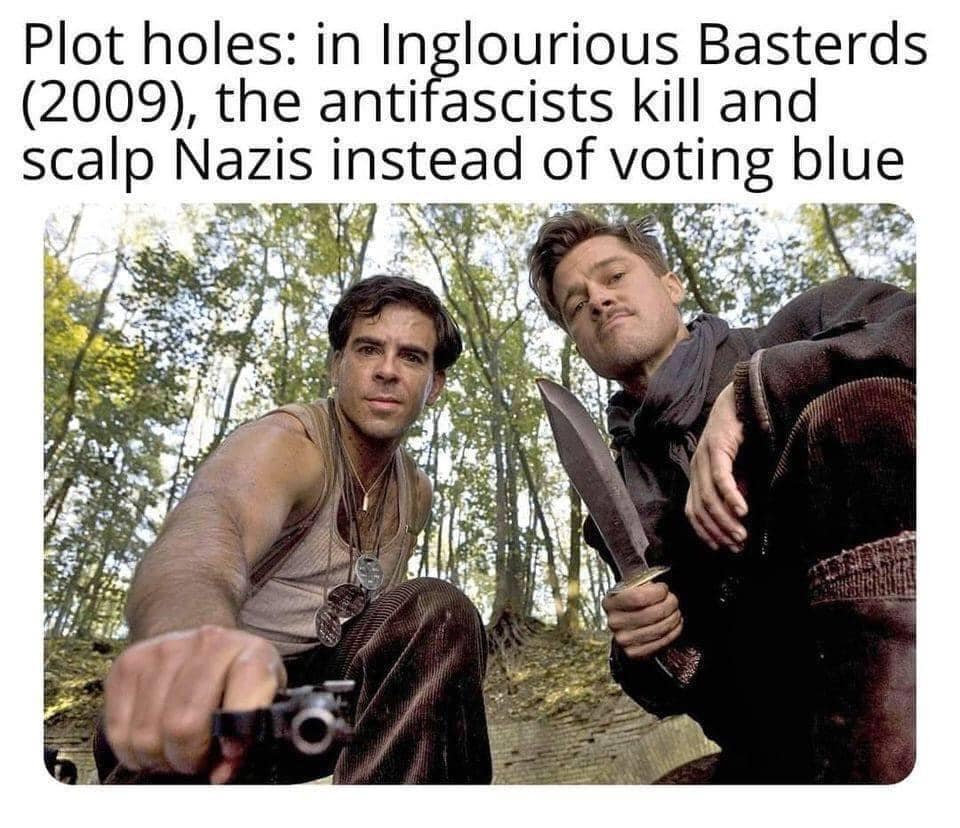
The meme is a humorous reference to the 2009 film "Inglourious Basterds" and its subversion of expectations. The image shows two characters from the film, with one holding a gun and the other holding a knife, and the text "Plot holes: in Inglourious Basterds (2009), the anti-fascists kill and scalp Nazis instead of voting blue." The meme is poking fun at the idea that the film's characters would be more effective in fighting fascism by killing Nazis rather than voting for a certain political party.
detailed-analysis (gemma3-27b-vision)
Okay, let's break down this meme referencing Quentin Tarantino's Inglourious Basterds (2009) through the lens of the theoretical frameworks you've requested. It’s important to note this is a playful meme, and applying such complex theory requires interpretation and a degree of stretching. I will clearly indicate when a section does not apply strongly.
Please Note: The core of the meme is a political joke: the implication that some advocate for violent confrontation with fascism (killing Nazis) instead of political engagement (voting). This frames the interpretation.
Visual Description
The image features a low-angle shot of two characters from Inglourious Basterds: Lieutenant Aldo Raine (Brad Pitt) on the left, and Sgt. Donny Donowitz ("The Bear Jew") played by Eli Roth. Raine is shirtless, revealing a necklace with a large pendant. He is flexing his bicep. Donowitz is clutching a large knife, looking stoic and somewhat menacing. The background is a blurry woodland. The lighting is somewhat muted and naturalistic, suggesting a forest environment. The low angle emphasizes their perceived strength and dominance.
Foucauldian Genealogical Discourse Analysis
This section is relevant as it concerns power, discourse, and the construction of "truth."
The meme references the "discourse" surrounding anti-fascism. Foucault's genealogical method investigates how concepts—like "anti-fascism," "violence," "democracy," and "Nazism"—are historically constructed through power dynamics. The meme positions two extremes: violent "scalping" and peaceful "voting."
The very term "anti-fascism" is not a neutral descriptor. It’s constructed in opposition to the discourse of fascism, defining itself through resistance. The meme challenges the dominant framing of what legitimate anti-fascist action looks like. Traditionally, democratic societies have privileged electoral politics as the "correct" path to resisting oppressive ideologies. The meme subverts this by presenting a visceral, violent alternative.
The “scalping” metaphor is important. It's a deliberately shocking, visually potent image. It moves away from rational discourse and engages with the raw, primal nature of revenge and retribution. Foucault would argue that this "scalping" acts as a counter-discourse to the perceived (and often problematic) neutrality of democratic processes.
Critical Theory
This is a strong fit for analyzing the meme.
The meme engages with a core tenet of the Frankfurt School's Critical Theory: the critique of power structures and ideologies. The joke stems from the idea that some see only two options in the fight against fascism: violent revolution (represented by the "Basterds") or passive participation in the political system (voting).
The meme implicitly critiques the limitations of electoral politics. Critical theorists argue that liberal democracy can often reproduce existing power structures rather than challenging them. By juxtaposing violence and voting, the meme suggests that simply voting might not be enough to dismantle deeply entrenched ideologies like fascism.
The meme forces the viewer to consider the power dynamics at play. The image of Raine and Donowitz embodies a raw, direct challenge to authority—a rejection of the "rules of the game" that often protect oppressive systems. They are not asking for change; they are imposing it.
Marxist Conflict Theory
This also applies, though with some nuance.
From a Marxist perspective, the meme alludes to the historical class struggle and the use of force to resolve conflicts. The “Nazis” represent the oppressive ruling class, while the “anti-fascists” represent the oppressed seeking liberation.
The "scalping" metaphor can be interpreted as a violent overthrow of the existing power structure, a direct confrontation with the forces of oppression. The meme implicitly suggests that sometimes, revolution—the use of force to dismantle the old order—is necessary.
However, it’s important to note that Marxism is not simply about violence. Marxism envisions a classless society achieved through a complex process of historical development. The meme simplifies this by presenting only two extremes.
Postmodernism
This is a weaker fit, but present.
The meme exhibits some characteristics of postmodern thought. The use of a shocking image ("scalping") and its juxtaposition with the seemingly mundane act of voting create a sense of fragmentation and challenge conventional notions of political engagement.
The meme also plays with the idea of representation. It presents a highly stylized, cinematic depiction of anti-fascism, rather than a realistic portrayal. The image, therefore, becomes a simulacrum – a copy without an original – that questions the very nature of truth and authenticity.
The meme itself is an intertextual reference to Tarantino's film, layering meaning and disrupting traditional narrative structures.
Queer Feminist Intersectional Analysis
This section is the least applicable.
While the film Inglourious Basterds itself can be analyzed through a queer or feminist lens (particularly regarding the female characters and the performativity of masculinity), the meme does not explicitly engage with these themes.
One could argue that the meme subtly challenges traditional notions of power and masculinity by showcasing a non-traditional form of resistance. However, this is a tenuous connection. The meme primarily focuses on the political conflict between anti-fascists and Nazis, without addressing issues of gender, sexuality, or intersectionality.
Disclaimer: This analysis is inherently interpretive, and other readings are possible. The meme is a complex cultural artifact that can be analyzed from multiple perspectives.
simple-description (llama3.2-vision)
The meme is a play on the title of the 2009 film "Inglourious Basterd" by taking its title and replacing "Basterds" with "Basterds" with "Bastards" and then replacing "Bastards" with "Bastit- - - - - - - - - - - - - - - - - - - - - - - - - - - - - - -
tesseract-ocr
Plot holes: in eure Basterds (2009), the antifascists kill and scalp Nazis instead of voting blue ] 3 ERR NE aS ae ig BN ete Ce cee ae cet ps > piv ie J y4 | A ek ys Be) Se A ‘ N Ter : a was : ei ee ca <tr, ,