First Seen
2023-05-10T21:03:33+00:00
simple-description (llama3.2-vision_11b)
This meme is a humorous take on the concept of "I see dead people" from the movie The Sixth Sense, but with a twist related to anti-fascism. The image features a character from a popular TV show ( likely a character from The Good Place) in a dark, gothic-inspired setting, with the caption "I see dead fascists".
detailed-analysis (gemma3-27b-vision)
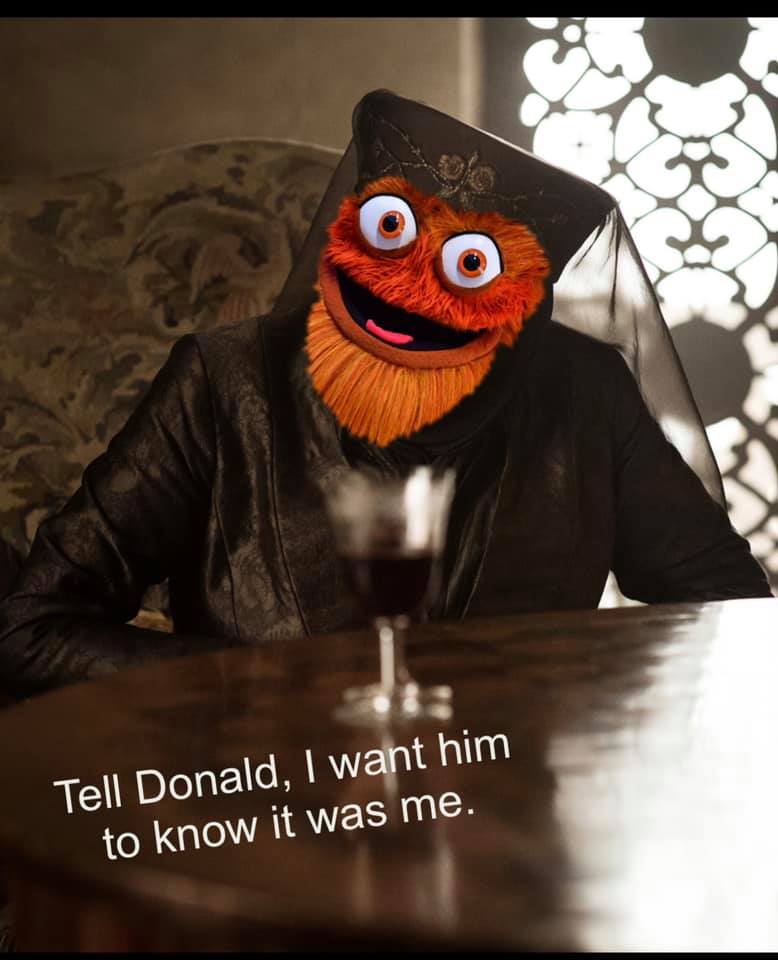
Okay, let's break down this image, which is... quite a lot. It's a digitally manipulated image of the Philadelphia Flyers mascot, Gritty, appearing in a highly unusual and potentially unsettling context. Here's an analysis through the lenses you requested, with sections only if they truly apply.
Visual Description
The image presents Gritty, the famously chaotic Philadelphia Flyers mascot, positioned within what appears to be a lavish, baroque interior – reminiscent of a European palace or high-end hotel. He's wearing a black, formal cloak and an elaborate head covering akin to a medieval noble or a bishop. He is seated at a dark wooden table with a blurred background of ornate detailing and a reflective surface. He has a direct, intense gaze and appears to be looking at the viewer. Beneath the image is a text caption: "Tell Donald, I want him to know it was me." The composition evokes a sense of mystery, conspiracy, and a deliberate staging of a specific atmosphere. The incongruity of Gritty in this setting is immediately striking and unsettling.
Foucauldian Genealogical Discourse Analysis
This image is rich for Foucauldian analysis. The entire composition represents a discourse – a system of thought, language, and power that constructs meaning. Here’s how:
- Power/Knowledge: Gritty’s placement in this setting shifts the power dynamic. He’s no longer merely a sports mascot, but a figure of implied authority, secrecy, and perhaps even danger. His message ("Tell Donald...") implies involvement in an event or scheme, constructing him as a wielder of power. Knowledge is being conveyed, but selectively. We don’t know what "it" is, creating a power imbalance between the subject (Gritty) and the viewer.
- Genealogy of Authority: The opulent setting – the baroque interior, the cloak – is a genealogical reference to historical forms of authority (religious, aristocratic). By associating Gritty with these symbols, the image is tracing the history of how power has been constructed visually and symbolically.
- Discursive Shift: The image disrupts the expected discourse around Gritty. We expect him to be silly, loud, and involved in hockey culture. This image forces a re-evaluation of his symbolic meaning, pushing him into the realm of intrigue and hidden agendas.
Critical Theory
The image lends itself to a critical examination through the lens of Adorno and Horkheimer's concept of the culture industry.
- Commodification of Meaning: Gritty, originally a symbol of local sports fandom, is being repurposed and injected into a completely different context. This demonstrates how symbols are increasingly detached from their original meaning and become commodities within a broader system of cultural production.
- False Consciousness: The image can be read as a form of "spectacle" – a carefully constructed visual event that distracts from underlying social and political realities. The ambiguity of the message ("Tell Donald...") might be seen as a way to create intrigue without addressing any substantive issues.
- Parody/Critique: On another level, the image can be seen as a parody of power and authority. The absurdity of Gritty in this context undermines the seriousness typically associated with the symbols he is now connected to.
Postmodernism
This image is highly postmodern.
- Pastiche and Irony: The combination of a hyper-real sports mascot with the exaggerated imagery of historical authority is a prime example of pastiche. The irony of a chaotic figure like Gritty attempting to convey a serious, secretive message is central to the image’s effect.
- Hyperreality and Simulation: The image blurs the lines between reality and simulation. Gritty is a mascot, a constructed persona. The manipulation of the image further adds to this sense of artificiality. This contributes to a postmodern sensibility where representation often takes precedence over "the real."
- Deconstruction of Meaning: The image actively resists a single, definitive interpretation. The ambiguity of the message, the incongruity of the setting, and the overall artificiality all contribute to a deconstruction of traditional meaning-making.
Let me know if you'd like me to elaborate on any of these points or explore other interpretive frameworks!
simple-description (llama3.2-vision)
The meme features a character from the popular children's television show "Ses
tesseract-ocr
nd S . | ee /< , Ps aT-)\l ipYenaler Neat him to know Taig i