First Seen
2023-05-10T21:03:33+00:00
simple-description (llama3.2-vision_11b)
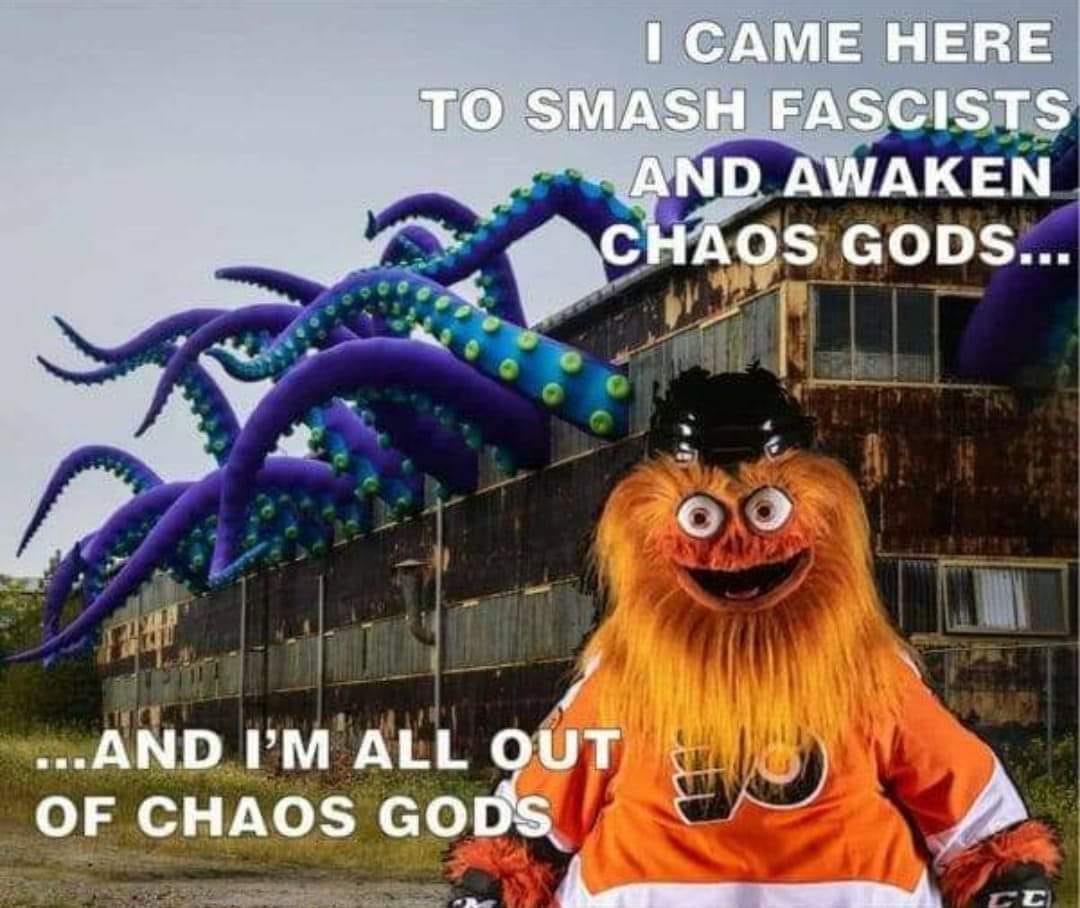
This meme uses the image of a popular children's character, Gru (from Despicable Me) as a fascist, but instead of the usual "I'm Gru" catchphrase, it says "I'm Gru... I came here to smash fascists and awaken Chaos Gods... and I'm all out of Chaos Gods". The meme is a humorous take on the idea of a character who is supposed to be evil, but is actually just trying to do good, but is running out of resources to do so.
detailed-analysis (gemma3-27b-vision)
Okay, let's break down this rather bizarre and meme-infused image through the requested theoretical lenses. This is going to be a bit of a ride given the inherent absurdity of the source material!
1. Visual Description
The image is a digitally manipulated meme featuring Gritty, the Philadelphia Flyers’ mascot, a large, orange, vaguely monstrous, furry creature. He’s wearing a flat cap and sunglasses, giving him a somewhat rebellious or mischievous appearance. Behind him looms a large, purple, tentacled creature—resembling an octopus or Lovecraftian entity—that is digitally superimposed over a building. The image is overlaid with text: “I CAME HERE TO SMASH FASCISTS AND AWAKEN CHAOS GODS…” and “…AND I’M ALL OUT OF CHAOS GODS”. The overall aesthetic is digitally created and intentionally absurd. The lighting and background appear realistic, contrasting with the fantastical addition of the tentacled monster. There is an obvious contrast between the seemingly mundane setting and the fantastical element, creating a sense of surreality.
2. Foucauldian Genealogical Discourse Analysis
A Foucauldian approach would not seek meaning in the image, but rather trace the discursive formations that make it possible. Here's how:
- Discourses of Mascotry: Mascots, historically, have been deployed to construct collective identities, instill loyalty, and channel aggression. Gritty, however, subverts the traditional role of the mascot. He's intentionally chaotic, unpolished, and anti-establishment. His "roughness" is a disruption of the expected polished, corporate-approved mascot archetype.
- Discourse of Anti-Fascism: The meme explicitly invokes anti-fascist sentiment. This draws upon a historical discourse of resistance to authoritarianism, which has evolved significantly over time. The connection of anti-fascism with "chaos gods" complicates this discourse, suggesting a rejection of order itself as a potential structure for oppression.
- Discourse of the Monstrous: The "chaos god" is a figure of the monstrous, invoking a history of fearing "the other." By placing it alongside the anti-fascist message, the meme suggests a blurring of boundaries between resistance and monstrousness. It’s a rhetorical act of aligning with those traditionally demonized.
- Genealogy of "Chaos": Tracing the history of the concept of "chaos" reveals it’s not simply "disorder," but a category used to define and exclude what doesn't fit within established systems. The meme appropriates "chaos" as a potentially positive force, a rejection of control.
The genealogy would emphasize that the image isn’t simply about something; it is produced by historical power dynamics. It is a product of the ways we have historically categorized and defined concepts such as mascots, fascism, chaos and “the monstrous”.
3. Critical Theory (Frankfurt School)
From a Critical Theory perspective, this image is a fascinating example of how counter-cultural resistance can be co-opted and commodified even as it attempts to be radical.
- Culture Industry: Gritty, originally intended to engage fans, has become a viral phenomenon, readily marketable through memes and merchandise. The image leverages this virality. This fits neatly into the Culture Industry’s tendency to absorb dissent and turn it into a consumable product.
- False Consciousness: The meme, while ostensibly anti-fascist, uses spectacle and absurdity. It could be argued this distracts from actual political organizing and provides a sense of "doing something" without fundamentally challenging power structures. The "chaos" element could represent a rejection of reason and a descent into irrationality.
- Critique of Enlightenment Reason: The invocation of "chaos gods" is a rejection of the Enlightenment’s emphasis on order and rationality. This rejection could be seen as a valid critique of structures that perpetuate injustice, but also as a potentially dangerous embrace of irrationality.
- Commodity Fetishism: Gritty’s image itself is a commodity. The meme relies on the recognition of that commodity to deliver its message. This paradox highlights how even resistance can be embedded in the logic of capitalism.
4. Marxist Conflict Theory
A Marxist interpretation would focus on the underlying class struggle and the appropriation of symbols within that struggle.
- Ideology & Hegemony: The image could be seen as a counter-hegemonic attempt to disrupt the dominant ideology. It uses absurdity to challenge accepted norms and values. However, the ease with which it has been absorbed into popular culture also raises questions about its actual effectiveness.
- Class Consciousness: While the meme invokes anti-fascism, it doesn't directly address class exploitation. Fascism is often linked to capitalist interests, but this connection is obscured by the focus on "chaos gods."
- Symbolic Violence: The "chaos god" can be interpreted as a symbol of forces that threaten the established order. The meme's embrace of this force is a challenge to the symbolic violence used to maintain that order.
- Reification of Struggle: The image represents struggle—resistance against fascism—as spectacle. This can reify the struggle, turning it into something divorced from actual material conditions and political organizing.
5. Postmodernism
A postmodern reading would emphasize the image's deconstruction of meaning, its playfulness, and its rejection of grand narratives.
- Simulacra & Simulation: The image is a simulation of resistance—an image that has become divorced from its referent. The meaning of "anti-fascism" and "chaos" are both fluid and contested, existing primarily as signs in a complex web of references.
- Deconstruction of Meaning: The juxtaposition of Gritty, a seemingly innocent mascot, with a Lovecraftian monster and the phrase "chaos gods" deliberately disrupts any straightforward interpretation.
- Pastiche & Intertextuality: The image draws upon multiple cultural references—mascot culture, Lovecraftian horror, anti-fascist activism—creating a pastiche that resists easy categorization.
- Rejection of Metanarratives: The meme rejects the idea of a single, overarching narrative of resistance. It embraces ambiguity and fragmentation.
6. Queer Feminist Intersectional Analysis
This is a more complex fit, but possible.
- Subversion of Norms: Gritty, as a mascot, represents a carefully constructed performance of masculinity. His deliberately chaotic and unconventional persona subverts those expectations. The image can be seen as a playful disruption of gendered norms.
- Monstrous Feminine: The "chaos god" can be interpreted through the lens of the "monstrous feminine"—a figure that challenges patriarchal norms by embodying qualities traditionally associated with the abject and threatening. The image could be seen as a reclamation of monstrousness as a form of empowerment.
- Intersectional Resistance: The image implies a resistance to multiple forms of oppression—fascism, patriarchal norms, the constraints of established order. While the meme doesn’t explicitly address intersectionality, its embrace of chaos can be interpreted as a rejection of rigid categories and hierarchies.
- Reclaiming the Abject: Embracing "chaos" and the monstrous can be seen as a reclaiming of elements that are typically marginalized and demonized.
Important Note: These are interpretations, and the image is intentionally open-ended. A single image can support multiple readings, and the “correct” interpretation is subjective. The goal here was to demonstrate how these theoretical frameworks can be applied to analyze seemingly simple cultural artifacts.
simple-description (llama3.2-vision)
The meme features Gritty, a Philadelphia Flyers mascot, standing in front of an abandoned building with a large, tentacled creature emerging from it. The text reads, "I came here to smash fascists and awaken chaos gods... and I'm all out of chaos gods." The image is a humorous take on the idea of a powerful, ancient entity being called upon to destroy enemies, but instead, it's just Gritty, a beloved hockey mascot. The image pokes fun at the idea of calling upon powerful forces to achieve goals, only to find that they are not as powerful as thought.
tesseract-ocr
Sie , I » AY /AKEN Boe tec ey ae Lae Dis . ty Ait J : nP pes iii ot we || F y q me \ TMU \ eyo OF CHAOS ee ed, y nanny = AY) ae