First Seen
2023-05-10T21:03:33+00:00
simple-description (llama3.2-vision_11b)
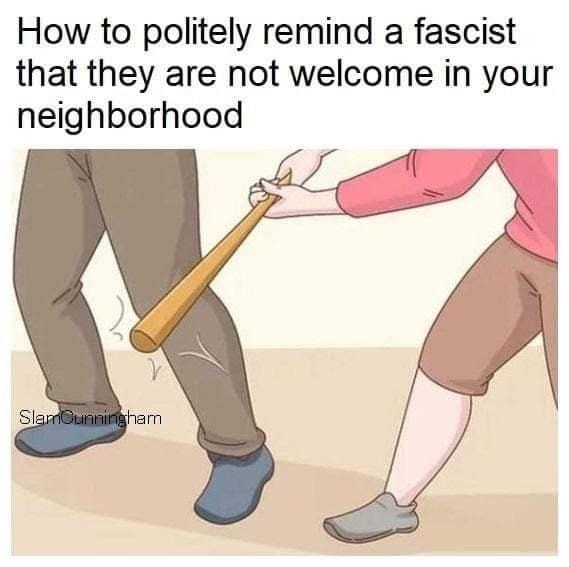
The meme is a humorous guide on how to politely remind a fascist that they are not welcome in your neighborhood. The image shows a person holding a sign that says "I'm a fascist, but I'm still a good neighbor" and a neighbor responding with a baseball bat, implying that they are not welcome. The text "How to politely remind a fascist that they are not welcome in your neighborhood" is overlaid on the image.
detailed-analysis (gemma3-27b-vision)
Okay, let's break down this image and the accompanying text through the requested theoretical lenses. Please be aware that the image depicts violence, and analyzing it through these lenses is done to understand the complexities of power and resistance it portrays, not to endorse violence.
Disclaimer: This analysis will be detailed and may delve into sensitive topics.
1. Visual Description
The image is a cartoon-style illustration showing two figures engaged in a physical altercation. The text above the image reads, "How to politely remind a fascist that they are not welcome in your neighborhood."
- Composition: The image focuses on the lower bodies of the individuals, emphasizing the physicality of the conflict. The view is from a low angle, making the impact of the action seem greater.
- Figures: One figure, in dark blue trousers and blue socks, is in a bent over position with a baseball bat aimed toward their back. The other figure, in brown shorts and grey shoes, has a grip on the bat.
- Color Palette: The color palette is limited and somewhat muted. This may aim to convey a sense of seriousness or grim reality.
- Humor/Irony: The framing of a violent act as "politely reminding" creates a stark irony, driving home the core message.
2. Foucauldian Genealogical Discourse Analysis
Foucault’s concept of genealogy explores how power operates through discourse and the historical construction of knowledge.
- Power/Knowledge: The image challenges the dominant discourse surrounding "politeness" and "reminders." Normally these terms imply verbal communication. By pairing "politeness" with physical force, the image disrupts the conventional power dynamics inherent in discourse. It suggests that sometimes, direct physical resistance is a necessary form of “communication” against oppressive ideologies.
- Disciplinary Power: The act of physically confronting a "fascist" can be seen as a refusal of disciplinary power. Fascism itself is a regime of disciplinary power, seeking to control bodies and behavior. The image suggests a reclaiming of agency and the right to self-defense against such control.
- Archaeology of “Politeness”: A Foucauldian lens might ask: How has the concept of "politeness" been historically constructed to maintain social hierarchies and silence dissent? The image then exposes the limits of this discourse when faced with ideologies that are inherently violent and oppressive.
- Genealogy of "Fascism": Examining the historical roots of fascism (its origins in violence, nationalism, and control) reveals how the label "fascist" carries a history of power and oppression, justifying resistance.
3. Critical Theory
Critical Theory, originating with the Frankfurt School, examines society and culture to critique power structures and promote emancipation.
- Domination and Resistance: The image is a clear depiction of resistance against perceived domination. The “fascist” represents a system of power, and the confrontation represents a refusal to be subjected to it.
- Ideology Critique: The meme’s text directly engages in ideology critique. It casts "fascism" as an ideology that doesn’t deserve respect or accommodation, and therefore, resistance is justified.
- The Culture Industry: One could argue that the meme itself is part of the "culture industry," a means of disseminating critical ideas and challenging dominant narratives. It uses a simple, provocative image to spread a message of anti-fascist resistance.
- Emancipatory Potential: The image, despite depicting violence, can be seen as having an emancipatory potential by encouraging people to challenge oppressive ideologies and take action to defend their communities.
4. Marxist Conflict Theory
Marxist Conflict Theory sees society as structured by class conflict and power struggles over resources.
- Class Struggle: While the image doesn’t explicitly portray class, “fascism” often relies on exploiting class divisions to consolidate power. The confrontation can be seen as a rejection of this exploitation.
- Power Relations: The image illustrates a direct power struggle. The individual confronting the “fascist” is asserting their power and agency against a perceived oppressor.
- Revolutionary Potential: The image's provocative nature and call to action can be seen as having a revolutionary potential. It suggests that sometimes, direct conflict is necessary to challenge and overthrow oppressive systems.
- False Consciousness: The meme implicitly critiques those who might be complacent or tolerant of fascist ideologies, suggesting they are suffering from “false consciousness” – a lack of awareness of their own oppression or the oppression of others.
5. Queer Feminist Intersectional Analysis
This analysis focuses on how intersecting systems of oppression (gender, sexuality, race, class, etc.) create unique experiences of marginalization.
- Fascism as a System of Control: Fascism inherently seeks to control and suppress marginalized groups – particularly LGBTQ+ individuals, people of color, and women. The image can be seen as a resistance against this control.
- Bodily Autonomy: The act of physically confronting the “fascist” can be interpreted as a reclaiming of bodily autonomy and a refusal to be subjected to violence or oppression.
- Intersectional Oppression: While the image doesn't explicitly depict intersectional oppression, it's important to remember that fascism often targets multiple marginalized identities simultaneously. The resistance depicted can be seen as a defense of all marginalized groups.
- Radical Resistance: The image embodies a form of radical resistance that challenges traditional notions of politeness and accommodation. This can be particularly empowering for marginalized communities who have historically been silenced and oppressed.
Important Note: This analysis is complex and open to interpretation. The image is provocative and raises important questions about violence, resistance, and the nature of power. It is essential to engage with these questions critically and responsibly.
simple-description (llama3.2-vision)
This meme is a satirical commentary on how to identify and address someone who is not welcome in your neighborhood. The image shows a person being hit with a bat by another person, with the text "How to politely remind a fascist that they are not welcome in your neighborhood" above it. The humor comes from the absurdity of using violence to address someone's presence in your neighborhood, which is typically not a polite or acceptable way to handle the situation.
tesseract-ocr
How to politely remind a fascist that they are not welcome in your neighborhood > = | as \ im