First Seen
2023-05-10T21:03:33+00:00
simple-description (llama3.2-vision_11b)
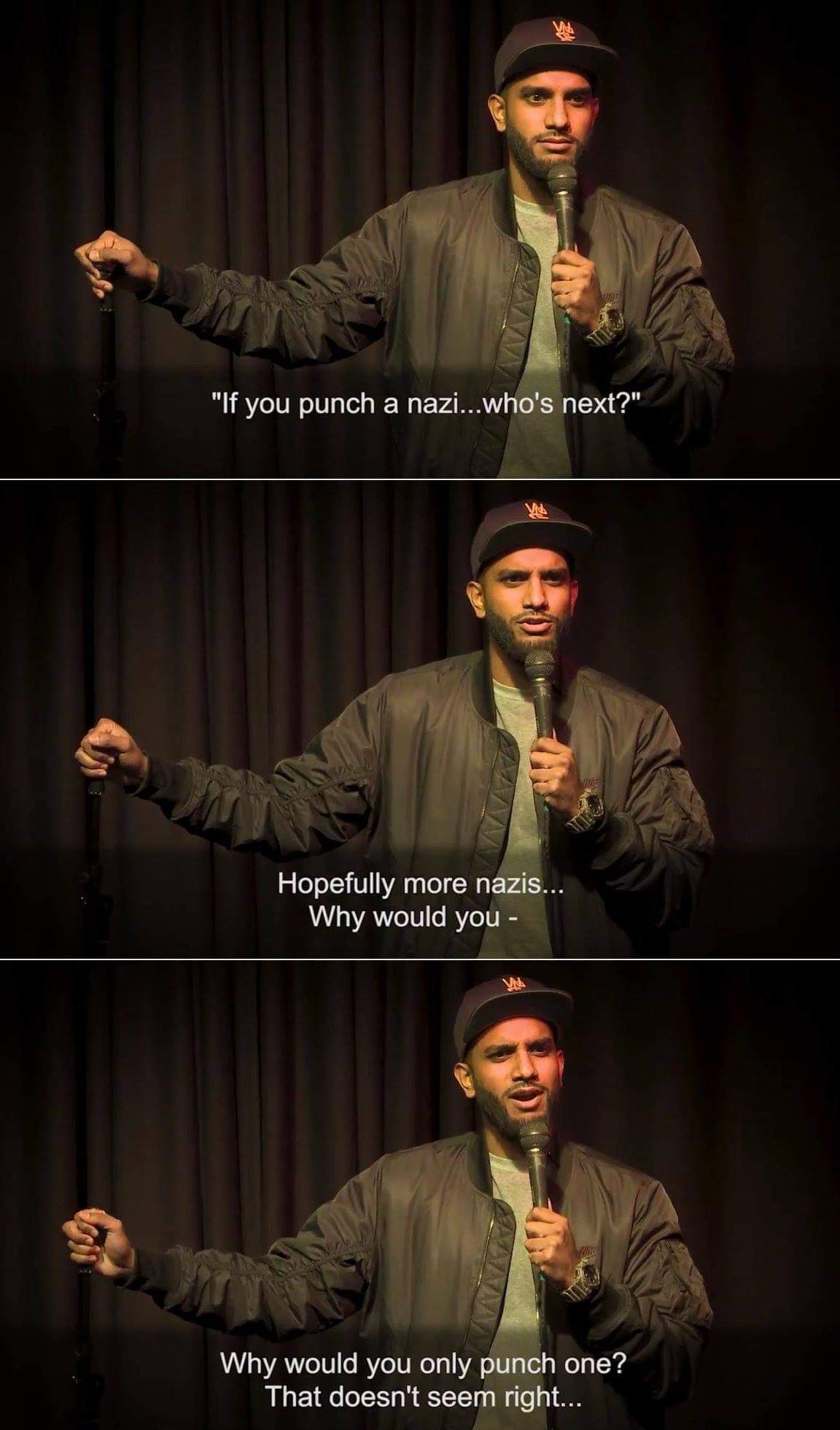
The meme is a screenshot of comedian John Robins' 2022 stand-up routine, where he jokes about the absurdity of a hypothetical situation where he's asked to punch a Nazi. The text "If you punch a Nazi, who's next?" is displayed, implying that the question is absurd and that the person asking is trying to provoke a response.
detailed-analysis (gemma3-27b-vision)
Okay, here's an analysis of the provided images of a stand-up comedian, broken down into sections addressing the requested theoretical frameworks. It's important to note that applying these frameworks to a snippet of stand-up is interpretive and speculative, but aims to highlight potential points of engagement.
Visual Description
The images depict a man, presumably a stand-up comedian, on a stage with a dark backdrop. He's wearing a baseball cap, an olive green jacket, and a dark t-shirt. He is holding a microphone and appears to be mid-performance, gesturing with his hands. The lighting is focused on him, creating a spotlight effect. The overall aesthetic is typical of a stand-up comedy club. The text captions are overlaid on the images, representing lines from his set. The first reads "If you punch a nazi...who's next?", the second reads “Hopefully more nazis… Why would you-", and the third reads “Why would you only punch one? That doesn't seem right.”
Foucauldian Genealogical Discourse Analysis
Foucault’s work explores how power operates through discourse—systems of thought, language, and practice. This snippet reveals a discourse around violence, morality, and the construction of the "Nazi" as an other.
- Power/Knowledge: The comedian's questioning establishes a power dynamic where he sets the terms of the conversation. He invites the audience to consider the ethical implications of violence against a specific group, framing "Nazis" as objects of potentially justified aggression.
- Genealogy of Morality: The joke touches upon the genealogy of morality by questioning why we limit violence, even against those perceived as deeply immoral. The questions challenge the traditional moral prohibition against violence, suggesting a potential "logic" to escalating violence against “Nazis.”
- Disciplinary Power: By posing questions, the comedian doesn’t give answers, but rather compels the audience to participate in constructing the "right" response. This functions as a form of subtle discipline, reinforcing (or questioning) the norms around violence and morality.
Critical Theory
Within the tradition of the Frankfurt School, critical theory examines the ways in which power structures are embedded in culture and ideology.
- Ideology Critique: The joke subtly critiques the idea that violence is always wrong. It opens space for questioning the assumptions that uphold the status quo and challenges simplistic moral categories. It encourages the audience to consider why they would stop at punching only one "Nazi."
- Reason and Enlightenment: This comedy can be seen as a twisted extension of Enlightenment rationality. By posing the question ("Why only one?"), the comedian applies a logic to violence that is deeply unsettling and forces us to confront the potential for reason to be used to justify extreme actions.
- Commodification of Outrage: In a broader sense, this joke taps into a contemporary culture where outrage is commodified and performative. The comedian is responding to, and participating in, a culture where identifying and condemning “Nazis” (often in symbolic terms) is a form of social signaling.
Marxist Conflict Theory
While the joke doesn’t directly address economic class, conflict theory can still be applied in terms of the inherent conflict between groups defined by ideology.
- Us vs. Them: The joke fundamentally relies on the creation of an "us" (those who oppose Nazism) and "them" (Nazis). It reinforces this binary, even while questioning the limits of the conflict.
- Power Struggle: The joke suggests an ongoing power struggle and questions the appropriateness of limiting violence even against a perceived enemy. It subtly implies that the goal should be total subjugation, rather than mere resistance.
- Dehumanization: By posing the question about punching more Nazis, the comedian hints at a process of dehumanization—reducing individuals to their ideological label and justifying violence against them.
Postmodernism
Postmodern thought often challenges grand narratives, universal truths, and stable meanings.
- Deconstruction of Morality: The joke deconstructs traditional moral categories by questioning the absolute prohibition against violence. It exposes the contingency and constructed nature of these norms.
- Irony and Parody: The joke is delivered with a degree of irony and may be seen as a parody of moral outrage. It undermines the sincerity of self-righteous condemnation.
- Relativism: The joke hints at a form of moral relativism, suggesting that the "right" thing to do depends on the specific context and the identity of the "other."
Queer Feminist Intersectional Analysis
This framework might be less directly applicable to the snippet but can offer some insights.
- Critique of Violence: Queer and feminist thought are often deeply critical of violence, particularly structural and systemic violence. The joke’s seemingly casual engagement with violence could be seen as problematic, even if it’s directed at those perceived as “evil.”
- The Power of Labeling: The simplistic labeling of “Nazi” masks the complexities of individual identity and lived experience. It potentially reinforces a dangerous "othering" that can be used to justify violence and oppression.
- Intersectional Context: The joke lacks any consideration of the intersectional context of violence – the ways in which race, gender, class, and other factors shape experiences of both victimhood and oppression.
Disclaimer: This analysis is speculative and based on a limited amount of information. Different interpretations are possible.
Let me know if you'd like a more detailed exploration of any specific theoretical framework, or if you have any other questions!
simple-description (llama3.2-vision)
The meme features a series of three images of comedian and actor, Kumail Nan
tesseract-ocr
/ te P | : . < ie il S&S : Wik, m iy ye ’ ‘ Has if SS | Ry 1 i . ew S| Ge e \/-44) 4 "If you punch a nazi...who's next?" 7. vi \ Ww \i 8S", | x, on Sa PS. a lf i i. wv. TS ie Iz iy i AS a. > (J) (Bae) 0) 4 Hopefully more nazis... Why would you - — i oa | \ Bs a il 4 \ > \ } \ Yj We ; ff i sill wy . * Sa | hl <S e Te 2 eal! | uae ; \ ey) q bg Why would you only punch one? That doesn't seem t fein aan