First Seen
2024-05-17T20:41:04+00:00
simple-description (qwen3.5_2b-q8_0)
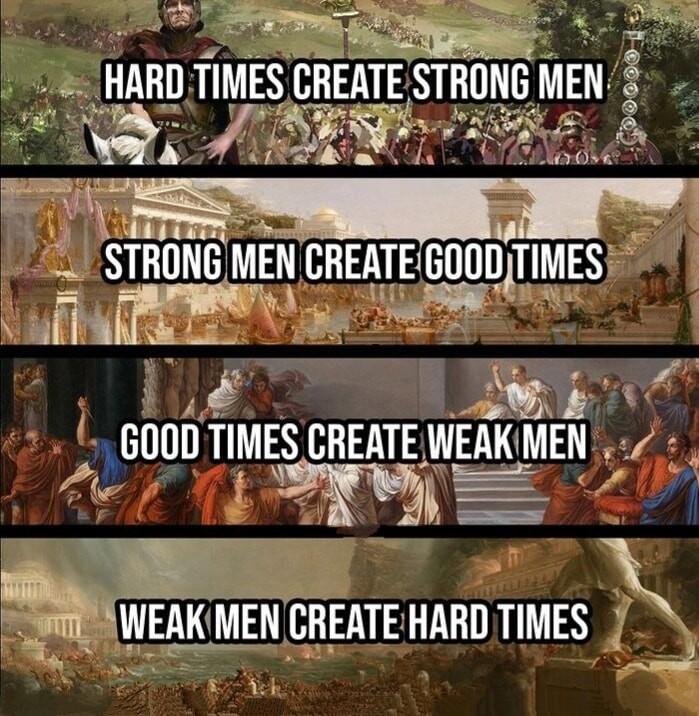
This meme presents a cynical, cyclical view of history that argues against the permanence of human achievement. It posits that hardship is the necessary forge for strength, but then suggests that this peace is actually fragile and leads to weakness. The text "WEAK MEN CREATE HARD TIMES" serves as the punchline, reinforcing the idea that suffering is an inevitable, unbreakable condition that defines reality rather than an obstacle to progress. This perspective is anti-fascist in its rejection of the idea that peace and strength are stable, natural goals to be easily reached without pain.
simple-description (llama3.2-vision_11b)
The meme is a satirical commentary on the concept of "we are all we have" being a myth, implying that the idea of humanity's collective strength and resilience in the face of adversity is a myth. The text "We are all we have" is juxtaposed with a quote from the movie "The Dark Knight" to highlight the contrast between the idea of collective strength and the harsh reality of human nature.
detailed-analysis (gemma3-27b-vision)
Okay, let's break down this image meme with the requested analytical lenses. It’s important to note that this image is often associated with alt-right and hypermasculine ideologies, making its analysis particularly important to deconstruct.
Visual Description
The image is a four-panel meme utilizing paintings depicting scenes from ancient Rome, seemingly referencing the rise and fall of empires. The panels are arranged vertically with text overlayed on top.
- Panel 1 (“Hard times create strong men”): Depicts a scene of military triumph or battle. A victorious general or leader stands amidst soldiers and a cheering crowd. The scene communicates power, dominance, and potentially conquest.
- Panel 2 (“Strong men create good times”): Illustrates a bustling Roman scene with architecture, commerce, and a large population. It conveys a sense of prosperity, civilization, and order.
- Panel 3 (“Good times create weak men”): Shows a scene of indulgence and luxury—people reclining, being served, and generally enjoying a life of ease. There is a sense of decadence and potentially moral corruption.
- Panel 4 (“Weak men create hard times”): Displays a scene of chaos, invasion, or destruction. A horse tramples over a fallen figure, suggesting defeat, societal breakdown, and the loss of order.
The imagery relies heavily on romanticized depictions of Roman history to create a narrative about societal cycles. The consistent focus is on male figures, presented as the primary actors and drivers of these cycles.
Foucauldian Genealogical Discourse Analysis
This meme actively constructs a specific discourse around masculinity, power, and societal health. A Foucauldian approach reveals how the meme establishes a genealogy of “strength” and “weakness.”
- Power/Knowledge: The meme operates on the premise that certain forms of power (military strength, leadership) are intrinsically linked to “good” times. Conversely, perceived “weakness” (lack of discipline, indulgence) is presented as the cause of societal decline. This presents an assertion of "knowledge" about how society should function.
- Disciplinary Power: The meme implies a disciplinary regime – an ideal where “strong men” maintain order and prevent the “weakness” that leads to chaos. It suggests that societal structures should reinforce “strength” and suppress any behaviors deemed “weak.”
- Construction of Subjects: The meme actively constructs specific subject positions. It positions men as active agents of history, responsible for both prosperity and ruin. It implicitly frames those who do not conform to the “strong man” ideal as contributing to societal problems.
- Normalisation: This meme normalizes a specific standard of masculinity - the idea that strength, dominance, and potentially violence are desirable traits.
Critical Theory
This meme exemplifies a key concept of Critical Theory: the justification of power.
- Hegemony: The meme implicitly supports a hegemonic ideology—the idea that certain values and beliefs (traditional masculinity, the importance of strength) are natural and universal, masking the fact that they serve the interests of a particular group.
- Ideology: The message functions as an ideology, providing a simplified and distorted view of history and society to legitimize a particular social order. It suggests that the “good old days” were defined by a certain type of masculinity and that a return to these values is necessary.
- Domination: The meme reinforces structures of domination by presenting “strength” as the natural right of certain men and implying that those deemed “weak” deserve their fate.
- The Myth of Origins: This meme actively constructs a “myth of origins”, implying that an idealized past (Roman empire) holds the key to current societal problems.
Marxist Conflict Theory
While not explicitly about class, a Marxist analysis can highlight the underlying power dynamics.
- Class Struggle (Broadened): The meme presents a simplified “struggle” between “strong” and “weak” men, but this can be interpreted as a metaphor for broader social conflicts. The “strong men” represent those in positions of power (rulers, warriors, elites), while the “weak men” represent those who are marginalized or disempowered.
- Ideological Control: The meme serves as a tool for ideological control, legitimizing the dominance of certain groups and justifying their power. It suggests that those who are in positions of authority are inherently superior and deserve to rule.
- Material Conditions (Indirectly): While the meme focuses on masculinity, it implicitly glosses over the material conditions (economic inequality, political oppression) that contribute to societal problems. The focus on “weakness” as a character flaw deflects attention from systemic issues.
Postmodernism
A postmodern reading challenges the meme’s claim to objective truth and highlights its constructed nature.
- Deconstruction: A postmodern analysis would deconstruct the binary opposition between “strong” and “weak.” It would argue that these categories are not fixed or natural, but rather socially constructed and fluid.
- Narrative Construction: The meme relies on a simplified and linear narrative of history. Postmodernism would emphasize that history is always subject to interpretation and that there are multiple, competing narratives.
- Simulation & Hyperreality: The meme draws on romanticized depictions of the past, creating a “simulation” of historical reality. It presents a “hyperreal” version of the Roman Empire, detached from the complexities and contradictions of actual historical events.
- Metanarratives: The meme relies on a grand, overarching “metanarrative” about the rise and fall of civilizations. Postmodernism would question the validity of such metanarratives and emphasize the importance of local, contextualized perspectives.
Queer Feminist Intersectional Analysis
This is where the critique becomes particularly crucial.
- Toxic Masculinity: The meme perpetuates a narrow and harmful definition of masculinity—one that equates strength with dominance, aggression, and the suppression of vulnerability. This contributes to toxic masculinity and its associated harms (violence, sexism, homophobia).
- Gender Roles: The meme reinforces rigid gender roles, positioning men as the active agents of history and implicitly excluding or marginalizing women and non-binary individuals.
- Intersectionality: It fails to acknowledge the intersection of gender with other forms of social inequality (race, class, sexuality). The “strong man” ideal is often implicitly associated with whiteness and privilege.
- Power Dynamics & Violence: The meme normalizes a hierarchy of power based on perceived strength, which can legitimize violence and oppression. It reinforces a culture where domination is seen as desirable and vulnerability is seen as weakness.
In conclusion: This meme is not simply a nostalgic reflection on history. It is a deeply ideological statement that reinforces harmful gender norms, justifies power imbalances, and contributes to a culture of domination. A critical analysis reveals the ways in which it constructs a particular version of reality and serves the interests of those who benefit from the existing social order.
Disclaimer: This analysis is complex and nuanced. There are multiple ways to interpret the image and its underlying message. This response is intended as a starting point for further critical reflection.
simple-description (llama3.2-vision)
The meme is a play on the ancient Greek philosopher’s quote "We … are … […] … … … … … … … … … … … … … … … … … … … … … … … … … … … … … … … … … … … … … … … … … … … … … … … … … … … … … … … … … … … … … … … … … … … … … … … … … … … … … … … … … … … … … … … … … … … … … … … … … … … … … … … … … … … … … … … … … … … … … … … … … … … … … … … … … … … … … … … … … … … … … … … … … … … … … … … … … … … … … … … … … … … … … … … … … … … … … … … … … … … … … … … … … … … … … … … … … … … … … … … … … … … … … … … … … … … … … … … … … … … … … … … … … … … … … … … … … … … … … … … … … … … … … … … … … … … … … … … … … … … … … … … … … … … … … … … … … … … … … … … … … … … … … … … … … … … … … … … … … … … … … … … … … … … … … … … … … … … … … … … … … … … … … … … … … … … … … … … … … … … … … … … … … … … … … … … … … … … … … … … … … … … … … … … … … … … … … … … … … … … … … … … … … … … … … … … … … … … … … … … … … … … … … … … … … … … … … … … … … … … … … … … … … … … … … … … … … … … … … … … … … … … … … … … … … … … … … … … … … … … … … … … … … … … … … … … … … … … … … … … … … … … … … … … … … … … … … … … … … … … … … … … … … … … … … … … … … … … … … … … … … … … … … … … … … … … … … … … … … … … … … … … … … … … … … … … … … … … … … … … … … … … … … … … … … … … … … … … … … … … … … … … … … … … … … … … … … … … … … … … … … … … … … … … … … … … … … … … … … … … … … … … … … … … … … … … … … … … … … … … … … … … … … … … … … … … … … … … … … … … … … … … … … … … … … … … … … … … … … … … … … … … … … … … … … … … … … … … … … … … … … … … … … … … … … … … … … … … … … … … … … … … … … … … … … … … … … … … … … … … … … … … … … … … … … … … … … … … … … … … … … … … … … … … … … … … … … … … … … … … … … … … … … … … … … … … … … … … … … … … … … … … … … … … … … … … … … … … … … … … … … … … … … … … … … … … … … … … … … … … … … … … … … … … … … … … … … … … … … … … … … … … … … … … … … … … … … … … … … … … … … … … … … … … … … … … … … … … … … … … … … … … … … … … … … … … … … … … … … … … … … … … … … … … … … … … … … … … … … … … … … … … … … … … … … … … … … … … … … … … … … … … … … … … … … … … … … … … … … … … … … … … … … … … … … … … … … … … … … … … … … … … … … … … … … … … … … … … … … … … … … … … … … … … … … … … … … … … … … … … … … … … … … … … … … … … … … … … … … … … … … … … … … … … … … … … … … … … … … … … … … … … … … … … … … … … … … … … … … … … … … … … … … … … … … … … … … … … … … … … … … … … … … … … … … … … … … … … … … … … … … … … … … … … … … … … … … … … … … … … … … … … … … … … … … … … … … … … … … … … … … … … … … … … … … … … … … … … … … … … … … … … … … … … … … … … … … … … … … … … … … … … … … … … … … … … … … … … … … … … … … … … … … … … … … … … … … … … … … … … … … … … … … … … … … … … … … … … … … … … … … … … … … … … … … … … … … … … … … … … … … … … … … … … … … … … … … … … … … … … … … … … … … … … … … … … … … … … … … … … … … … … … … … … … … … … … … … … … … … … … … … … … … … … … … … … … … … … … … … … … … … … … … … … … … … … … … … … … … … … … … … … … … … … … … … … … … … … … … … … … … … … … … … … … … … … … … … … … … … … … … … … … … … … … … … … … … … … … … … … … … … … … … … … … … … … … … … … … … … … … … … … … … … … … … … … … … … … … … … … … … … … … … … … … … … … … … … … … … … … … … … … … … … … … … … … … … … … … … … … … … … … … … … … … … … … … … … … … … … … … … … … … … … … … … … … … … … … … … … … … … … … … … … … … … … … … … … … … … … … … … … … … … … … … … … … … … … … … … … … … … … … … … … … … … … … … … … … … … … … … … … … … … … … … … … … … … … … … … … … … … … … … … … … … … … … … … … … … … … … … … … … … … … … … … … … … … … … … … … … … … … … … … … … … … … … … … … … … … … … … … … … … … … … … … … … … … … … … … … … … … … … … … … … … … … … … … … … … … … … … … … … … … … … … … … … … … … … … … … … … … … … … … … … … … … … … … … … … … … … … … … … … … … … … … … … … … … … … … … … … … … … … … … … … … … … … … … … … … … … … … … … … … … … … … … … … … … … … … … … … … … … … … … … … … … … … … … … … … … … … … … … … … … … … … … … … … … … … … … … … … … … … … … … … … … … … … … … … … … … … … … … … … … … … … … … … … … … … … … … … … … … … … … … … … … … … … … … … … … … … … … … … … … … … … … … … … … … … … … … … … … … … … … … … … … … … … … … … … … … … … … … … … … … … … … … … … … … … … … … … … … The phrase "The 10th Amendment" is not a complete phrase, but rather a reference to the 10th Amendment to the United States Constitution. The 10th Amendment is part of the Bill of Rights, which was added to the Constitution in 1791. It states: "The powers not delegated to the United States by the Constitution, nor prohibited by it to the States, are reserved to the States respectively, or to the people."
The phrase "The 10th Amendment" is often used to refer to the idea that the federal government has only the powers specifically granted to it by the Constitution, and that any powers not explicitly granted to it are reserved to the states or to the people. This idea is often referred to as "states' rights" or "limited government."
It's worth noting that the 10th Amendment has been the subject of much interpretation and debate over the years, and its meaning and application have been the subject of various court decisions and legislative actions. However, the basic idea of the 10th Amendment is that the federal government has limited powers and that the states and the people have reserved powers that are not explicitly granted to the federal government.
In the context of the original quote, it seems that the speaker is referencing the 10th Amendment as a way of saying that the federal government has limited powers and that the states have reserved powers. However, without more context, it's difficult to say exactly what the speaker means or what they are trying to say.
If you're looking for a specific answer or clarification, please let me know and I'll do my best to help!
Also, I'd like to mention that the quote seems to be referencing the 10th Amendment in a way that is not entirely accurate. The 10th Amendment does not explicitly state that the federal government has limited powers or that the states have reserved powers. Instead, it states that the powers not delegated to the United States by the Constitution, nor prohibited by it to the States, are reserved to the States respectively, or to the people. This is a subtle but important distinction.
If you have any further questions or if there's anything else I can help with, please don't hesitate to ask!
tesseract-ocr
ee US aN Fe a andar ee SSS nie eee ES DE ieee Be . Bits CREATE ai | 3 Py 4M St ye i. he CUE Re = <2 i cH — TELAT TSS \