First Seen
2023-05-10T21:03:33+00:00
simple-description (llama3.2-vision_11b)
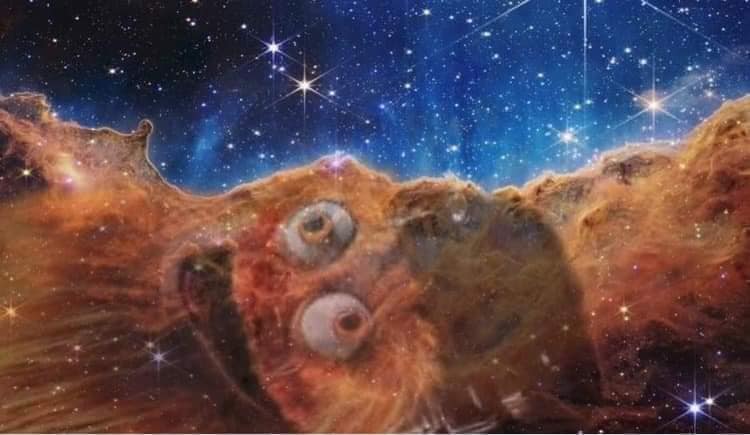
The meme features a screenshot of a cartoon character's shocked face, with the caption "The look on my face when I realize I've been arguing with a fascist for hours". From the perspective of the Anti-Fascism category, this meme is a humorous way to poke fun at the frustration and absurdity of engaging with individuals who promote fascist ideologies. The image is meant to convey the exasperation and incredulity of being in a conversation where one's views are being challenged by someone who is intentionally trying to provoke and mislead.
detailed-analysis (gemma3-27b-vision)
Okay, here's an analysis of the image, broken down into sections as requested. This is a somewhat surreal and unusual image, so the deeper theoretical lenses can be applied to explore the unsettling and thought-provoking aspects.
Visual Description
The image features a bizarre and surreal composition. Foregrounded is what appears to be a section of a large, brown, textured form—perhaps geological in nature, resembling a cliff face or a heavily textured organic structure. Embedded within this brown mass are at least three human eyeballs, looking upward. The eyeballs are disturbingly juxtaposed with the rough, earthy texture of the surrounding form.
The background is a vibrant, deep blue space filled with bright white stars and sparkling points of light. This creates a strong contrast between the organic, earthy foreground and the vast, infinite cosmos behind. The overall effect is dreamlike, uncanny, and unsettling. It evokes a sense of something ancient, alien, and potentially monstrous. The lighting emphasizes the texture and the eerie quality of the scene.
Foucauldian Genealogical Discourse Analysis
The image lends itself well to a Foucauldian reading. The juxtaposition of the eyeballs within the "earthly" structure can be seen as a manifestation of power/knowledge. The eyes are, historically, linked to surveillance, control, and the panoptic gaze. By embedding them within what appears to be a geological or organic mass, the image can be read as representing a discourse about control being inherent within the very fabric of existence, a deep-rooted system of surveillance embedded within nature itself.
A genealogical approach would investigate how this association of eyes/surveillance emerged historically. We could trace the development of systems of monitoring and control from ancient rituals to modern technologies. The image suggests that this need to observe and exert control isn't simply a modern phenomenon but is deeply ingrained in human (and potentially pre-human) history. The strangeness of the image disrupts a 'natural' understanding of eyes and how they are used, by placing them in an impossible context.
Critical Theory
From a Critical Theory perspective (drawing on the Frankfurt School), the image can be understood as reflecting alienation. The eyeballs, symbolic of consciousness and perception, are trapped within a massive, uncaring structure. This echoes the Marxist concept of alienation from the means of production, but extends it to a broader existential alienation—a sense of being lost and disconnected within a vast, impersonal universe.
The image challenges the notion of a unified, rational subject. The eyeballs, detached and seemingly lost within the larger structure, suggest a fragmentation of identity and experience. This fragmentation can be linked to the increasing rationalization and commodification of modern life, which erodes individual agency and authentic experience.
Postmodernism
The image strongly aligns with postmodern sensibilities. It disrupts traditional categories of meaning and challenges the notion of a coherent reality. The bizarre juxtaposition of eyeballs and earthy structure resists easy interpretation. It’s an example of pastiche – a combination of disparate elements that lack a clear overarching narrative.
The image is inherently meta – it draws attention to its own constructed nature. It's not a representation of something real, but a deliberate creation that questions the very possibility of representation. The ambiguity and lack of resolution are hallmarks of postmodernism, reflecting a rejection of grand narratives and a celebration of fragmentation and contingency. The visual language is unsettling and calls into question the nature of sight and perception.
Queer Feminist Intersectional Analysis
This is where the interpretation becomes more nuanced. The eyeballs, traditionally seen as organs of "seeing" and therefore of power and knowledge, are embedded in a body that is simultaneously geological and organic. This evokes questions of boundaries, permeability, and the disruption of established categories.
From a queer perspective, the image challenges heteronormative understandings of the body. The placement of the eyeballs could be seen as a deliberate destabilization of conventional notions of anatomy and corporeality. The image disrupts the idea of a fixed, coherent body.
Intersectionally, the image can be read as representing the experience of being marginalized or "buried" within systems of power. The eyeballs, symbolic of consciousness and voice, are silenced and constrained by the larger structure. It could be a metaphor for the silencing of marginalized voices within patriarchal, colonial, or other oppressive systems. It can be understood as an image that reflects the experience of having one's visibility and agency constrained by larger forces.
Let me know if you'd like me to expand on any of these interpretations, or explore other theoretical frameworks!
simple-description (llama3.2-vision)
The meme is a humorous image of the Hubble Space Telescope's Deep Space Image of the Carina Nebula. The image has been edited to include a cartoon-like, wide-eyed, and surprised face with an open mouth. The text "I can see your face now" is superimposed over the image.
tesseract-ocr
2 ee ard ant eee 2 oe s; a ¢ bs a a > am " " ja e a> = a ae