First Seen
2023-05-10T21:03:33+00:00
simple-description (llama3.2-vision_11b)
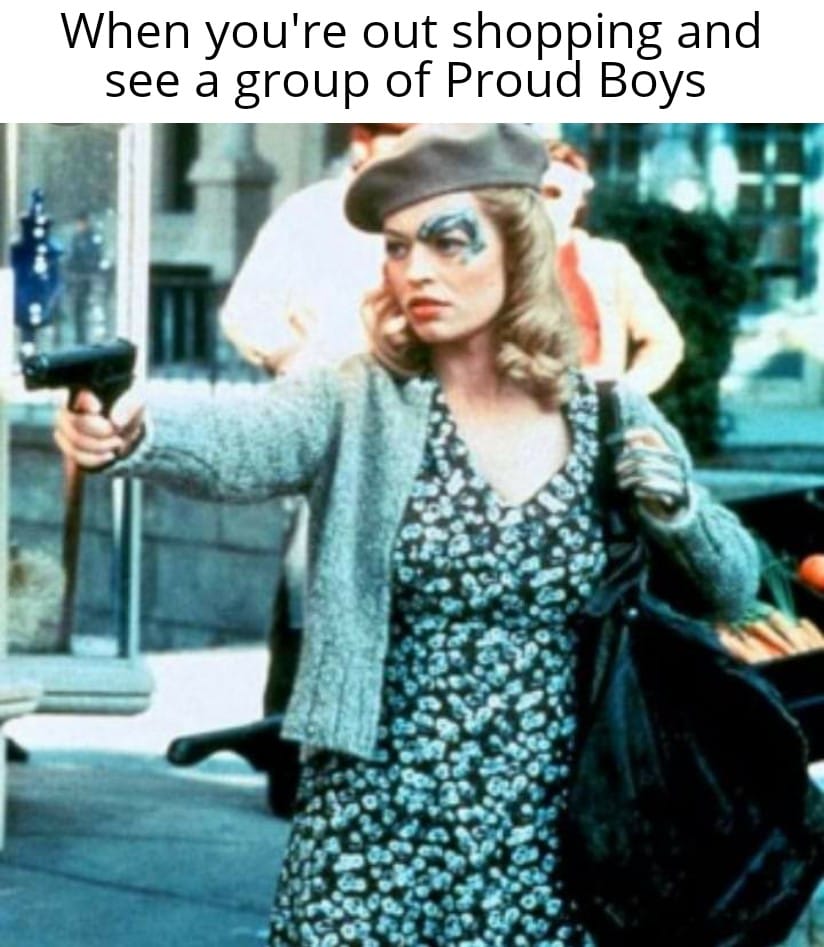
The meme features a still image from the 1979 film "The Warriors" where a character, Luther, is holding a gun and yelling at a group of people. The image is captioned "When you're out shopping and see a group of Proud Boys". The meme is a humorous commentary on the absurdity of being prepared for a confrontation with a group of far-right extremists while simply going about one's daily shopping.
detailed-analysis (gemma3-27b-vision)
Okay, let's break down this image and its accompanying text through the requested theoretical lenses. It's a complex meme, and the analysis will necessarily be interpretive.
Visual Description
The image depicts a dramatic still from the 1993 film, The Last Seduction. Linda Fiorentino portrays Kitty Tyler, a femme fatale character, holding a pistol. She is looking directly at the camera with a hostile expression. Her makeup is done in a somewhat exaggerated style. She’s dressed in a floral patterned dress with a teal cardigan. The overall tone is confrontational and possibly dangerous. The lighting is slightly washed-out, giving a gritty, cinematic feel. The text overlay reads, "When you're out shopping and see a group of Proud Boys."
Foucauldian Genealogical Discourse Analysis
This image, through the text, constructs a discourse pitting a historically marginalized identity (represented by the ‘Kitty Tyler’ character embodying camp and femininity) against a contemporary group associated with right-wing extremism and masculinity—the Proud Boys. A Foucauldian analysis focuses on the power relations embedded within this juxtaposition.
- Power/Knowledge: The image taps into a specific cultural knowledge about the 'Kitty Tyler' character as a force of agency, even potentially violence, and subversion. It re-codes this character to be a counter to the perceived threat of the Proud Boys. The assertion (through the meme) is that a display of strong feminine energy, even with a hint of danger, can “combat” or at least stand against their perceived threat.
- Discursive Shift: The image shifts the discourse from a narrative where the Proud Boys are seen as dominant actors, to one where a character embodying a counter-culture aesthetic stands up to them. This is achieved by utilizing a pre-existing cinematic image and attaching it to a contemporary political issue.
- Genealogy: A genealogical tracing of the concept of "masculinity" (as potentially embodied by the Proud Boys) versus traditionally marginalized femininity would reveal how these concepts are historically constructed through power dynamics. The image subverts the expected power dynamic between aggressive, masculine figures and traditionally vulnerable, feminine figures.
Queer Feminist Intersectional Analysis
This is where the image truly shines, opening a complex network of meaning:
- Subversion of Gender Performance: The image fundamentally disrupts traditional gender roles. The ‘Kitty Tyler’ character is deliberately portrayed as not the damsel in distress. She is the aggressive, potentially dangerous actor, turning the traditional power dynamic on its head.
- Intersectionality: The meme juxtaposes a historically marginalized gender expression (a femme fatale playing with gender roles in a 90’s film) with a contemporary right-wing group often associated with white supremacy and hyper-masculinity. The message isn’t just about gender, but about resisting all forms of oppressive power structures.
- Camp Aesthetics & Resistance: The meme utilizes the aesthetic of camp—exaggeration, irony, theatricality—as a form of resistance. The over-the-top makeup and dress of Kitty Tyler are not just stylistic choices but a deliberate rejection of normative expectations. Camp, as Susan Sontag argues, can be a powerful tool for subversion.
- Threat of Violence: The presence of a gun is significant. It hints at a readiness to defend oneself against a perceived threat – in this case, a group often associated with violence and intimidation. The image uses violence as a tool of resistance—a complex and potentially problematic, but intentionally provocative, choice.
Marxist Conflict Theory
From a Marxist perspective, the image can be read as a visual representation of class and ideological conflict.
- Power Dynamics: The Proud Boys represent a particular class and ideology, generally conservative and often associated with a perceived defense of traditional values. The meme positions the ‘Kitty Tyler’ character as a force opposing this ideology.
- False Consciousness: The image can be seen as a critique of the "false consciousness" perpetuated by groups like the Proud Boys – the idea that their ideology serves the interests of a privileged few while suppressing the rights and agency of others.
- Class Struggle: The image subtly suggests a “struggle” between different groups with competing interests – in this case, those who seek to uphold traditional power structures and those who challenge them.
Postmodernism
The image aligns with postmodern sensibilities in several ways:
- Pastiche/Intertextuality: The meme relies heavily on intertextuality—the referencing of a pre-existing cultural text (the film The Last Seduction). It blends this with contemporary political commentary.
- Irony and Meta-Commentary: The juxtaposition of the cinematic image and the text is ironic. It's not a literal depiction of a shopping trip, but a commentary on the perceived threat of the Proud Boys.
- Rejection of Grand Narratives: The image resists the notion of a single, overarching narrative. It acknowledges the fragmented and complex nature of contemporary politics and culture.
Critical Theory
In a broader critical theory framework, the image highlights:
- Ideology Critique: The image challenges the ideologies of both the Proud Boys and traditional gender norms. It asks us to question the power structures that reinforce these ideologies.
- Emancipatory Potential: The image suggests that resistance to oppression is possible, even through unexpected means (like a character from a 90’s film). It emphasizes the importance of challenging dominant power structures.
Let me know if you'd like me to elaborate on any of these interpretations or explore other theoretical lenses!
simple-description (llama3.2-vision)
The meme features a still image of a woman from the 1974 film "The God of The St St Tr e a r a o l e a r e o l a r e a r e o l e a r e o l e a r e a r e o l e a r e a r e o l e a r e a r e o l e a r e a r e a r e o l e a r e a r e a r e a r e a r e a r e a
tesseract-ocr
When you're out shopping and see a group of Proud Boys ikat.* ie © > P " Le .ea. ; 7 r * # 4 cpa we Ilowe / ot as alae. “ . Sites cS : Dae? ‘Si ad " ~~ ° ) BS ag a empegenie Sy 7 ee a ? Sm et ee : EY ng at - 1 A K LMS Ee ES ee ee ee RT