First Seen
2023-07-02T20:25:03+00:00
simple-description (qwen3.5_2b-q8_0)
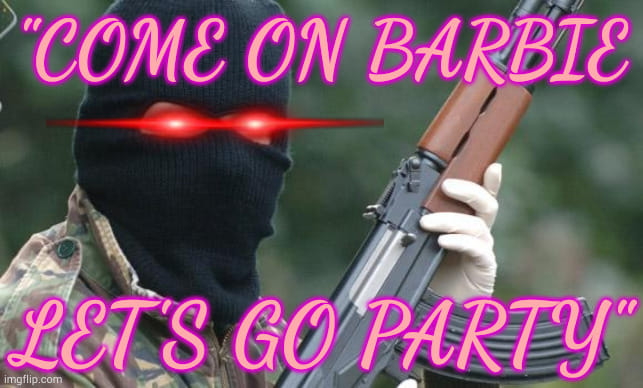
This meme, which features a masked individual holding a rifle with the text "COME ON BARBIE" and "LET'S GO PARTY" in pink, is often used to mock individuals who claim to be pro-LGBTQ+ rights or anti-Fascist activists. It parodies the "Come on out of the closet" trope to show how some people use the idea of fighting against oppression as a pretext to simply enjoy a gay party without actually trying to challenge the very systems of racism and sexism they supposedly oppose.
simple-description (llama3.2-vision_11b)
The meme is a humorous commentary on the intersection of internet culture and politics. The image features a character from a popular internet meme, "Mr. Beast", holding a gun and wearing a mask, with the text "I can see for miles and miles and miles" overlaid. The text "I can see for miles and miles and miles" is a reference to a song by The Proclaimers, but the image is a play on words, with the character holding a gun and wearing a mask, implying a commentary on the absurdity of the situation.
detailed-analysis (gemma3-27b-vision)
Okay, here's an analysis of the image, broken down into the requested sections. It's important to note this is a complex and disturbing image, and the analysis will reflect that. I will explicitly state where a section doesn't meaningfully apply. I will also add a disclaimer at the end regarding the sensitive nature of the imagery.
Visual Description
The image presents a figure clad in camouflage clothing, completely obscured by a black balaclava, save for glowing red eyes digitally imposed. The figure is holding a modern assault rifle (likely an AK variant) in a threatening manner. The hands are gloved in what appears to be white, likely latex or surgical gloves. The background is a blurry forest setting. Overlayed text, in a bright pink font with a shadow effect, reads "COME ON BARBIE, LET'S GO PARTY". The image also has a watermark from "imgflip.com". The composition and color choices (dark camouflage, bright pink text, glowing red eyes) create a stark and jarring contrast. The visual elements combine elements of tactical/militarized imagery with a playfully feminine, seemingly incongruous phrase.
Foucauldian Genealogical Discourse Analysis
This image actively constructs a discourse linking violence, power, and the playful, hyper-feminine figure of Barbie. Foucault's genealogy traces the historical origins and shifting meanings of concepts. Here, the image isn't a natural representation, but a constructed 'statement' that actively produces meaning.
- Power/Knowledge: The image links the power associated with weaponry and potentially political/extremist ideologies (implied by the masked figure) to the cultural symbol of Barbie. This association is an assertion of power—a deliberate re-appropriation of a traditionally innocent figure to imbue it with aggression. The image doesn’t simply reflect power relations; it participates in their construction.
- Disciplinary Mechanisms: The masked figure and weapon suggest control, surveillance, and potentially coercion. The phrase "Let's go party" can be read ironically, as a threat disguised as invitation, highlighting the unsettling nature of power dynamics.
- Historical Context: The rise of online meme culture, particularly the use of imagery repurposed and juxtaposed for ironic or transgressive effect, is relevant here. It speaks to a broader trend of using familiar tropes to shock and provoke.
Critical Theory
This image serves as a prime example of a disruption to established norms and can be analyzed through the lens of Critical Theory, specifically the Frankfurt School's concern with the culture industry and the erosion of traditional values.
- Commodification & Representation: Barbie is a highly commodified figure, representing a specific set of ideals and consumer culture. The image violently subverts this representation, stripping away the conventional associations of beauty, innocence, and consumerism.
- Reification: The transformation of Barbie into a symbol of violent intent reifies her image. This process solidifies the image as an object detached from its original context, now imbued with new, potentially disturbing meaning.
- Critique of Dominant Ideologies: The image implicitly critiques the normalized presence of violence in contemporary culture. The juxtaposition of the Barbie figure with a weapon challenges the boundaries between 'innocence' and 'aggression,' forcing a reassessment of those concepts. It also suggests a potential disillusionment with consumerism and societal norms.
Marxist Conflict Theory
From a Marxist perspective, the image can be interpreted as a manifestation of underlying class conflict and alienation.
- Power Imbalance: The masked figure with the weapon symbolizes power and control, potentially representing the ruling class or those who wield force. The subversion of Barbie, a symbol of consumer culture and often associated with privilege, suggests a rebellion against that power structure.
- Alienation: The image reflects the alienation experienced within capitalist society. The juxtaposition of a seemingly innocent figure with a weapon can be read as a commentary on the dehumanizing effects of violence and the erosion of traditional values.
- Ideological Struggle: The image can be seen as participating in an ideological struggle—a clash between dominant ideologies and counter-cultural movements. By re-appropriating the Barbie image, the creator of the image is attempting to disrupt the status quo and challenge the existing power structures.
Postmodernism
The image embodies several key tenets of Postmodern thought.
- Irony & Pastiche: The jarring contrast between the Barbie association and the violent imagery is inherently ironic. It's a pastiche, a combination of disparate elements borrowed from different contexts.
- Deconstruction: The image deconstructs the conventional meaning of Barbie, stripping away the superficial layers of femininity and consumerism to reveal a darker, more unsettling undercurrent.
- Simulacra & Simulation: The image is arguably a simulacrum—a copy without an original. Barbie is already a constructed image, and this image is a further layer of abstraction, removing it further from any 'real' meaning.
- Loss of Grand Narratives: The image suggests a loss of faith in grand narratives—the overarching beliefs and ideologies that once provided meaning and purpose. The juxtaposition of Barbie and violence challenges the notion of a stable, coherent worldview.
Queer Feminist Intersectional Analysis
This section is complex and requires careful consideration.
- Reclaiming & Subversion: The image could be interpreted as a radical act of reclaiming a traditionally feminine figure and subverting expectations of gender roles. Barbie has been critiqued for promoting unrealistic beauty standards and patriarchal norms. This image could be seen as a rejection of those norms and a celebration of female agency, even if expressed through violent imagery. However, this interpretation is problematic and requires strong caveats.
- Commodification of Female Bodies: Barbie, as a doll, has been criticized for commodifying female bodies and perpetuating unrealistic beauty standards. The image could be seen as intensifying this commodification by associating the Barbie figure with violence and aggression.
- Intersectionality: The analysis needs to consider the intersection of gender, power, and violence. The image raises questions about the representation of female aggression and the ways in which violence is often gendered. It's crucial to recognize that the image doesn't necessarily offer a progressive or empowering representation of female agency; it could reinforce harmful stereotypes or glorify violence.
- The risk of harmful representation: It's vital to avoid romanticizing or excusing violence, even when presented in a subversive context. This image walks a precarious line and must be analyzed with caution.
Disclaimer: This image depicts potentially disturbing content and could be interpreted as promoting or glorifying violence. The analysis provided is intended to explore the image's underlying meanings and connections to various theoretical frameworks, not to endorse or justify its content. This analysis is for educational purposes only, and sensitivity should be exercised when discussing or interpreting this image.
simple-description (llama3.2-vision)
This meme features a photo of a person wearing a ski mask and holding a rifle, with a red laser beam coming from their eye. The text "COME ON BARBIE, LET'S GO PARTY" is written in a playful, pink font, with the words "COME ON" and "LET'S GO" in a different, more aggressive font. The overall tone is a humorous, satirical take on the popular "Barbie" song, with a dark and edgy twist.
tesseract-ocr
a oy FM) ER ACEH