First Seen
2024-03-05T07:20:09.835493+00:00
simple-description (qwen3.5_2b-q8_0)
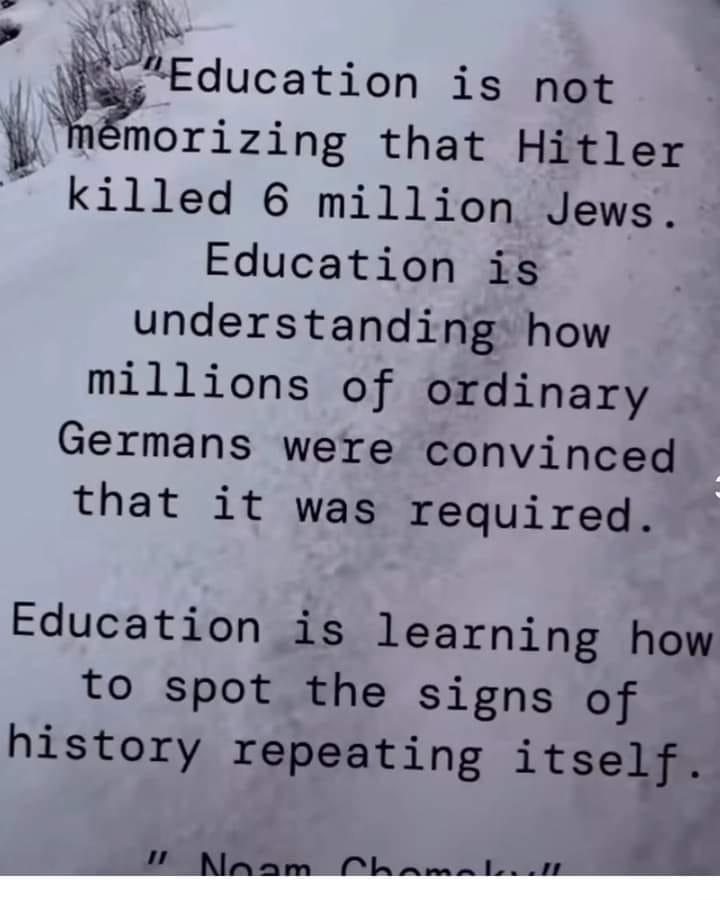
This anti-fascist quote by Noam Chomsky challenges the "education for peace" narrative, arguing that simply memorizing specific historical tragedies does not truly educate the public. It suggests that instead of just knowing that Hitler killed 6 million Jews, we must understand how ordinary Germans believed the logic of racial survival was "required." By highlighting how history might repeat itself, the meme implies that by ignoring the deep-seated ideology of fascism, we allow its logic to remain dormant and dangerous in our present world.
simple-description (llama3.2-vision_11b)
This meme is a satirical commentary on the dangers of anti-Semitism and the importance of education in combating it. The image shows a quote from a book by a historian who is not known for being anti-Semitic, but the quote is presented in a way that implies it is from a Nazi or fascist. The meme is saying that even someone who is not anti-Semitic can be misled into thinking that the Holocaust was not real, and that education is necessary to prevent this from happening.
detailed-analysis (gemma3-27b-vision)
Here's an analysis of the image, broken down into sections as requested. Note that not all sections are equally relevant, and some may have limited application.
Visual Description
The image presents a text quote overlaid on a dark, textured background. The text is white and appears to be in a sans-serif font. The background appears to be a close-up photograph of a dark textured material, perhaps fabric. The quote is attributed to Noam Chomsky. It reads:
"Education is not memorizing that Hitler killed 6 million Jews. Education is understanding how millions of ordinary Germans were convinced that it was required. Education is learning how to spot the signs of history repeating itself."
The overall aesthetic is somewhat stark and focuses the viewer’s attention on the text itself. The dark background may be intended to evoke a sense of gravity or seriousness, as it relates to a weighty historical subject.
Foucauldian Genealogical Discourse Analysis
This quote lends itself powerfully to Foucauldian analysis. Foucault was concerned with how knowledge itself is a form of power and how discourses create and maintain power relations. The statement emphasizes a shift from memorizing a ‘fact’ (Hitler killed 6 million Jews) to understanding the processes that made this possible.
- Discourse and Power: The quote implicitly critiques the dominant discourse surrounding the Holocaust, which often focuses on the perpetrators’ individual evil. It points toward a deeper, more complex discourse that involves social, political, and ideological factors that enabled mass violence. It asks how was it possible for so many “ordinary” people to participate, not just who committed the act.
- Genealogy: A Foucauldian genealogical approach would attempt to trace the historical conditions, power dynamics, and discourses that contributed to the acceptance of such atrocities. It would not seek a singular cause but map the interplay of various forces. It would look at the practices that normalized hateful ideologies and dehumanized Jews, and how these practices built on previous histories.
- Subjectivation: The statement highlights how "ordinary Germans" were subjected to a system of belief that made the Holocaust possible. Their participation wasn’t simply about individual malice but about being produced as subjects within a specific historical and discursive formation.
Critical Theory
The quote exemplifies a core tenet of Critical Theory, which emphasizes the importance of understanding the underlying structures and power dynamics that shape society.
- Critique of Positivism: The rejection of simple memorization (“Hitler killed 6 million Jews”) as the goal of education is a direct critique of positivist approaches to knowledge. Positivism focuses on observable facts, while Critical Theory is concerned with the social and historical context that gives rise to those facts.
- Ideology: The statement implicitly suggests that the Holocaust wasn’t simply a matter of individual evil but was facilitated by an ideology that convinced people it was “required.” Critical Theory is deeply concerned with how ideologies function to maintain power structures.
- Emancipation: The emphasis on learning to “spot the signs of history repeating itself” implies a desire for emancipation—a freeing from oppressive structures. By understanding the mechanisms that led to the Holocaust, we can potentially prevent similar atrocities from happening again.
Marxist Conflict Theory
While not the primary focus, elements of Marxist conflict theory can be detected.
- Class and Ideology: One could argue that the indoctrination of "ordinary Germans" was linked to the maintenance of power structures within German society, possibly benefiting certain classes or groups. The ideology that justified the Holocaust may have served to suppress internal conflict and consolidate power.
- False Consciousness: The statement implies that many Germans were operating under a "false consciousness"—a state of being unaware of the true nature of their social and political situation. This lack of awareness allowed them to participate in a system that ultimately harmed others.
Postmodernism
The statement challenges the idea of a single, objective truth about the Holocaust.
- Deconstruction of Narrative: By shifting the focus from what happened to how it happened, the statement implicitly challenges dominant narratives that present the Holocaust as a simple case of good versus evil. It asks us to examine the complex web of factors that contributed to the event.
- Rejection of Grand Narratives: The statement indirectly rejects the notion of "grand narratives" (e.g., the narrative of historical progress). It suggests that history is not a linear progression toward a better future but a complex and often chaotic process that can repeat itself.
Queer Feminist Intersectional Analysis
This lens is the least directly applicable, but some connections can be made:
- Marginalization and Othering: The Holocaust involved the systematic dehumanization and "othering" of Jews, a process that shares similarities with other forms of oppression based on gender, sexuality, or race. Queer feminist theory examines how power operates through the creation and enforcement of norms and the marginalization of those who deviate from them.
- Intersectionality: While the quote doesn't explicitly mention intersectionality, the Holocaust involved multiple layers of oppression. Jewish people who were also women, disabled, or members of other marginalized groups faced additional forms of discrimination and violence. Understanding these intersecting oppressions is crucial for a complete understanding of the Holocaust.
Let me know if you'd like me to elaborate on any of these sections or explore a different analytical framework!
simple-description (llama3.2-vision)
The meme is a satirical commentary on the lack of education in today's society. It presents a quote from Noam Chomel... (the text is cut off) and then states that education is not memorizing that Hitler killed 6 million Jews. The text then continues with a quote that is also cut off. The text appears to be a satirical commentary on the lack of education in today's society.
tesseract-ocr
- Jj ¥. RNS, . Je"Education is not { Stenorizing that Hitler ~ killed 6 million Jews. Education is understanding how millions of ordinary Germans were convinced that it was required. Education is learning how to spot the signs of history repeating itself. ae ——