First Seen
2024-08-11T22:30:54.747984+00:00
simple-description (qwen3.5_2b-q8_0)
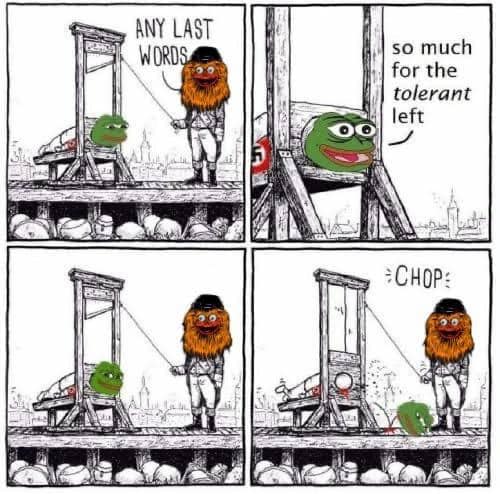
This anti-fascist meme depicts a dictator (the bearded figure) using a guillotine with a Nazi swastika to threaten a political opponent. The text "ANY LAST WORDS" suggests a final ultimatum, while "CHOP" at the end signifies the violent crushing and defeat of the fascist regime. The line "so much for the tolerant left" adds a critique against politicians who fail to stop such extremism.
simple-description (llama3.2-vision_11b)
The meme is a humorous take on the concept of the guillotine, a symbol of the French Revolution's execution of King Louis XVI, but with a twist. The image shows a cartoon guillotine with a caption "I can explain it in 3 minutes" and a figure on the guillotine with a speech bubble saying "I'm sorry, I'm going to have to cut you off". The meme is poking fun at the idea that someone is trying to explain a complex topic, but is being cut off by the guillotine, a reference to the historical use of the guillotine as a method of execution.
detailed-analysis (gemma3-27b-vision)
Here's an analysis of the image, broken down by the requested theoretical frameworks. It's important to note this is a highly charged image, utilizing internet meme culture, and interpretation can be subjective. I'll aim for a balanced approach, outlining potential readings.
Visual Description
The image is a four-panel comic depicting a cartoon frog ("Pepe the Frog", a meme co-opted by alt-right groups) being executed by guillotine.
- Panel 1: A man with a large beard and wearing a classic, somewhat formal outfit (possibly intended to evoke a historical revolutionary figure, or even a caricature of a "bourgeois" intellectual) is poised to release the blade of a guillotine. The frog is strapped into the device. Text reads "ANY LAST WORDS?"
- Panel 2: The frog, with an exaggerated grimace, says "so much for the left."
- Panel 3: The man pulls the lever and the blade begins its descent.
- Panel 4: The blade has fallen, and a splatter of red (presumably blood) is visible. Text reads “CHOP.”
The style is intentionally crude, resembling a hand-drawn comic strip. The background appears to be a crowd represented as a mass of white shapes, suggesting a mob or an audience. The overall mood is violent and sardonic.
Foucauldian Genealogical Discourse Analysis
This image can be read as a visual articulation of a discourse about "the left" and its perceived failures or "demise." Foucault’s genealogical method focuses on power/knowledge relations and the historical construction of meanings.
- Power/Knowledge: The image positions a specific authority figure (the bearded man) in a position to enact violence upon the symbol of "the left" (the frog). This is a visual enactment of power – the power to define, judge, and eliminate. The choice of the guillotine, historically associated with the French Revolution and the Reign of Terror, is crucial. It establishes a discourse of radical politics and punishment.
- Discontinuity and Historical Contingency: The use of a historically loaded symbol (guillotine) alongside a modern internet meme highlights the disjointed nature of contemporary political discourse. The meme is detached from its original context (originally a harmless cartoon frog) and repurposed within a new power dynamic, illustrating the malleability of meaning.
- Discursive Formation: This image participates in the discursive formation of a narrative that positions "the left" as something to be destroyed, as failing or “dying” in some way. It creates a specific logic and set of associations around this concept.
Critical Theory
Following the Frankfurt School tradition, we can read this image through a lens of societal critique.
- Instrumental Reason: The image can be seen as a critique of the way rational thought (the seemingly ‘logical’ act of execution) is used to enforce a specific ideology. The image suggests a cold, calculating dismissal of "the left" justified by some (unspecified) reasoning.
- Culture Industry & Propaganda: The use of a meme, a product of digital culture, points to how ideologies can be disseminated through popular culture. The image functions as a sort of political "meme" – a condensed, shareable expression of a particular viewpoint. It could be argued that it's propaganda designed to demonize and delegitimize leftist thought.
- Authoritarian Tendencies: The image hints at a yearning for a forceful, decisive solution to perceived political problems. The violence of the execution suggests a rejection of dialogue and compromise.
Marxist Conflict Theory
From a Marxist perspective, the image represents a visual articulation of class struggle or ideological conflict.
- Ideology and False Consciousness: The image attempts to portray "the left" as a destructive force deserving of elimination. This can be seen as a manifestation of dominant ideological forces attempting to suppress opposing viewpoints.
- Power Dynamics: The image depicts a clear imbalance of power – the man (potentially representing the ruling class or a conservative ideology) wielding the power to destroy the symbol of "the left."
- Revolutionary Violence: The use of the guillotine suggests a radical rejection of the existing order. However, it is important to note that in this instance, the violence is directed against a symbol of the left, rather than being used in a revolutionary struggle.
Postmodernism
A postmodern reading focuses on the image's self-referentiality, fragmentation, and rejection of grand narratives.
- Simulacra and Simulation: The image is a simulation of an execution, lacking any real-world consequences. It is a representation of a representation, divorced from any authentic experience.
- Deconstruction of Meaning: The image undermines any fixed definition of “the left.” It treats it as a floating signifier, a symbol devoid of inherent meaning.
- Irony and Parody: The image’s sardonic tone and juxtaposition of historical symbolism with internet culture create a sense of ironic detachment. It is difficult to discern whether the image is meant to be taken seriously or as a form of parody.
- Meta-Narratives: The image questions (or attempts to dismantle) the meta-narrative of progress, justice, or revolutionary change.
Queer Feminist Intersectional Analysis
This is the most challenging framework to apply directly. However:
- Power and Marginalization: The image can be seen as an extension of broader systems of power that marginalize and silence dissenting voices. "The left" is positioned as disposable, echoing the experiences of other marginalized groups.
- Violence as a Tool of Control: The act of execution is a metaphor for the ways in which dominant forces attempt to control and eliminate those who challenge the status quo. This resonates with feminist critiques of patriarchal violence.
- Co-optation of Symbols: The frog's origin as a harmless meme being co-opted and used to express violent and extremist views illustrates how symbols can be manipulated to reinforce oppressive ideologies. This is often seen in the co-opting of LGBTQ+ symbolism by harmful actors.
- Intersectionality: While not directly present, one can view the destruction of "the left" as an attack on various intersecting struggles for social justice, including those related to gender, sexuality, race, and class.
Important Considerations:
It is crucial to acknowledge that this image is highly contentious and can be interpreted in multiple ways. Its use of a meme associated with the alt-right raises serious ethical concerns. The analysis provided here is intended to be a critical examination of the image's potential meanings and implications, not an endorsement of its ideology.
simple-description (llama3.2-vision)
The meme is a four-panel comic strip featuring the character of PogChamp, a popular internet meme, in a guillotine scenario. The first panel shows PogChamp in the guillotine, with a sign that reads "ANY LAST WORDS?" The second panel shows PogChamp's response, "SO MUCH FOR THE TOLERANT LEFT". The third panel shows PogChamp's execution, with a sign that reads "CHOP". The fourth panel shows PogChamp's head being removed from the guillotine, with a sign that reads "SO MUCH FOR THE TOLERANT LEFT". The meme is a satirical commentary on the internet's "troll" culture and the concept of "trolling" as an internet phenomenon.