First Seen
2025-03-08T20:52:12.982974+00:00
simple-description (qwen3.5_2b-q8_0)
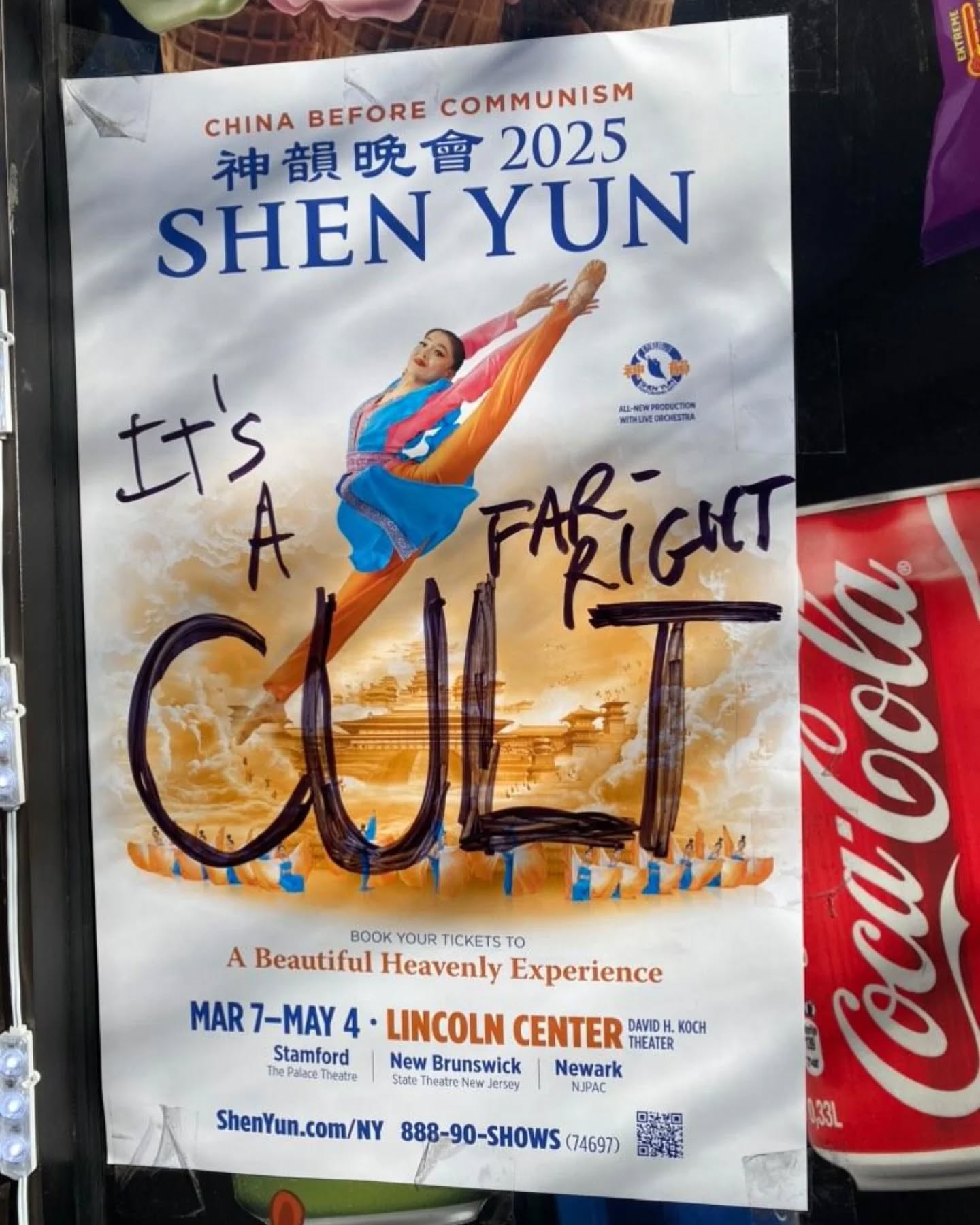
The handwritten phrase "It's a FAR-CULT" appears on the poster as an anti-fascist joke. It plays on the double meaning of the word "cult," implying that Shen Yun is a radical, far-right, or fascist group, which satirizes the idea of small organizations with extremist ideologies. This is a common rhetorical strategy used to mock political extremism while seemingly praising the artistic show.
detailed-analysis (gemma3_27b-it-q8_0)
Here's an analysis of the image—a Shen Yun poster defaced with "It's a Far Right Cult"—from an Anti-Fascist perspective, broken down into relevant theoretical frameworks.
Visual Description
The image shows a Shen Yun performing arts group advertisement poster. The poster depicts a dancer in traditional attire, set against a backdrop of a golden, idealized classical Chinese architectural landscape. The poster is boldly marked with spray-painted graffiti reading "It's a Far Right Cult." A bottle of Coca-Cola is prominently placed to the right, providing a stark contrast with the traditional imagery. The poster advertises performances in multiple locations (Stamford, New Brunswick, Newark) and provides a website and phone number for ticketing. The year "2025" is also visible. The color scheme is dominated by gold, red, and white, with the graffiti in black.
Foucauldian Genealogical Discourse Analysis
From a Foucauldian perspective, this graffiti isn't simply a labeling act, but an intervention into a discourse. Shen Yun doesn't present itself as merely a cultural performance; it constructs a narrative about China, about spirituality, about tradition, and implicitly, about the current Chinese government (which it subtly opposes). This narrative is not neutral.
Shen Yun's discourse constructs an idealized pre-communist China, a "Golden Age," inherently implying a critique of the People's Republic of China. The "Heavenly Experience" tagline suggests a spiritual purity lost under communism. This, however, isn't about a genuine preservation of culture, but the creation of a specific version of it that serves a particular ideological purpose.
The graffiti then actively disrupts this constructed discourse. It re-frames Shen Yun not as a cultural offering, but as a "cult." "Cult" isn’t a neutral term; it carries connotations of manipulation, authoritarianism, and dangerous ideology. This reframing challenges the legitimacy of Shen Yun’s narrative. The genealogy of this labeling reveals a history of concern about Shen Yun's connections to the Falun Gong movement, which has a complex history of political and religious motivations (often framed as resistance to the CCP, but also prone to conspiratorial thinking and aggressive recruitment).
The act of graffiti itself is a form of counter-discourse, a challenge to the power to define what is considered legitimate art or cultural expression. It's an attempt to expose the underlying ideological apparatus at work.
Critical Theory
Critical Theory would view the image as a manifestation of the culture industry. Shen Yun, though positioned as an alternative to mainstream entertainment, still functions as a commodity within capitalist structures. Its “authenticity” is manufactured and marketed to a specific audience, appealing to a desire for “spiritual” or “traditional” experiences. The Coca-Cola bottle juxtaposed with the poster speaks to the inherent contradictions of capitalism – the globalized consumer culture coexisting with the illusion of cultural preservation.
The graffiti is a critical intervention, attempting to demystify Shen Yun’s presentation. It exposes how culture can be used to propagate specific ideologies, in this case, an ideology that aligns with far-right themes. Critical Theory argues that seemingly neutral cultural products are always embedded with power relations and contribute to maintaining existing social hierarchies. The “Heavenly Experience” is not just a performance, but an ideological tool.
Marxist Conflict Theory
From a Marxist perspective, this image highlights a clash of ideologies and power dynamics. The underlying conflict here is not just about cultural expression but about political and economic control.
- The Commodification of Culture: Shen Yun represents the commodification of Chinese culture, turning it into a product for consumption, primarily by Western audiences.
- Ideological Struggle: The poster's presentation of a romanticized pre-communist China serves to delegitimize the current socialist government in China. This aligns with Western geopolitical interests.
- Class Dynamics: Attending Shen Yun performances is a leisure activity primarily accessible to those with disposable income, reinforcing class divisions.
- The Graffiti as Resistance: The graffiti itself can be seen as a form of class consciousness and resistance – a rejection of the commodified and ideologically loaded spectacle offered by Shen Yun. The act is a public assertion that this cultural offering isn't simply entertainment but a vehicle for potentially harmful ideas.
Postmodernism
A Postmodern reading would emphasize the constructedness of "authenticity" and the deconstruction of grand narratives. Shen Yun relies on the idea of a singular, authentic Chinese culture, a "Golden Age" that can be recovered. Postmodernism would challenge this notion, arguing that cultures are fluid, fragmented, and constantly evolving.
The graffiti contributes to this deconstruction. It exposes the instability of meaning. Is Shen Yun "art" or a "cult"? The graffiti forces us to question the categories themselves and recognize that meaning is not inherent but is created through discourse and power relations.
The Coca-Cola bottle also embodies postmodern fragmentation. It represents globalized consumer culture, a symbol of late capitalism that disrupts any sense of cultural purity.
Anti-Fascist Considerations
The label "Far Right Cult" is key within an anti-fascist context. While Shen Yun is not explicitly a fascist organization, its rhetoric and appeal resonate with several themes common in far-right ideology:
- Nostalgia for a Romanticized Past: The focus on a "Golden Age" of pre-communist China evokes a longing for a mythical past, a common tactic of nationalist and far-right movements.
- Anti-Communism: Its implicit and sometimes explicit anti-communist stance aligns with historical anti-leftist sentiments used to justify authoritarianism.
- Spiritual Nationalism: The emphasis on spirituality and traditional values can be a vehicle for nationalist and exclusionary ideologies.
- Cult-Like Recruitment Practices: Reports of aggressive marketing, intense devotion from followers, and conspiracy-minded narratives surrounding Falun Gong raise concerns about cult-like tendencies.
- Connection to Right-Wing Networks: Shen Yun has been promoted and supported by figures and groups on the far right.
The graffiti is, therefore, a political statement, aimed at warning potential audiences about the ideological undercurrents of Shen Yun and its connection to dangerous political tendencies. It’s an attempt to prevent the normalization of far-right ideas disguised as cultural performance.
Disclaimer: It's important to note that the labeling of something as "far right" is complex and requires careful consideration. This analysis is based on a specific political framework and is intended to provide one perspective on the image.
simple-description (llama3.2-vision_11b)
The meme is a satirical image of a Chinese opera performance poster, with a dancer in a traditional Chinese costume, but with a twist: the dancer is holding a sign that says "It's a Cult" in bold letters. The image is meant to poke fun at the idea that the Chinese government's propaganda and cultural events are often used to control and manipulate the population, with the phrase "It's a Cult" implying that the Chinese government's influence is so pervasive and controlling that it's like a cult. The text "It's a Cult" is written in a bold, graffiti-like font, adding to the satirical tone of the image.
detailed-analysis (gemma3-27b-vision)
Okay, let's break down this image of a Shen Yun poster, through the lenses you've requested.
Visual Description
The image is a photograph of a Shen Yun performance poster displayed behind what appears to be a clear plastic display case, likely in a store. The poster features a central image of a dancer in traditional Chinese attire, arms outstretched in a dramatic pose, seemingly leaping or suspended in mid-air. The dancer is wearing a bright blue and pink costume. The background is a deep blue. Text is prominent, with "SHEN YUN" in large letters. Superimposed over the dancer is graffiti-style text reading "It's A CULT" and "FARIGHT" (possibly "Far Right"). Below the central image, the poster details the show's performance locations (Lincoln Center, Stamford, New Brunswick, Newark) and dates (March 7 - May 4, 2024). A website address and phone number are also included. There's a QR code for ticket purchase. To the right of the poster is a stack of Coca-Cola cans, providing a jarring contrast of consumer culture with the poster’s imagery. The overall impression is one of confrontation – the pristine presentation of the Shen Yun marketing materials marred by direct, accusatory vandalism.
Foucauldian Genealogical Discourse Analysis
A Foucauldian analysis would examine how the categories of "cult" and "far-right" have come to be defined, and how this poster performs these definitions. The graffiti isn't just stating a fact, it’s an intervention in the discourse surrounding Shen Yun.
- Power/Knowledge: The act of labeling Shen Yun a "cult" and associating it with the "far right" is an assertion of power. The person(s) who wrote this are claiming the authority to define Shen Yun, potentially aiming to limit its reach or delegitimize it. The very act of tagging the poster creates a discourse – it forces viewers to consider these labels.
- Genealogy: Tracing the genealogy of "cult" and "far right" would reveal how these terms evolved. “Cult” historically tied to religious deviance, now used more broadly for groups with extreme ideologies and manipulative practices. "Far right" emerges from a specific political context, denoting extremist nationalism, often with racist undertones. By applying these labels to Shen Yun, the graffiti seeks to tap into existing anxieties and condemnations surrounding these categories.
- Disciplinary Power: The poster, even vandalized, functions as a form of discipline. Shen Yun seeks to present a specific vision of Chinese culture (often tied to pre-communist aesthetics) and its values. The graffiti disrupts that presentation, seeking to control the narrative and re-frame Shen Yun’s message.
Critical Theory
From a critical theory perspective, this image reveals the underlying power dynamics at play.
- Ideology: Shen Yun presents a carefully constructed image of traditional Chinese culture, but critics argue that it is heavily infused with the ideology of the Falun Gong spiritual movement (which Shen Yun is closely linked to). The show often portrays a romanticized, pre-communist China, while omitting complex historical realities.
- Hegemony: Shen Yun's marketing aims to establish a hegemonic (dominant) narrative about Chinese culture. The poster (and the show itself) seeks to shape public perception.
- Counter-Hegemony: The graffiti is a clear act of counter-hegemony. It’s a direct attempt to disrupt Shen Yun's narrative and challenge its authority. The vandal is not accepting the promoted version of Chinese culture and is actively resisting it through public critique.
- Commodification of Culture: The presence of the Coca-Cola cans is particularly significant. It highlights how cultural expression (Shen Yun’s performances) can become commodified and intertwined with consumer culture, potentially obscuring its original meaning or authenticity.
Marxist Conflict Theory
From a Marxist perspective, the image can be analyzed as a manifestation of class struggle and ideological conflict.
- Ideological Struggle: Shen Yun presents a particular ideological vision that implicitly critiques the communist regime in China. The Falun Gong movement, which is associated with Shen Yun, has been heavily persecuted by the Chinese government. The poster represents a struggle over the definition of Chinese culture and history.
- Dominant vs. Subordinate Groups: The Chinese Communist Party represents the dominant group, controlling the narrative within China. Shen Yun, through its performances and marketing, attempts to present a counter-narrative from outside of China. The graffiti suggests a further level of conflict, with individuals challenging both the communist regime and the Falun Gong-associated narrative presented by Shen Yun.
- False Consciousness: Critics of Shen Yun argue that it presents a romanticized, distorted view of Chinese history, potentially masking the complex social and economic inequalities that existed in pre-communist China. This could be seen as a form of “false consciousness”, where the audience is misled about the true nature of the past.
Postmodernism
A postmodern analysis would focus on the fragmentation of meaning and the questioning of grand narratives.
- Deconstruction of Meaning: The graffiti actively deconstructs the intended meaning of the Shen Yun poster. It challenges the authenticity and authority of the performance.
- Rejection of Grand Narratives: The poster and the graffiti both reflect a rejection of simple, monolithic narratives about Chinese culture and history. Shen Yun presents a curated version, while the graffiti challenges that curation.
- Simulacra and Simulation: Some might argue that Shen Yun’s performances represent a “simulacrum” – a copy without an original. The show presents a stylized, idealized version of Chinese culture that may bear little resemblance to lived reality.
- Intertextuality: The image demonstrates intertextuality – the interplay of different texts (the poster, the graffiti, the Coca-Cola cans). Each element contributes to a complex and multifaceted meaning.
It's important to note: The image is provocative and raises complex questions. The graffiti, while arguably a form of protest, is also an act of vandalism. The analysis presented here is based on interpreting the visual elements and considering the potential implications, but definitive interpretations are subjective.
Let me know if you'd like me to delve deeper into any of these perspectives!
simple-description (llama3.2-vision)
This meme is a photo of a poster for the 2025 Shen Yun performance, a Chinese cultural show. The poster is defaced with black marker to read "It's a cult" and "It's a far right" in a sarcastic, humorous tone, implying that the show's cultural and spiritual themes are being perceived as extreme or oppressive.