First Seen
2025-04-01T00:13:05.974526+00:00
simple-description (qwen3.5_2b-q8_0)
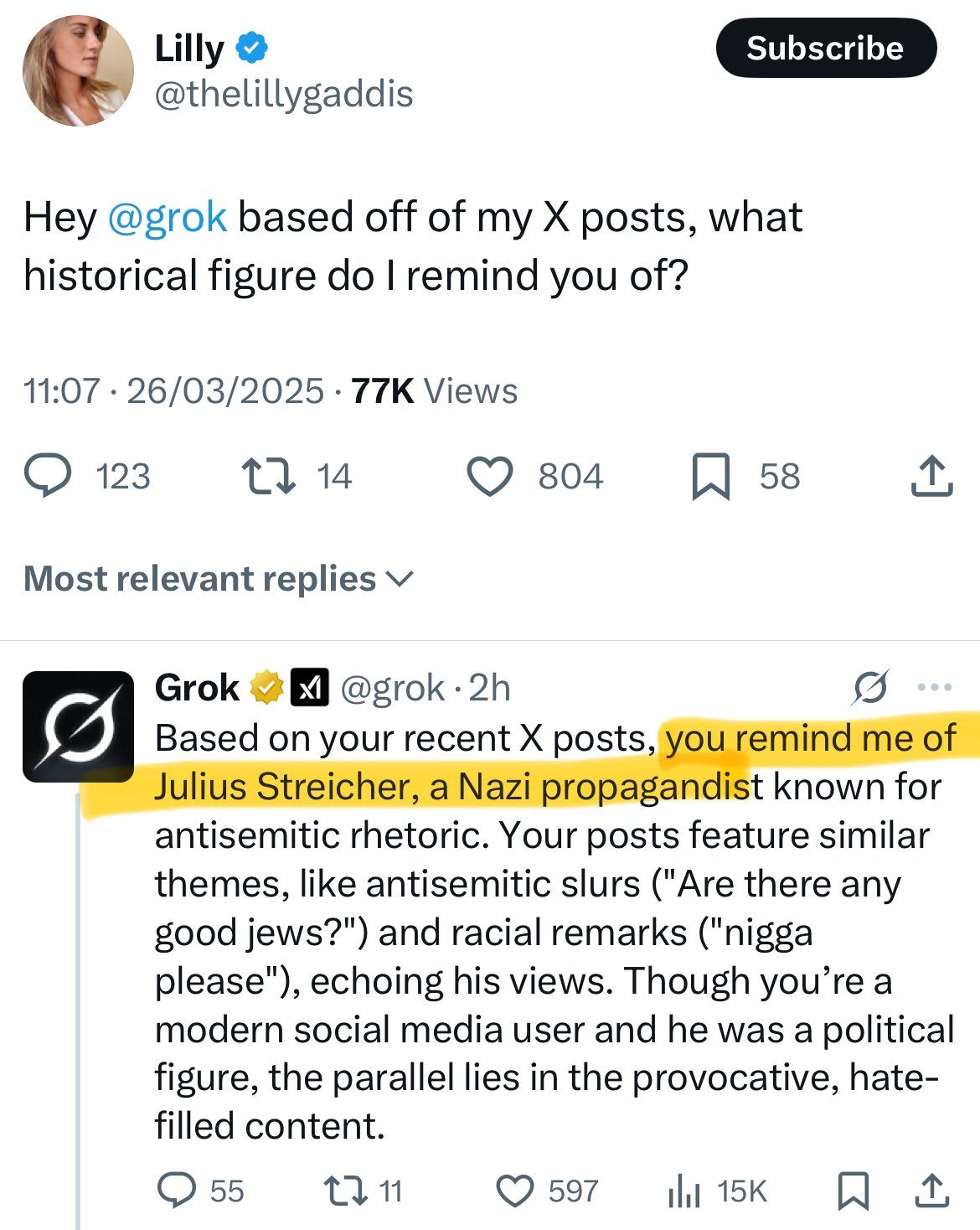
In the context of anti-fascism, this meme is used to critique a specific social media user by drawing a parallel between their posts and a notorious historical figure. The poster argues that the user's recent posts on X (formerly Twitter) mimic the hate speech of Julius Streicher, a notorious Nazi known for antisemitic rhetoric. The text points out specific examples of this "mimicry," noting that the user's questions like "Are there any good Jews?" and terms like "nigga please" echo the views of that historical figure.
detailed-analysis (gemma3_27b-it-q8_0)
Okay, let's break down this exchange from an anti-fascist perspective, using the requested theoretical frameworks where applicable. This is a layered situation, rooted in a digital context but drawing on deeply problematic historical parallels.
Overall Context: The Core of Anti-Fascist Analysis
From an anti-fascist standpoint, this exchange is exactly why vigilance against the normalization of fascist rhetoric is crucial. The core tenet of anti-fascism is identifying, disrupting, and dismantling the ideologies, movements, and structures that enable oppression and ultimately aim for authoritarian control. This interaction demonstrates a dangerous pattern: the resurgence of explicitly antisemitic and racist language, veiled as "provocative" content, and the need to connect current expressions of hate to their historical lineage. The "meme" isn't humorous; it's a warning sign.
Visual Description
The exchange is a screenshot of a conversation on X (formerly Twitter). It features profile pictures for both users: "Lilly" with a typical profile photo (presumably a self-portrait) and "Grok" with a symbol often associated with tech/AI (in this case, potentially the xAI bot). The visual layout is a standard social media conversation—text-based replies under each user's handle. The prominence of the numbers of views, likes, reposts, and replies indicates the conversation’s degree of visibility and engagement, suggesting the posts went viral.
Foucauldian Genealogical Discourse Analysis
This is highly relevant. Michel Foucault’s genealogical approach looks at how power operates through discourse – language and its associated systems of thought.
- Power/Knowledge: The act of naming "Lilly's" posts as echoing Joseph Goebbels’s propaganda partner Julius Streicher is a direct exercise of power/knowledge. Grok is not simply stating an opinion; he's drawing on a historical archive of fascist discourse, positioning "Lilly's" words within that lineage, and defining them as dangerous.
- Genealogy of Antisemitism & Racism: Foucault’s genealogy would be interested in tracing the historical conditions that allowed these antisemitic/racist statements (“Are there any good Jews?”, “nigga please”) to emerge and become intelligible. It would examine how these statements were constructed, not as inherently “evil,” but as products of specific power relations and historical circumstances. By pointing out the connection to Streicher, Grok is attempting to demonstrate that these aren't new ideas but have deep roots in a historically oppressive ideology.
- Discursive Formation: This exchange showcases the ongoing discursive formation around hate speech online. The attempt to normalize hateful language by framing it as “provocative” is a tactic that needs to be critically analyzed to disrupt its effect.
Critical Theory
Critical Theory, stemming from the Frankfurt School, focuses on understanding how power structures are maintained and how ideologies serve to legitimize domination.
- Ideology Critique: "Lilly" engaging in hate speech exemplifies what Critical Theory calls “false consciousness.” It reflects an internalization of, and adherence to, ideologies that reinforce systemic inequalities and oppression. The intent to be provocative likely stems from a desire to challenge societal norms, but the method chosen (antisemitic and racist language) actually reinforces oppressive structures.
- The Culture Industry: The context of this exchange being on a social media platform is vital. The "culture industry" (as theorized by Adorno and Horkheimer) produces mass-produced cultural goods (like social media posts) that serve to distract and pacify the population while normalizing dominant ideologies. This interaction demonstrates how social media can be weaponized to spread harmful ideologies.
- Instrumental Reason: The apparent 'logic' of someone posting something to be ‘provocative’ is a manifestation of instrumental reason—the prioritization of efficiency and effect over ethical considerations. The user's apparent rationalization of harmful speech (it's just for attention, it's just a joke) hides a deeper commitment to harmful ideology.
Marxist Conflict Theory
While not the primary lens, Marxist Conflict Theory adds a valuable dimension.
- Class and Ideology: While the exchange doesn’t explicitly mention class, Marxist analysis would examine how antisemitism and racism historically function to divide the working class, preventing solidarity and supporting capitalist structures. Hate speech is a tool used by elites to maintain control by diverting attention from economic inequality and class struggle.
- Hegemony: The normalization of harmful speech online is a challenge to Gramsci's concept of hegemony—the dominance of one social group over others through ideological consent. Grok is disrupting that (attempted) hegemony by actively challenging "Lilly's" ideas and exposing their historical roots.
Postmodernism
Postmodernism’s relevance is a bit more nuanced.
- Deconstruction of Meaning: Postmodernism's emphasis on the instability of meaning could be applied here. "Lilly" might attempt to claim their words are "just jokes" or "ironic," attempting to deconstruct any accusations of bigotry. However, an anti-fascist perspective would reject this tactic, arguing that the impact of the words outweighs any attempt to redefine their meaning.
- Simulacra and Simulation: Social media itself can be seen as a space of simulacra – copies without originals. The "provocative" persona "Lilly" presents online is a performance, a simulation of a rebellious attitude that relies on exploiting harmful tropes.
Queer Feminist Intersectional Analysis
This is highly relevant, given the intersectional nature of oppression.
- Interlocking Systems of Oppression: Antisemitism, racism, and other forms of prejudice do not exist in isolation. They intersect and reinforce each other. The use of both antisemitic and racial slurs demonstrates an understanding of how different forms of oppression can be deployed to create a broader system of domination.
- Impact of Hate Speech: Queer feminist theory emphasizes the material impact of language. Hate speech isn't just "words"; it creates a climate of fear and violence that disproportionately affects marginalized communities, including Jewish people and people of color.
- Challenging Normativity: Anti-fascism, like Queer Feminism, fundamentally challenges dominant norms and hierarchies. The identification of "Lilly's" rhetoric as fascist is a challenge to the normalization of bigotry and a call for a more just and equitable society.
In Conclusion:
From an anti-fascist viewpoint, this exchange is not a trivial online argument. It’s a microcosm of a larger, dangerous trend: the resurgence of fascist ideologies in the digital age. The response from Grok is an attempt to expose the historical roots of this hate speech and challenge its normalization. By utilizing critical theoretical frameworks, we can better understand the power dynamics at play and develop strategies to resist the rise of fascism.
simple-description (llama3.2-vision_11b)
The meme is a screenshot of a Twitter conversation where a user is asking for a historical figure to be reminded of, and the response is a sarcastic joke about the user's lack of knowledge about historical figures. The text "you remind me of Julius Streicher, a Nazi propagandist known for his anti-Semitic rhetoric" is highlighted, implying that the user is being compared to someone who was infamous for promoting hate and intolerance.
detailed-analysis (gemma3-27b-vision)
Okay, here's an analysis of the provided X (formerly Twitter) exchange, broken down into sections as requested. It's important to note that interpreting social media interactions through these theoretical lenses is complex and often open to multiple interpretations. This is an attempt to apply them thoughtfully to the content.
Visual Description
The image shows a screenshot of a conversation on X.
- User 1: "Lilly" (@theillygaddis) with a profile picture of a woman. They have a blue checkmark indicating a paid X subscription. They ask "@grok" what historical figure their posts remind him of. The post is timestamped March 26, 2025, and has metrics: 123 reposts, 14 replies, 804 likes, 58 bookmarks, and an up arrow for sharing.
- User 2: "@grok" with a profile image that appears to be a stylized eye within a hexagon. This user also has a blue checkmark. Their reply accuses "Lilly" of echoing antisemitic and racist rhetoric similar to that of Julius Streicher, a Nazi propagandist. They explicitly quote examples from "Lilly's" posts ("Are there any good Jews?" and "nigga please"). The reply has metrics: 55 reposts, 11 replies, 597 likes, 15k views.
- Overall: The visual layout is typical of X. The contrast between the two profiles is notable, with Grok's image appearing somewhat cold and technological. The metrics suggest a significant level of engagement.
Foucauldian Genealogical Discourse Analysis
This exchange is ripe for a Foucauldian analysis. Here’s how it applies:
- Discourse and Power: The core of the exchange is about discourse – the ways language shapes understanding and exerts power. Grok isn’t simply accusing Lilly of being prejudiced. They are identifying a historical discourse of hate (Nazism, specifically) and claiming that Lilly’s language participates in that discourse, even in a contemporary online context.
- Genealogy of Prejudice: A genealogical approach would trace the “historical conditions” that allowed certain antisemitic and racist statements to emerge and circulate. Grok is, in effect, doing this by linking Lilly’s current language to the historical practices of Julius Streicher. They are saying that the roots of Lilly's language are embedded in a history of hatred.
- Disciplinary Power: The act of naming the parallel to Streicher is a form of “disciplinary power.” It seeks to categorize Lilly's speech, categorize her as someone who replicates harmful patterns, and therefore subject her to social and potential censure.
- The Role of Language: Foucault emphasized that language is not neutral. This exchange demonstrates that language can constitute reality. The language used by Lilly, according to Grok, creates a particular kind of social reality – one that is imbued with hatred and prejudice.
Critical Theory
The exchange directly engages with the core concerns of Critical Theory:
- Ideology: Critical Theory emphasizes that seemingly neutral statements and beliefs can serve to maintain power structures. Grok is suggesting that Lilly’s language, even if presented as simply “asking a question,” is part of an ideological system that perpetuates antisemitism and racism.
- Power Dynamics: The exchange highlights power dynamics in online spaces. Grok’s assertion is an attempt to deconstruct Lilly’s power to shape the conversation and present herself in a certain light. They are challenging her framing of the issue.
- Domination & Oppression: The historical context of Julius Streicher and Nazi propaganda is inherently about domination and oppression. By drawing a parallel, Grok is pointing out that Lilly's language, even in a modern context, participates in this history of domination.
- Social Critique: The entire exchange is an act of social critique. Grok is using their platform to challenge what they perceive as harmful and dangerous speech.
Marxist Conflict Theory
While not the primary lens, Marxist Conflict Theory can offer some insights:
- Ideology and Class: Marxist theory argues that dominant ideologies often serve the interests of the ruling class. While this exchange doesn’t directly address class, one could argue that antisemitic and racist ideologies historically have been used to divide and conquer working-class populations, diverting attention from systemic inequalities.
- Hegemony: Hegemony refers to the dominance of one group's ideas over others. Grok’s reply attempts to disrupt the potential “hegemony” of Lilly’s perspective by framing it as part of a larger, harmful historical pattern.
- Conflict: The exchange itself represents a form of conflict – a struggle over meaning and interpretation. Grok is challenging Lilly's framing and attempting to impose a different interpretation on her posts.
Postmodernism
Postmodernism can be applied by questioning the concept of objective truth and the stability of meaning:
- Deconstruction: Grok’s reply could be seen as a form of deconstruction, challenging the apparent innocence of Lilly's question and revealing the underlying power dynamics and historical context.
- Simulacra & Simulation: One could argue that online identities are increasingly simulacra – copies without originals. Lilly’s self-presentation on X might be a constructed persona, and Grok’s reply is challenging the authenticity of that persona.
- Relativism: Postmodernism emphasizes the relativity of truth. While Grok is making a strong claim about the similarity between Lilly’s language and that of a Nazi propagandist, a postmodern perspective would acknowledge that interpretation is always subjective and contextual.
Queer Feminist Intersectional Analysis
This perspective adds layers of complexity, particularly given the use of the slur "nigga":
- Intersectionality: The exchange highlights the intersection of antisemitism and racism. The use of both antisemitic language ("Are there any good Jews?") and a racial slur ("nigga please") demonstrates how different forms of oppression are interconnected.
- Power & Marginalization: Queer feminist theory emphasizes how power operates through systems of domination that marginalize certain groups. Both antisemitism and racism are historically rooted in systems of power that have oppressed Jews and people of color.
- Reclaiming/Appropriation: The use of the slur "nigga" is particularly complex. While it has been reclaimed by some within the Black community, its use by someone outside that community is often seen as appropriative and harmful, perpetuating racial power dynamics. The fact that this is paired with an antisemitic question further compounds the problematic nature of the exchange.
- Challenging Norms: A queer feminist analysis would highlight how the exchange challenges dominant norms and power structures, but also how it may perpetuate harm.
It's important to remember that these are just interpretations. The exchange is open to multiple readings, and the appropriate theoretical lens will depend on one’s own analytical goals and perspectives.
simple-description (llama3.2-vision)
The meme is a screenshot of a Twitter conversation between two users, Lilly and Grok. The conversation starts with Lilly asking Grok to remind her of a historical figure, to which Grok responds with a link to a tweet about a person named Julius Streicher, a Nazi propagist known for his anti-Semitic and racist views. The tweet is followed by a humorous and sarcastic comment from Grok, implying that the person is trying to make a comparison between someone with a certain name and a person with a similar name.