First Seen
2025-04-21T06:16:07.575744+00:00
simple-description (qwen3.5_2b-q8_0)
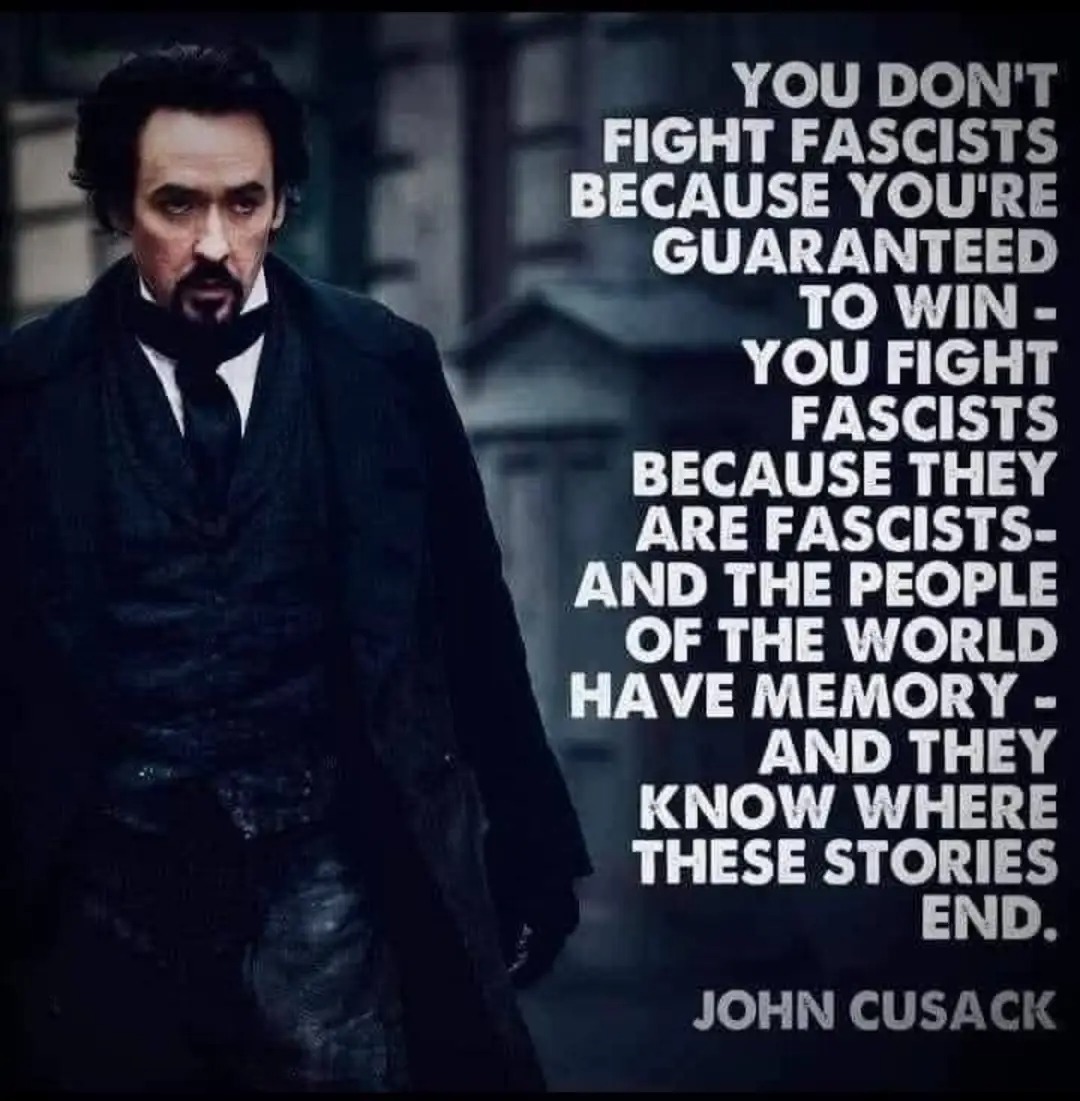
This meme features a character from the movie No Country for Old Men (played by John Cusack) wearing dark, period clothing and walking with a serious, intense expression. The text argues that you don't fight fascists because you will inevitably win, but because fascists are inherently evil and the people of the world have a memory of history. It serves as a powerful call to defend freedom against fascism based on the knowledge of good and evil, rather than violence.
detailed-analysis (gemma3_27b-it-q8_0)
Here's an analysis of the meme from the perspective of the "Anti-Fascism" category, broken down into relevant sections.
Visual Description
The image features actor John Cusack in a dark coat and a slightly troubled expression. He appears to be walking outdoors, with a blurred building facade visible in the background. The photograph is desaturated and conveys a sense of seriousness and somber reflection. The text overlay, bold and white, dominates the image, contrasting sharply with the muted color scheme. The attribution to John Cusack is placed at the bottom right, indicating the source of the quote. The overall aesthetic leans towards a film noir vibe, hinting at a dramatic narrative.
Critical Theory
This meme speaks directly to core concerns of Critical Theory, particularly its focus on power structures and domination. Fascism, as understood within Critical Theory, isn't merely a political ideology, but a mode of thinking rooted in hierarchical structures, exclusionary practices, and the suppression of dissent.
The meme’s core argument—"You fight fascists because they are fascists"—is a rejection of the notion of neutrality or compromise. It’s a call to actively oppose ideologies that seek to maintain dominance through force, control, and the dehumanization of others. The assertion that "the people of the world have memory and know where these stories end" is a crucial critical point. It appeals to historical awareness as a safeguard against repeating past atrocities. Critical Theory emphasizes the importance of historical context and the dangers of ignoring patterns of oppression. This meme encourages a recognition of the recurring characteristics of fascist regimes and their predictable, harmful outcomes.
Marxist Conflict Theory
From a Marxist lens, the meme can be interpreted as recognizing fascism as a tool of the ruling class to suppress working-class movements and maintain capitalist control. Fascism arises when the contradictions of capitalism become so acute that the system faces existential threats (e.g., revolutions, socialist movements). The fascists then serve as the “last resort” for the bourgeoisie to violently repress these challenges.
The 'guaranteed win' is not simply about defeating political opponents, but about the inevitable trajectory of history toward a more egalitarian outcome. The recognition of past "stories" speaks to the historical class struggles and the failures of capitalism that pave the way for fascist responses. Fighting fascism, then, is not just a moral imperative but a necessary component of the ongoing class struggle.
Foucauldian Genealogical Discourse Analysis
Michel Foucault's genealogical approach examines how power operates through discourse—the ways we talk and think about things. The meme operates within this framework by challenging the normalization of fascism.
The meme implicitly rejects attempts to understand or reason with fascism. By simply stating "they are fascists," it disrupts any attempt to legitimize or rationalize their ideology. It cuts through the potential for complex debates about intent or justification, laying bare the essential nature of fascism.
The emphasis on "memory" is also crucial here. Foucault argued that power operates through the production and control of knowledge. Collective memory acts as a counter-discourse, providing a historical understanding that resists the attempts of those in power to rewrite or erase the past. "Knowing where these stories end" signifies possessing a counter-narrative that exposes the ultimate consequences of fascist rule.
Postmodernism
While seemingly straightforward, a postmodern reading acknowledges the constructed nature of the category "fascist" itself. Postmodernism would argue that there is no neutral or objective definition of fascism, and the term is often deployed strategically to silence opposition.
However, the meme's power lies precisely in its rejection of postmodern relativism. It posits that despite the ambiguities inherent in labeling and categorization, certain ideologies—those identified as fascist—represent a clear and present danger that demands resistance. It leverages the fear of the documented historical trajectory of fascism to provide a grounding and moral urgency.
In Conclusion
The meme is a potent anti-fascist statement that draws strength from multiple theoretical frameworks. It is a call to action rooted in a historical understanding of fascism's destructive potential, fueled by a rejection of neutrality, and underpinned by the recognition of power structures and the importance of collective memory. Its concise, direct message makes it highly shareable and effective as a rallying cry for anti-fascist resistance.
simple-description (llama3.2-vision_11b)
The meme features a quote from the 2013 film "Les Misérables" where Jean Valjean says "You have power when you have nothing and you have nothing when you have power." This quote is used to make a humorous comparison between the character's situation and the idea of fighting against fascist ideologies. The meme is likely used to make a point about the importance of standing up against oppressive systems, and the power that can come from being powerless.
detailed-analysis (gemma3-27b-vision)
Okay, here's an analysis of the image, broken down into sections addressing the topics you requested, only where applicable. It's important to note that while any of these theoretical lenses could be applied speculatively, some are more directly relevant than others.
1. Visual Description
The image features a dark, dramatic portrait of actor John Cusack. He is wearing a dark suit and appears to be looking downward or slightly off-camera, creating a somber or determined mood. The lighting is low-key, emphasizing shadows and creating a sense of seriousness. Overlaid on the portrait is text in white capital letters, attributed to Cusack. The text forms a powerful quote about fighting fascists. The overall aesthetic is evocative of a political poster or a publicity image meant to convey a strong message. The image uses stark contrast and a dramatic composition to capture attention and emphasize the seriousness of the statement.
2. Foucauldian Genealogical Discourse Analysis
This image is rich territory for a Foucauldian analysis. The quote itself ("You don't fight fascists because you're guaranteed to win - You fight fascists because they are fascists - And the people of the world have memory - And they know where these stories end.") can be understood as an assertion of discourse—a way of constructing meaning around the concept of fascism.
- Power/Knowledge: The quote isn’t simply about a practical battle; it's about reclaiming the definition of what "fascist" means and the knowledge associated with it (the historical outcomes, the suffering caused). It challenges a potential discourse where fighting fascism is seen as a calculation of winning versus losing, and re-centers it on moral obligation and historical awareness.
- Genealogy of "Fascism": A genealogical approach would trace the historical development of the term "fascism," how it was initially defined, how it has been deployed politically, and how it has shifted in meaning over time. The quote implies a specific genealogical trajectory—one where the “stories” (historical events) of fascism have clear, negative ends.
- Disciplinary Power: The “memory” the quote refers to acts as a kind of disciplinary power. Remembering the outcomes of fascist regimes serves as a deterrent and shapes behavior, discouraging the resurgence of such ideologies.
- Subjectivation: The quote implicitly calls on individuals to subjectivate themselves in opposition to fascism. It suggests that remembering the past and recognizing the nature of fascism creates a certain type of subject – one committed to resisting it.
3. Critical Theory
The image and its quote engage directly with key themes of Critical Theory, particularly those concerned with power, ideology, and resistance.
- Ideology: The quote can be seen as a critique of ideologies that would downplay the dangers of fascism or frame resistance as a mere strategic calculation. It’s a rejection of the idea that fighting fascism is about winning; it's about upholding ethical principles and preventing the repetition of historical atrocities.
- Enlightenment & Emancipation: The invocation of "memory" suggests a commitment to historical awareness as a means of preventing future oppression. This aligns with the Critical Theory project of using reason and knowledge to achieve emancipation.
- Domination & Resistance: The quote directly addresses the relationship between power and resistance. Fascism represents a form of domination, and the call to fight it represents a rejection of that domination.
- The Culture Industry: One could even analyze the image itself as part of the “culture industry.” It’s a message being disseminated, using a celebrity image to influence public opinion.
4. Marxist Conflict Theory
While not the primary lens, aspects of Marxist conflict theory are relevant.
- Class Struggle: Fascism is historically linked to the suppression of labor movements and the protection of capitalist interests. The quote, though not explicitly mentioning class, implicitly acknowledges this by framing fascism as a force that needs to be actively opposed.
- Hegemony: The quote challenges a potential hegemonic discourse that might normalize or excuse fascist tendencies. It seeks to disrupt the dominant narrative and reclaim the definition of fascism.
5. Queer Feminist Intersectional Analysis
While less directly applicable, a Queer Feminist Intersectional analysis could find points of connection.
- Intersectionality: Fascism historically targets marginalized groups, including LGBTQ+ individuals and women. The quote's assertion of memory could be interpreted as a call to remember the specific ways in which these groups have suffered under fascist regimes.
- Power Dynamics: Fascism is based on hierarchies of power, and queer feminist theory challenges those hierarchies. The quote's call to resist fascism aligns with the broader feminist and queer struggle for liberation.
- Critique of Normativity: Fascism relies on enforcing rigid social norms, and queer theory challenges those norms. This connection could be drawn, though it is not explicitly stated in the quote.
I hope this detailed analysis is helpful! Let me know if you would like me to expand on any of these points or explore other theoretical perspectives.
simple-description (llama3.2-vision)
This meme is a humorous quote from the movie "The Count of ... [ ] " ( ) [ ] ". The quote is a famous ... [ ] " ( ) [ ] " from ... [ ] " ( ) [ ] ". The quote is a famous ... [ ] " ( ) [ ] ".