First Seen
2025-05-20T19:33:07.168769+00:00
simple-description (qwen3.5_2b-q8_0)
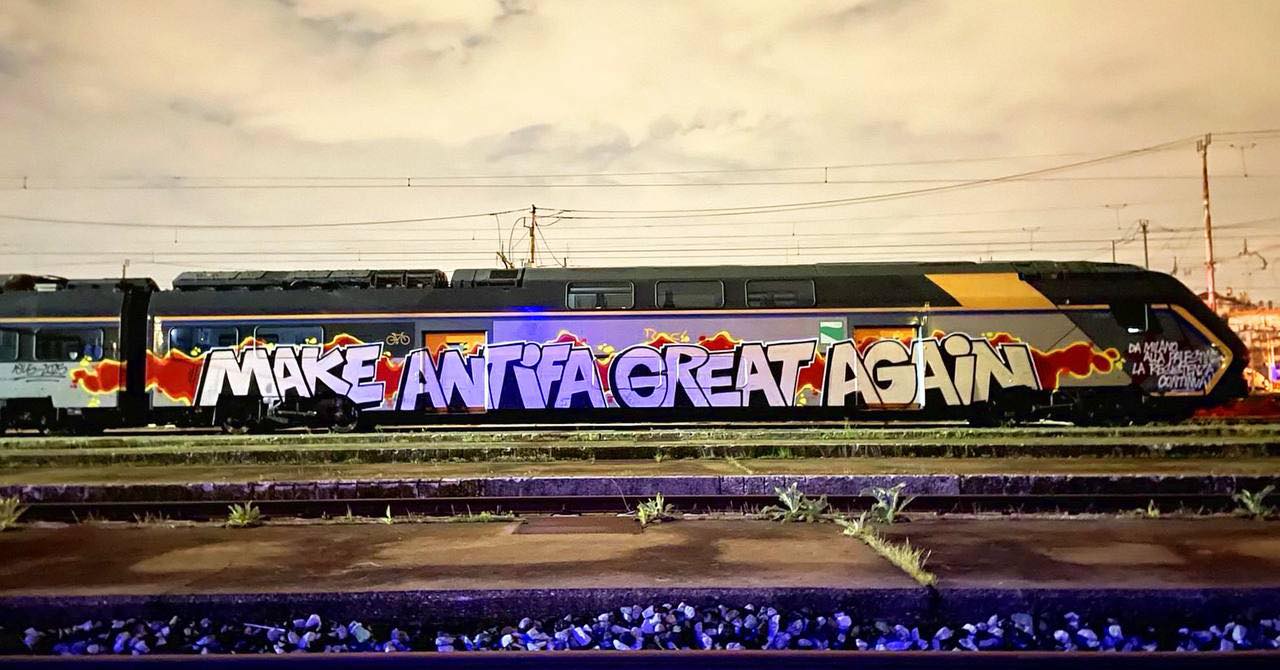
The text "MAKE ANTIFA GREAT AGAIN" is a political parody of the "Make America Great Again" slogan. From the perspective of Anti-Fascism, this meme acts as a critique of the political status quo, suggesting that a radical or anarchist group (Antifa) should gain significant political power and influence rather than existing as a small, powerless minority. It serves as a form of satirical resistance against nationalist rhetoric and the dominance of traditional political power structures.
detailed-analysis (gemma3_27b-it-q8_0)
Okay, let's break down the image and its meaning through the lens of anti-fascism, utilizing relevant theoretical frameworks where applicable.
Visual Description
The image depicts graffiti spray-painted onto the side of a train car. The text reads "MAKE ANTIFA GREAT AGAIN" in large, bold letters. The lettering style mimics that used in the slogan "MAKE AMERICA GREAT AGAIN" popularized by Donald Trump. There's additional smaller graffiti visible around the main slogan, adding a chaotic and layered texture. The train is on a track, illuminated by artificial lights, suggesting a nighttime urban environment. The overall aesthetic is a clear act of unauthorized public expression.
Foucauldian Genealogical Discourse Analysis
This graffiti is a prime example of a discursive intervention. Michel Foucault's genealogical approach examines how power operates through discourse – how language and ideas shape what is considered 'normal' or 'true.' The original “Make America Great Again” slogan was incredibly effective in constructing a narrative of a lost past that needs to be reclaimed, often implicitly appealing to a nostalgic, and exclusionary, vision of the nation.
The "MAKE ANTIFA GREAT AGAIN" graffiti deconstructs that narrative. It hijacks the language of the right and flips it, reclaiming the act of 'making great' for an explicitly anti-fascist ideology. It functions as a counter-discourse, challenging the power of the original slogan. The act of graffiti itself—an unauthorized alteration of public space—is a transgression that highlights the power dynamics inherent in controlling public discourse. Foucault would be interested in how this graffiti works to disrupt the established order of meaning. It doesn't offer a 'truth,' but an active challenge to the truth constructed by a dominant power structure. The implication is that the state of things isn’t great, but that anti-fascist action is what’s needed to truly improve it.
Critical Theory
From a critical theory perspective, particularly the Frankfurt School’s concerns with the “culture industry”, this graffiti is a subversive act within a system designed to maintain the status quo. The culture industry, the theory posits, disseminates hegemonic ideology, creating a passive and conformist population. This graffiti intervenes in that process, offering a critique of power and a call to action.
The slogan repurposes a marketing tool (“Make…Great Again”) for political purpose. Critical theorists would see this as an example of how even seemingly neutral forms of communication can be imbued with ideological weight. The message directly challenges the ideology underpinning the original slogan, which is often interpreted as supporting nationalist sentiment and potentially authoritarian tendencies. The graffiti points to a deeper critique of capitalist systems that are seen as facilitating and enabling the rise of fascism.
Marxist Conflict Theory
From a Marxist perspective, the image embodies class struggle and the historical tensions between oppressor and oppressed. Fascism, in Marxist theory, is often seen as a tool of the ruling class to suppress worker movements and maintain control. Anti-fascism, then, is a form of class consciousness and resistance.
The graffiti signifies a rejection of the ideology that serves the interests of the capitalist class, and an embrace of the struggle for a more equitable society. The slogan itself suggests that 'making' something 'great again' from an anti-fascist perspective means dismantling structures of oppression and challenging the power of the bourgeoisie. The train itself, as a symbol of industrial infrastructure, can be seen as representing the material conditions of production and the potential for both exploitation and liberation.
Postmodernism
From a postmodern viewpoint, the graffiti's appropriation of the MAGA slogan is a brilliant example of pastiche, irony, and the deconstruction of grand narratives. Postmodernism rejects the idea of objective truth and stable meaning. This graffiti doesn’t seek to establish a new, monolithic truth. Instead, it highlights the constructed nature of all truths—including those presented by political slogans.
The slogan's success relies on its recognition as a parody of the original. It is a self-aware intertextual reference that underscores the instability of meaning. It points to the idea that the original slogan was already a fabrication, a performance of meaning rather than an embodiment of truth. The use of graffiti, as an ephemeral and contested art form, also aligns with postmodernism’s emphasis on fragmentation and the blurring of boundaries.
In summary:
This image is far more than just a piece of graffiti. It's a complex political statement rooted in a rich theoretical framework. It's a disruptive act of counter-discourse, a challenge to dominant power structures, and a call for active resistance against fascism. It demonstrates the potency of reclaiming language and using it to subvert established ideologies.
simple-description (llama3.2-vision_11b)
The meme is a graffiti-style image of a train with the words "Make Anti-Fascism Great Again" written on it, playing on the phrase "Make America Great Again" that was popularized by Donald Trump. The image is meant to be a humorous and satirical take on the original phrase, applying it to the context of anti-fascism and suggesting that making anti-fascism great again is a more desirable goal than the original phrase's focus on nationalism and patriotism.
detailed-analysis (gemma3-27b-vision)
Okay, here's an analysis of the image broken down into sections as requested, focusing on applicable theoretical frameworks.
Visual Description
The image depicts a long, black passenger train covered in graffiti. The most prominent element is the phrase "MAKE ANTIFA GREAT AGAIN" spray-painted in large, stylized white letters across the length of one of the train cars. The lettering has a shadow effect, and there’s additional, less legible graffiti around it. The train is situated on a railway track which is surrounded by dark, somewhat sparse, greenery and blue colored railroad ties. A distant cityscape and power lines are visible under a muted, dusky sky, suggesting either dawn or dusk. The train itself is sleek and modern in design, contrasting with the raw, rebellious aesthetic of the graffiti.
Foucauldian Genealogical Discourse Analysis
The graffiti acts as a disruption of the established discourse surrounding notions of national identity and political slogans. The phrase is a deliberate appropriation of Donald Trump's "Make America Great Again" slogan. Foucault’s concept of discourse helps us understand how knowledge and power are intertwined. The original slogan, "Make America Great Again", functioned to construct a particular regime of truth – a set of assumptions and beliefs about what America should be, appealing to a nostalgic, often implicitly exclusionary, vision of the past.
The graffiti intervenes in this discourse. By substituting "America" with "Antifa," the author actively reconfigures the meaning. Antifa, as a loose collective of anti-fascist activists, is often demonized by conservative political forces. This appropriation inverts the power dynamic – taking a slogan used to promote conservative nationalism and re-applying it to a movement perceived as its opposition.
A genealogical approach, tracing the historical development of these slogans, shows how both are rooted in broader narratives of national identity and political struggle. The graffiti does not simply refute the original slogan, but re-articulates it in a way that challenges its underlying assumptions. It exposes the contested nature of “greatness” and who defines it, highlighting the power of language to shape political reality.
Critical Theory
From a Critical Theory perspective, the graffiti can be interpreted as a form of resistance against dominant power structures. The train, as a symbol of transportation and connection, can be seen as representing the established order, the infrastructure of societal control. The act of defacing it with subversive messaging disrupts the smooth operation of this system.
This action reveals the hidden ideologies embedded within everyday objects and practices. The original slogan implies a certain set of values and a preferred vision of the future. The graffiti challenges this vision, exposing the potential for social critique and resistance within the realm of public space.
The graffiti functions as a counter-narrative, aiming to deconstruct the hegemony of dominant ideologies and promote alternative ways of thinking. It highlights the importance of challenging the status quo and questioning the assumptions that underpin social norms.
Marxist Conflict Theory
From a Marxist perspective, the graffiti represents a manifestation of class conflict and ideological struggle. The train, often associated with both commerce and the transportation of workers, becomes the site of this conflict. The message, while about Antifa, implicitly points to broader systemic issues of power and inequality.
The "greatness" invoked in the original slogan, and then subverted, often relies on historical narratives that gloss over exploitation and oppression. The graffiti, by associating "greatness" with Antifa, a movement often associated with challenging capitalist structures, can be seen as an attempt to reclaim the narrative and redefine what constitutes progress.
This action can be understood as a form of class consciousness – an awareness of one's position within the social hierarchy and a desire for change. The graffiti is a symbolic act of defiance, challenging the legitimacy of the dominant power structures and asserting the rights of marginalized groups.
Postmodernism
The graffiti embodies several characteristics of postmodern thought. The appropriation and subversion of the original slogan is a prime example of pastiche – the imitation of a style or character in a humorous or ironic way. It deconstructs the original message, stripping it of its inherent meaning and re-contextualizing it in a way that challenges conventional interpretations.
The graffiti also challenges the notion of a single, unified truth. By juxtaposing two seemingly opposing ideologies, it highlights the fragmented and contingent nature of meaning. There is no clear or definitive answer to what constitutes "greatness," and the graffiti embraces this ambiguity.
The act of defacing public property can be seen as a rejection of grand narratives and a celebration of individual expression. The graffiti artist is not seeking to impose a new ideology, but rather to disrupt the existing order and provoke critical thinking.
Queer Feminist Intersectional Analysis
While not explicitly addressing queer or feminist issues, a queer feminist intersectional approach can add layers of interpretation. Antifa, as a movement, often includes queer and feminist activists and principles in its organizing. The graffiti, therefore, can be seen as representing an alignment with these movements and a rejection of oppressive ideologies.
The act of vandalism itself, reclaiming public space through artistic expression, can be seen as a form of resistance against patriarchal structures that often seek to control and suppress marginalized voices. The graffiti, by challenging the status quo, creates a space for alternative narratives and perspectives.
The graffiti also disrupts the traditional association of trains with male-dominated industries and spaces, creating a visual counterpoint that challenges gender norms. The act of reclaiming this space through subversive art can be seen as a step towards creating a more inclusive and equitable society.
Let me know if you'd like me to elaborate on any of these interpretations or explore other theoretical frameworks.
simple-description (llama3.2-vision)
This meme is an image of a graffiti-covered train car with the phrase "Make America Great Again" (MAGA) spray-painted on it, but with a twist: the "M" and "A" have been replaced with "Make" and "Anti" respectively, and the "G" has been replaced with "F" (a common typo). The result is "Make Anti Fa Great Again", a play on the original MAGA slogan that is now a reference to the far-right group Antifa.