First Seen
2025-05-28T16:35:44.718428+00:00
simple-description (qwen3.5_2b-q8_0)
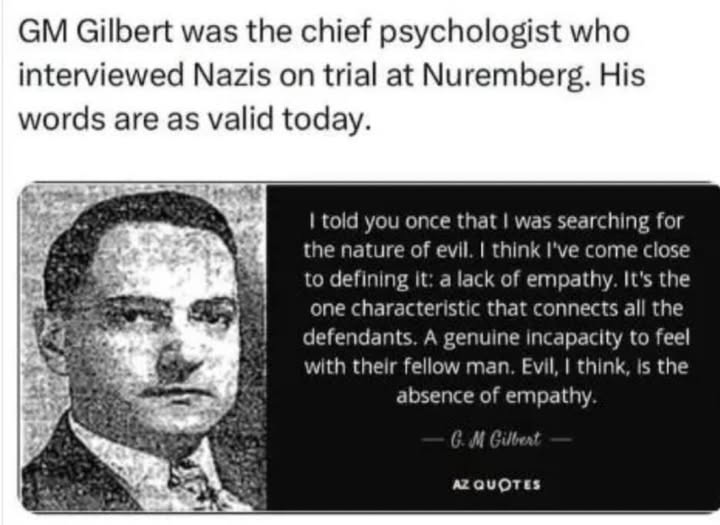
This meme connects G. M. Gilbert, a psychologist who testified against the Nazis at Nuremberg, to the concept that "evil" is a lack of empathy. It argues that the atrocities committed by Hitler were just an example of the human flaw that remains. By defining evil this way, the caption implies that while that specific behavior may be gone, the capacity for cruelty is still present in our society.
detailed-analysis (gemma3_27b-it-q8_0)
Okay, let's break down this meme through the lens of Anti-Fascism, utilizing relevant theoretical frameworks where applicable.
Overall Context: Anti-Fascism
This meme, presented within an Anti-Fascist context, doesn't merely present a quote. It activates it. The assertion that Gilbert's words "are valid today" implies a contemporary relevance to understanding and combating the resurgence of fascist and far-right ideologies. The core argument is that a central psychological attribute driving fascist behavior isn't ideological complexity, but a profound lack of empathy – a dehumanization of "the other" that allows for violence and oppression.
1. Visual Description
The image features a black and white portrait of Dr. Gustav Gilbert, a psychiatrist who interviewed Nazi leaders during the Nuremberg Trials. His face is stern, conveying seriousness and authority. Alongside the portrait is a text box containing a quote attributed to him. The quote directly addresses the psychological nature of evil, defining it as a lack of empathy. The "AZ Quotes" watermark gives a sense of legitimacy, even as the image is circulating online. The visual setup positions Gilbert as a credible authority offering a key insight into the perpetrators of horrific acts. This positioning is critical to the meme’s effect.
2. Foucauldian Genealogical Discourse Analysis
Michel Foucault's work on power and knowledge is particularly insightful here. Foucault wouldn't focus on inherent evil, but on the discourse of evil and how it is constructed.
- Genealogy: The meme implicitly undertakes a genealogical tracing. It reaches back to Gilbert's observations at Nuremberg – a pivotal moment in defining the postwar understanding of fascism – and then argues its continued relevance. It's a claim that the historical discourse surrounding fascism isn't closed, but actively informs the present.
- Power/Knowledge: Gilbert, as a psychologist at Nuremberg, held a position of power to define and categorize the Nazi defendants. His diagnosis (lack of empathy) became part of the dominant knowledge about them. The meme reiterates this connection between power and knowledge, suggesting that this diagnosis continues to hold value in identifying and understanding contemporary fascist tendencies.
- Discipline & Normalization: Foucault would ask how empathy is defined, and who gets to define it. Anti-fascists might argue that the lack of empathy in fascists isn’t a psychological ‘defect’ but a learned response cultivated within a particular power structure, enabling a callous disregard for the suffering of marginalized groups.
3. Critical Theory
From a Critical Theory perspective (drawing from thinkers like the Frankfurt School, especially Adorno and Horkheimer), the meme resonates with several key ideas:
- The Authoritarian Personality: The quote aligns with research on the authoritarian personality, which identified tendencies toward rigidity, conventionalism, and a suppression of empathy as characteristics associated with susceptibility to fascist ideology. This isn’t to say empathy is absent, but redirected toward in-groups and denied to out-groups.
- Instrumental Reason: Critical theorists argue that the Enlightenment’s emphasis on instrumental reason – focusing on efficiency and control – can lead to dehumanization. A lack of empathy can be seen as a product of this, enabling individuals to treat others as objects to be manipulated or eliminated.
- Critique of Ideology: The meme challenges the notion that fascism is driven by complex ideologies. It suggests that the psychological conditions – specifically, a deficiency in empathy – may be more fundamental.
4. Marxist Conflict Theory
While not a direct application, Marxist thought can inform an understanding of why this lack of empathy might arise:
- Class Struggle & Alienation: Marxist theory would see the social structures that give rise to fascism as rooted in class conflict and the alienation of individuals within capitalist systems. This alienation can erode empathy as people become focused on competition and self-preservation.
- Ideology as False Consciousness: Fascist ideology, from a Marxist perspective, is a "false consciousness" that obscures the true nature of class relations. It relies on demonizing "enemies" to maintain the power of the ruling class, and a lack of empathy is essential for accepting and perpetuating this demonization.
5. Postmodernism
Postmodernism is somewhat less directly applicable, but can be used in a critical way:
- Deconstructing ‘Evil’: A postmodern approach would question the very category of “evil.” It would argue that it's a socially constructed concept, used to label and demonize those who challenge dominant power structures. The meme presents Gilbert's definition as a definition, not the definition, but the meme doesn't engage with full-scale deconstruction.
- Relativism: While useful in dismantling essentialist views of morality, postmodernism's emphasis on relativism could be problematic in an Anti-Fascist context. It could potentially lead to a reluctance to condemn fascist ideologies as inherently harmful.
6. Queer Feminist Intersectional Analysis
This framework adds a crucial dimension:
- Empathy & Oppression: Queer and Feminist theories argue that empathy is often denied to marginalized groups. The lack of empathy displayed by fascists isn’t simply a general character flaw, but is often directed specifically towards those they seek to oppress—women, LGBTQ+ people, racial and ethnic minorities, etc.
- Intersectionality: The meme doesn't explicitly address intersectionality, but it’s critical to understand that the groups targeted by fascist violence are not monolithic. Their oppression is shaped by the intersection of multiple identities (race, class, gender, sexuality, etc.). A lack of empathy therefore operates across multiple axes of power.
- The "Othering" Process: Fascism relies on creating a clear distinction between "us" and "them." Dehumanizing the “other” (those not considered part of the in-group) is a key mechanism for justifying violence and discrimination.
In conclusion, the meme is a powerful statement within an Anti-Fascist framework. It isn’t simply presenting a psychological observation; it's mobilizing that observation to challenge contemporary forms of fascism, highlighting the role of dehumanization and the absence of empathy as key features of this dangerous ideology. The use of Gilbert's authority lends weight to the claim, and a variety of theoretical lenses (especially Foucauldian analysis and Critical Theory) help to unpack the underlying mechanisms at play.
simple-description (llama3.2-vision_11b)
This meme is a satirical commentary on the intersection of psychology and politics, specifically the infamous trial of the Nazi leaders in Nuremberg. The image juxtaposes a quote from a psychologist's book on the Nazi leaders' trial with a quote from a book on the Nazi leaders' trial. The text "I told you I'd never forgive you for not being a Nazi" is a humorous exaggeration of the psychologist's book.
detailed-analysis (gemma3-27b-vision)
Okay, let's break down the image and quote through the lenses you've requested. I'll only address those frameworks that genuinely apply, and will attempt to remain concise while still providing a thoughtful analysis.
Image and Quote Overview:
The image presents G.M. Gilbert, identified as the chief psychologist who interviewed Nazis on trial at Nuremberg. The quote attributed to him defines evil as a “lack of empathy” – a “genuine incapacity to feel with [one's] fellow man.”
1. Visual Description
The image is a vintage, monochrome portrait of a man (G.M. Gilbert). He is formally dressed in a suit and tie. The image has a slightly grainy texture consistent with older photography. His expression appears serious and thoughtful. The contrast between the black and white creates a somber mood. The visual focus on the individual sets the stage for a psychological and introspective inquiry.
2. Foucauldian Genealogical Discourse Analysis
This framework is particularly relevant. Foucault explored how "truth" about concepts like madness, criminality, and deviance are constructed through discourse – that is, through language and the systems of knowledge that govern it.
- Construction of “Evil”: Gilbert's definition isn't a timeless, objective truth. It is a discursive formation built on a particular historical and power context. Nuremberg wasn't just a trial; it was an attempt to define what was permissible and impermissible behavior after the war, to construct a new moral order.
- Power/Knowledge: The act of interviewing Nazis, particularly by a psychologist, is an exercise of power. Gilbert’s framework, his questions, and his interpretation of responses shaped the narrative of “evil.” The "truth" about what made them evil wasn't simply discovered, it was produced through this power dynamic.
- Genealogy: We could trace the genealogy of the concept of “empathy” itself, how it emerged as a central feature in psychological, philosophical, and moral discourse. Examining how it was used (and not used) prior to Nuremberg could reveal its ideological underpinnings.
3. Critical Theory
Critical Theory, especially in the tradition of the Frankfurt School, focuses on how power structures and ideologies shape consciousness and maintain social control.
- Ideology and Dehumanization: The lack of empathy Gilbert identifies isn’t merely an individual psychological trait. It’s deeply linked to the Nazi ideology that dehumanized groups (Jews, Roma, homosexuals, disabled people, etc.). The dehumanization facilitated the horrors of the Holocaust.
- Instrumental Reason: The Nazis’ actions can be seen as an example of “instrumental reason” (Max Horkheimer and Theodor Adorno). The pursuit of goals (racial purity, territorial expansion) became divorced from ethical considerations, leading to a purely calculating and ruthless application of power. The "lack of empathy" could be seen as a symptom of this instrumental rationality.
- Normalization of Evil: Gilbert’s quote, taken as a simple explanation, risks normalizing evil. It shifts the focus from the systemic forces that enabled the Holocaust (political structures, economic interests, historical conditions) to a seemingly individual "lack" of emotional capacity. This can obscure the wider conditions that create the possibility for such atrocities.
4. Marxist Conflict Theory
While not the most central framework here, Marxist theory can offer some insights.
- Class & Ideology: The Nazi regime was sustained by support from certain social classes (landowners, industrialists). The ideology of racial superiority served the interests of these groups by justifying their power and privilege. A lack of empathy could be seen as a tool to maintain that social hierarchy.
- Material Conditions: Conflict theory would emphasize the material conditions that led to the rise of Nazism (economic depression, political instability). The psychological “lack of empathy” would be considered a symptom of these broader societal problems, not the root cause.
In conclusion:
The image and quote offer a rich starting point for analysis. The most compelling frameworks are Foucauldian discourse analysis and Critical Theory, both of which challenge the notion of a simple, objective definition of “evil” and push us to consider the historical, social, and power dynamics that shape our understanding of it.
Let me know if you'd like me to elaborate on any of these points or explore another analytical framework.
simple-description (llama3.2-vision)
The meme is a satirical take on the concept of empathy, using a quote from G.M. Gilbert, a psychologist who interviewed Nazi leaders during the Nuremberg trials. The image features a black-and-white portrait of Gilbert, with a quote from his book "Nazi Psychology" superimposed over it. The quote reads, "I told you once that I was searching for the nature of evil. I think I've found it: lack of empathy." The image is accompanied by a text overlay that reads, "GM Gilbert was the chief psychologist who interviewed Nazis on trial at Nuremberg. His words are as valid today." The meme is meant to be humorous and satirical, using a historical figure to comment on contemporary issues.