First Seen
2025-06-08T05:33:57.655588+00:00
simple-description (qwen3.5_2b-q8_0)
From a political perspective rooted in anti-imperialist sentiment, this image depicts an individual who views state removal (deportation) as an act of violence against immigrants rather than protection. By stating "Deported And Now I'm Back," the shirt communicates that immigrants are resilient and will not allow their home countries to destroy them or subject them to further oppression.
detailed-analysis (gemma3_27b-it-q8_0)
Okay, let's break down this image within an anti-fascist framework, incorporating the requested theoretical lenses where applicable.
Visual Description
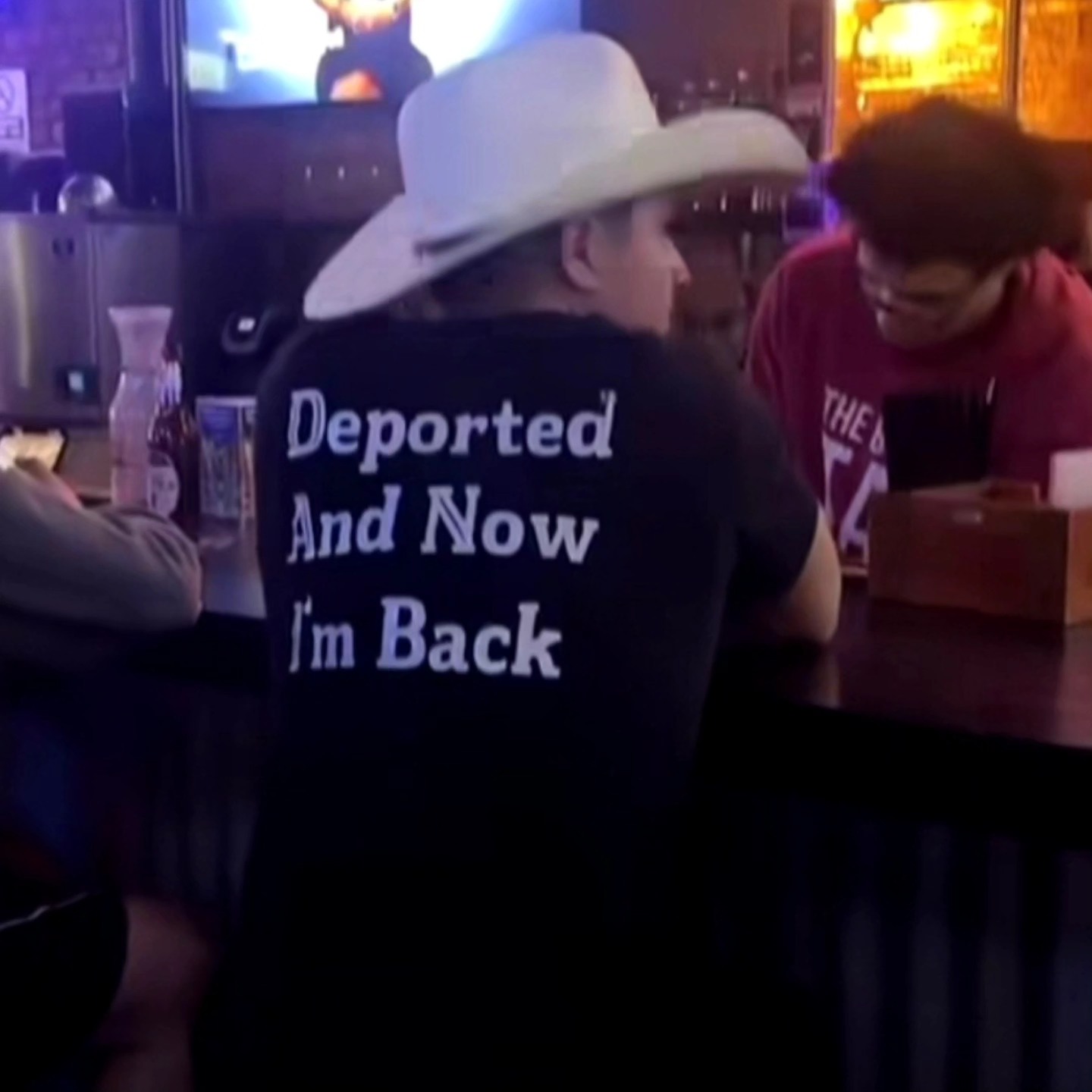
The image shows the back of a person wearing a black t-shirt and a white cowboy hat, standing at a bar. The t-shirt text reads "Deported And Now I'm Back". A person in a red shirt stands nearby, looking toward the first person. The lighting is subdued, suggesting a bar or similar indoor environment. The composition focuses on the back of the t-shirt, making the message the central visual element.
Foucauldian Genealogical Discourse Analysis
This meme taps into the discourse surrounding borders, citizenship, and the state's power to define who belongs. Foucault's work emphasizes how power operates through discourse – the systems of language, thought, and practice that construct reality. The very act of deportation is a powerful exercise of state power, defining someone as ‘outside’ the boundaries of the political community, marking them as ‘other’.
The statement "And Now I'm Back" directly challenges this disciplinary power. It disrupts the narrative that deportation is a permanent exclusion. The return implies an ability to circumvent, resist, or even expose the inherent fragility of border control as a mechanism of power. It highlights the constructed nature of these categories: "deported" and "belonging" aren't natural states, but products of historical and political forces.
From a genealogical perspective, the meme can be seen as a localized, contemporary expression of a long history of resistance to state control over movement. It evokes the narratives of returning exiles, refugees, and those who actively defy national boundaries. The t-shirt itself is a discourse, a statement meant to disrupt and challenge dominant narratives about migration.
Critical Theory
Within Critical Theory, this meme speaks to the issues of alienation and the oppressive structures of late-stage capitalism and nationalism. Deportation often occurs in the context of economic exploitation – people are brought in as labor, then rendered disposable and expelled when conditions change. The “return” then can be seen as a rejection of this disposability, a claim to agency.
The meme disrupts the Hegelian notion of a "rational" state acting in the interest of its citizens. The very act of deportation demonstrates the state’s willingness to prioritize economic or ideological imperatives (often aligned with nationalist agendas) over the basic human rights and well-being of individuals. The defiant return refuses to accept this irrationality.
Marxist Conflict Theory
From a Marxist perspective, the image can be seen as representative of class struggle, though not in a strictly economic sense. Deportation frequently targets working-class immigrants, often those engaged in essential but undervalued labor. The return challenges the power dynamic that seeks to exploit and control this labor force. It is a visible act of resistance against an economic system that relies on hierarchies of citizenship. The message implies a rejection of the imposed vulnerability inherent in being an undocumented or deported worker.
The potential for collective action is implied. The meme, by circulating, fosters a sense of solidarity with those who have been displaced and returns a challenge to the system that did the displacing.
Postmodernism
Postmodern theory might look at this meme as a disruption of grand narratives around national identity and belonging. The very idea of a "nation" or a "citizen" is deconstructed by the act of deportation and return. The meme doesn't offer a new, unified truth, but rather highlights the constructed and contingent nature of identity. The individual redefines their status through a simple, ironic statement.
It's an example of pastiche or irony – taking a negative experience ("deported") and turning it into a statement of defiance. This playfulness challenges the seriousness of the state's power and undermines the idea of a fixed, stable national identity.
Anti-Fascist Context
In the context of anti-fascism, this meme is particularly potent. Fascism relies heavily on the construction of a “pure” national identity, often achieved through exclusion and the demonization of “outsiders”. Deportation is a common tool of fascist regimes and nationalist movements to cleanse perceived impurities.
The message "Deported And Now I'm Back" represents a direct challenge to this exclusionary logic. It is a declaration that the attempt to erase or marginalize individuals has failed. The meme is a symbolic act of resistance against a system that seeks to define who deserves to belong. It embodies a refusal to be silenced or disappeared by state violence. The image functions as a form of counter-narrative, directly confronting the fascist rhetoric of national purity and control.
Disclaimer: This is an interpretation based on the provided image and the theoretical frameworks you requested. Meaning is always contextual, and other interpretations are possible.
simple-description (llama3.2-vision_11b)
The meme is a photo of a man wearing a t-shirt that reads "I don't like fascists. And the next time I see one, it will be the last time." The image is likely from a protest or rally, and the man's statement is a clear anti-fascist sentiment. The text on the shirt is a direct and unapologetic expression of opposition to fascist ideology.
detailed-analysis (gemma3-27b-vision)
Okay, let's break down this image through the lenses you've requested. It's important to note that interpreting images is always subjective, and these analyses are potential readings – not definitive truths.
Visual Description
The image appears to be a photograph taken in what looks like a dimly lit bar or tavern. The focus is on the back of a person wearing a black cowboy hat and a black t-shirt with white lettering. The t-shirt prominently displays the phrase "Deported And Now I'm Back". The individual is standing near what seems to be a bar counter, and there are other indistinct figures in the background, suggesting a busy atmosphere. The image quality is slightly grainy, possibly indicating it was taken with a mobile phone or in low light. The space feels crowded and perhaps a little rough around the edges.
Foucauldian Genealogical Discourse Analysis
This image becomes particularly interesting through a Foucauldian lens. The t-shirt’s message is a powerful statement that disrupts conventional discourses around immigration and deportation.
- Power/Knowledge: The phrase "Deported And Now I'm Back" directly challenges the power structures that govern borders and citizenship. Deportation is an exercise of state power; the act of returning disrupts that power, asserting agency in the face of it. The statement asserts a presence that the power structure attempted to erase. The t-shirt is a discourse that attempts to redefine the narrative of immigration from one of absence and subjugation to one of resilience and defiance.
- Genealogy: Tracing the genealogy of the idea of “deportation” reveals a historical construction of citizenship based on exclusion. The act of deportation isn’t neutral; it’s rooted in a complex history of national identity, racial politics, and economic interests. The wearer is reclaiming that history by stating their return, and acknowledging the conditions that originally led to deportation.
- Discursive Shift: By wearing this statement publicly, the individual isn’t simply stating a personal experience; they’re attempting to shift the discourse around immigration. The t-shirt becomes a catalyst for conversation and questioning of established norms.
Critical Theory
Applying Critical Theory allows us to analyze the social and political implications of the image.
- Ideology: The t-shirt can be seen as a challenge to the dominant ideology that frames immigration as a problem to be solved through border control and exclusion. It rejects the notion of the “illegal alien” and asserts the individual’s humanity and right to exist.
- Domination and Resistance: The act of deportation is an exercise of power, aiming to control and marginalize certain populations. The wearer’s return and public proclamation of it represent a form of resistance against that power. It's a refusal to be erased.
- Alienation: Deportation inherently leads to alienation – from family, community, and homeland. The t-shirt can be read as an attempt to overcome that alienation by reasserting belonging.
- Cultural Critique: The image prompts a critique of the cultural narratives surrounding immigration and borders. It challenges the romanticization of national identity and exposes the often-brutal realities of immigration policy.
Marxist Conflict Theory
From a Marxist perspective, the image speaks to issues of class, labor, and exploitation.
- Labor Migration: Deportation often disproportionately affects working-class immigrants who fill essential labor roles. Their removal disrupts the economic system, and their return can be seen as an attempt to reclaim their place within it. The phrase also hints at the economic impetus behind deportation - potentially reducing competition for low-wage labor.
- Class Struggle: The image can be interpreted as a form of class struggle, a challenge to the power of the ruling class (those who control immigration policy) by those who are subjected to it.
- Exploitation: Immigration, and the conditions that lead to deportation, can be seen as a form of exploitation, where individuals are valued for their labor but denied basic rights and protections. The image highlights the consequences of this exploitation.
Postmodernism
From a Postmodern perspective, the image speaks to the fragmentation of identity and the instability of meaning.
- Deconstruction of Narratives: The image challenges the linear and coherent narratives of national identity and belonging. It asserts a fluid and fragmented identity, one that is defined by displacement and return.
- Rejection of Grand Narratives: The statement rejects the grand narratives of patriotism and national unity. It asserts a more localized and personal narrative, one that is rooted in lived experience.
- Simulacra and Simulation: The t-shirt can be seen as a simulacrum – a representation of reality that has become detached from the original. The message is a performance of identity, a way of constructing meaning in a fragmented world.
Queer Feminist Intersectional Analysis
This lens can unpack how intersecting systems of power impact the individual in the image. While the image doesn't explicitly convey gender or sexual orientation, it’s valuable to consider these layers.
- Intersectionality: Individuals who are both immigrants and members of marginalized groups (e.g., LGBTQ+, people of color) face unique challenges. The experience of deportation can be compounded by discrimination and oppression based on other aspects of identity.
- Border Control as Violence: Queer and feminist scholars often view border control as a form of gendered and sexualized violence, targeting bodies deemed “undesirable” or “threatening.”
- Reclaiming Space: The act of returning and publicly displaying this message can be seen as an act of reclaiming space and asserting agency in the face of systemic oppression. It’s a refusal to be silenced or erased.
- Challenging Heteronormative National Identity: The image could challenge the notion of a homogeneous national identity that often excludes or marginalizes LGBTQ+ immigrants.
Important Note: These analyses are based on limited information. A deeper understanding would require knowing more about the individual, their specific circumstances, and the context in which the image was created.
simple-description (llama3.2-vision)
The meme features a man wearing a black t-shirt with white text that reads, "Deported And Now I'm Back." The image is likely intended to be humorous, possibly satirizing or commenting on the idea of someone being deported and then returning to their previous location. The text on the shirt is likely meant to be ironic or humorous, given the context of the image.