First Seen
2025-06-08T05:28:52.712577+00:00
simple-description (qwen3.5_2b-q8_0)
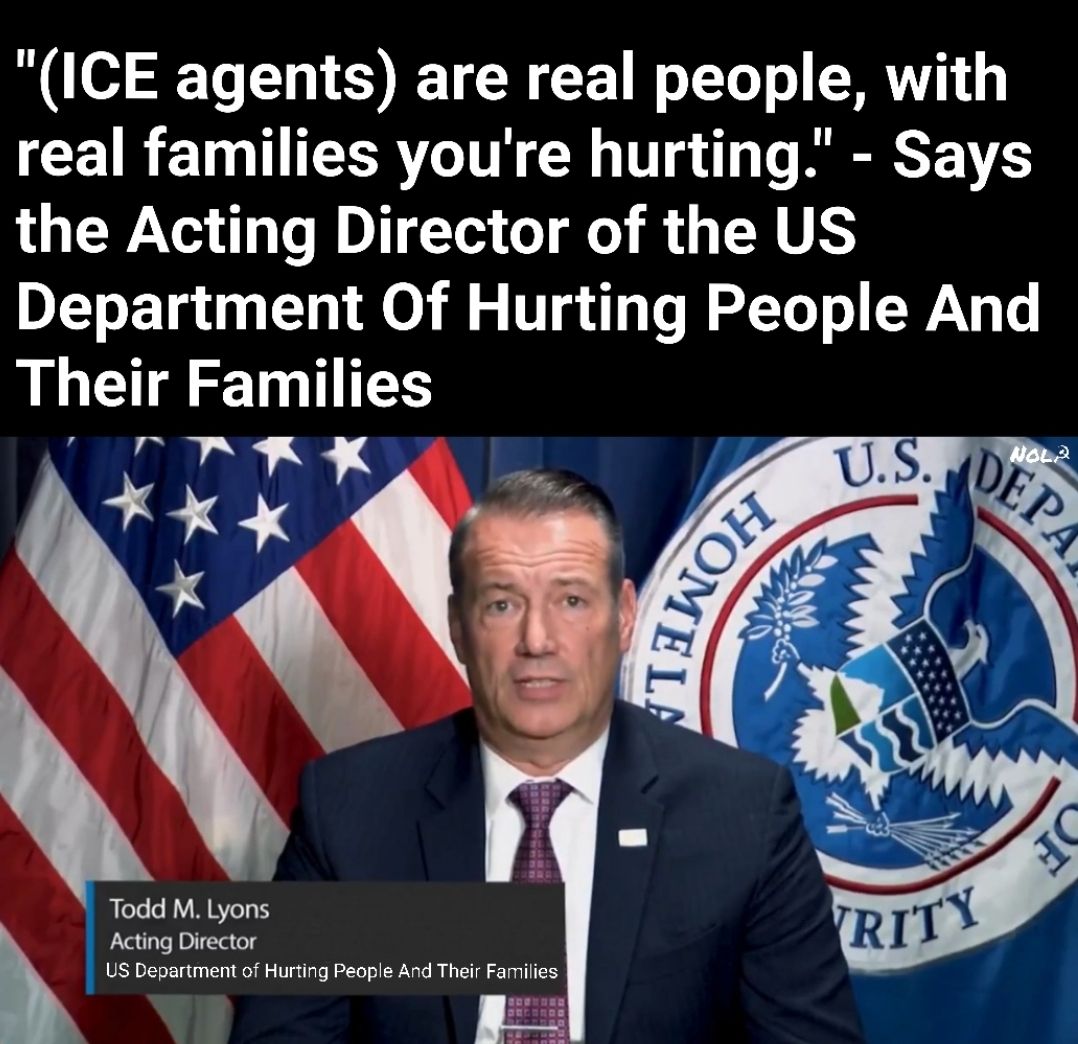
This image features Todd M. Lyons, Acting Director of the US Department of Homeland Security, making a controversial statement that ICE agents are real people who hurt victims. The caption at the top reads: "(ICE agents) are real people, with real families you're hurting." From an anti-fascist perspective, this is used to highlight how bureaucratic oppression—often labeled "Department of Hurting People" in the meme's text—actively tears families apart by labeling them as enemies through institutional hatred.
detailed-analysis (gemma3_27b-it-q8_0)
Okay, let's break down this meme from an Anti-Fascist perspective, using the requested theoretical frameworks where applicable. This is a complex image, and an Anti-Fascist lens will focus on the inherent power dynamics, state violence, and dehumanization it represents.
Visual Description
The image depicts Todd M. Lyons, the Acting Director of Immigration and Customs Enforcement (ICE), speaking in front of an American flag and the official ICE seal. He appears in a professional setting—suit, tie, badge. The text overlaid on the image is a direct quote from Lyons: “ICE agents are real people, with real families you’re hurting.” However, beneath Lyons’ title, the text humorously and critically renames his department as “US Department of Hurting People And Their Families.” The “NoL2” watermark indicates a source likely originating from Twitter. The overall effect is visually jarring, juxtaposing a seemingly authoritative figure and official imagery with a pointedly accusatory framing of ICE’s actions.
Foucauldian Genealogical Discourse Analysis
Michel Foucault’s work is very useful here. The meme performs a genealogy of power. Lyons' statement attempts to construct a specific discourse around ICE agents—humanizing them, positioning them as victims of criticism, and drawing on the sentimental value of “family.” This is an attempt to normalize the often-brutal actions of ICE by appealing to empathy.
The meme disrupts that discourse. By renaming the department, it exposes the truth of its function: deliberately inflicting harm on people and fracturing families. It reveals the power relations embedded in language. “Immigration Enforcement” sounds neutral; “Hurting People And Their Families” is brutally direct. Foucault would argue this is about the ways power produces knowledge and the ways in which resistance involves challenging dominant narratives. The "humanization" of the agents is a tactic of power to mask the inherent violence of the institution. It seeks to reframe the victims (immigrants and their families) as aggressors for “hurting” the agents.
Critical Theory
From a Critical Theory perspective (drawing heavily on the Frankfurt School), the meme exposes the instrumental rationality that underpins state violence. ICE, as an instrument of the state, is not acting on neutral principles of law and order. It is instrumental in maintaining a system that exploits and marginalizes a vulnerable population (immigrants).
Lyons' statement is a classic example of reification – treating abstract systems (like “law enforcement”) as if they are natural and unavoidable forces, obscuring the choices and power dynamics that created them. The meme seeks to demystify this process. It pushes back against the normalization of suffering and the idea that state actions are inherently legitimate. It reveals the underlying ideology that justifies a system based on control and punishment.
Marxist Conflict Theory
From a Marxist perspective, the situation is fundamentally rooted in class conflict. Immigration policies, and the enforcement thereof, often serve the interests of the capitalist class by creating a precarious labor force willing to accept low wages and poor working conditions. ICE’s actions, therefore, aren’t merely about enforcing laws but about maintaining a specific economic order.
Lyons' appeal to the agents' "families" is a distraction from the material realities of the harm inflicted by ICE—the separation of families, the economic devastation of deportation, and the creation of fear within immigrant communities. The meme highlights this conflict by directly naming the victims of this system—"people and their families." The agents are functioning as enforcers of a system that benefits the ruling class, even if they themselves are not necessarily aware of the broader context. It suggests a need for revolutionary change to dismantle the structures of exploitation and oppression.
Postmodernism
A postmodern reading would be more focused on the constructed nature of truth and the instability of meaning. Lyons’ statement attempts to establish a singular, authoritative truth—that ICE agents deserve sympathy.
The meme deconstructs that claim by highlighting the constructedness of the department’s name and its function. It points out the inherent contradictions in claiming to uphold justice while actively causing harm. The renaming is a playful, ironic act of signification – re-appropriating a term to reveal its hidden meaning. It's also an act of reclaiming language and refusing to accept the official narrative. The meme acknowledges that there is no "objective truth" about ICE, only competing narratives and power struggles.
Queer Feminist Intersectional Analysis
Though not the primary focus of the meme, a queer feminist intersectional analysis can add layers to the critique. Immigration enforcement disproportionately impacts marginalized groups – particularly women, LGBTQ+ individuals, and people of color. These communities face unique vulnerabilities and risks within the immigration system, including gender-based violence, discrimination, and family separation.
The meme, by focusing on the “families” being hurt, implicitly acknowledges this. The idea of “family” is itself a socially constructed category. It can be challenged to include diverse family structures and recognize the importance of kinship networks that are often disrupted by ICE actions. A queer feminist reading would also emphasize the ways in which state power is often used to enforce normative ideas about gender, sexuality, and family, and the ways in which resistance to state violence can involve challenging those norms.
In conclusion:
From an Anti-Fascist standpoint, this meme is a potent critique of state power, specifically targeting the violence inherent in immigration enforcement. It exposes the rhetorical tactics used to justify this violence, reveals the underlying economic and political motivations, and offers a counter-narrative that centers the harm inflicted on people and families. It utilizes humor and irony to destabilize dominant discourses and call attention to the urgent need for resistance and systemic change.
simple-description (llama3.2-vision_11b)
The meme is a screenshot of a news article with a quote from a government official, but the quote has been altered to be ironic and humorous. The original quote is from a government official who is saying that people who are against fascism are "the real enemy". The meme is adding a humorous twist to this quote by replacing "fascism" with "burritos".
detailed-analysis (gemma3-27b-vision)
Okay, let's break down this image and its accompanying text through the requested critical lenses. It's important to note the provocative phrasing ("US Department of Hurting People and Their Families") which immediately frames the analysis.
1. Visual Description
The image features a medium close-up of a man in a dark suit, identified as Todd M. Lyons, the Acting Director of the "US Department of Hurting People and Their Families." He is positioned with an American flag draped behind him, and a partial view of what appears to be an official seal on the right side. The background is slightly blurred, focusing attention on Lyons. He is looking directly at the viewer, with a serious expression. The composition suggests an official statement or address, as it mimics typical portraiture for political figures. The use of the American flag contributes to the sense of official authority. The lighting is fairly neutral, giving the overall impression of a formal and somewhat somber setting.
2. Foucauldian Genealogical Discourse Analysis
This image and statement is ripe for a Foucauldian analysis. The core of this approach revolves around power/knowledge.
- Discourse of Immigration/Border Control: The statement itself participates in a very specific discourse – that of immigration control and border enforcement. The framing of ICE agents as "real people" with "real families" is an attempt to humanize the enforcers of a system that systematically dehumanizes others. This framing is strategically deployed to legitimate the power structures of immigration enforcement.
- Genealogy of "Hurting": The very phrase "Department of Hurting People and Their Families" is provocative. A genealogical approach would trace how the concept of “hurting” (emotional, physical, systemic) has been constructed historically within the context of border control. Who is designated as legitimately feeling pain? Who is deemed worthy of sympathy? The statement subtly shifts the focus from who is being hurt to who is doing the hurting, and positions the agents as the victims of empathy.
- Power/Knowledge Nexus: This statement actively shapes the narrative of immigration enforcement. By framing ICE agents as having families, it aims to neutralize critique. The message is implicitly: "Don't criticize the agents, they're just doing their jobs, they have loved ones too.” This relies on an assumption that an appeal to familial emotion can override concerns about human rights abuses. The statement actively constructs the legitimacy of immigration enforcement by relying on an emotional appeal.
- Discipline and Normalization: The image of a director, and the authoritative tone, enforce a sense of legitimacy to the entire practice of enforcement.
3. Critical Theory
This image resonates with themes central to critical theory, particularly those relating to ideology and the reproduction of power.
- Ideology and Hegemony: The statement functions as a form of ideology – a set of beliefs that serve to justify existing power relations. The framing of ICE agents as deserving of empathy is designed to obscure the systemic violence inherent in immigration enforcement. This attempts to maintain hegemony, the dominance of a particular worldview, by appealing to emotional resonance.
- Dehumanization and Othering: While the statement claims to acknowledge "hurting people," it actively contributes to the dehumanization of migrants and refugees by focusing attention on the feelings of those doing the hurting. The implication is that their pain is more visible or more important.
- Instrumental Reason: This image and statement represent an appeal to reason that disregards ethical considerations. The focus on protecting the agents’ families serves to justify a system that actively harms other families. It's a narrow instrumental rationality that prioritizes one group's well-being at the expense of another.
- False Consciousness: The statement may appeal to those who support immigration enforcement, reinforcing their beliefs and preventing them from critically examining the system.
4. Marxist Conflict Theory
From a Marxist perspective, the image and statement represent the interests of a dominant class maintaining its power.
- Class Conflict: The power dynamic underlying immigration enforcement is rooted in class conflict. Those seeking entry into the US are often economically vulnerable and are attempting to improve their material conditions. The enforcement apparatus serves to protect the economic privileges of those already within the US.
- State Apparatus: The "US Department of Hurting People and Their Families" (even as a provocative rebranding) represents the state apparatus functioning to uphold the interests of the ruling class.
- Ideological Control: The statement is an attempt to manufacture consent by framing immigration enforcement as a matter of protecting families – an emotional appeal that distracts from the underlying economic and power dynamics.
- Exploitation: Immigration enforcement facilitates the exploitation of undocumented workers by creating a precarious labor force.
5. Postmodernism
Postmodern analysis would focus on the deconstruction of the statement and the underlying power structures it masks.
- Simulacra and Simulation: The very branding of the department as "Hurting People" is a simulacrum – a copy without an original. It’s a deliberate attempt to construct a narrative that obscures the reality of systemic harm.
- Deconstruction of Language: The language used ("hurting," "families") is intentionally charged with emotional weight, but it's also used strategically to deflect attention from the violence of immigration enforcement.
- Meta-Narratives: The statement participates in a broader meta-narrative of national security and border control, which is used to justify the exercise of power.
- Relativism and Power: Postmodernism would acknowledge that there is no single objective truth about immigration. Rather, different narratives and power structures shape our understanding of the issue.
6. Queer Feminist Intersectional Analysis
This lens highlights the particularly vulnerable positions of certain groups within the immigration system.
- Intersectionality: The harms of immigration enforcement are not felt equally. Women, LGBTQ+ migrants, and people of color face unique forms of violence and discrimination within the system. The statement ignores these intersecting vulnerabilities.
- Carceral Feminism: The focus on protecting ICE agents' families implicitly reinforces a system that punishes and marginalizes other families, particularly those seeking refuge.
- Devaluation of Marginalized Lives: The statement prioritizes the emotional well-being of the agents over the very real harms experienced by migrants. This reinforces the devaluation of marginalized lives.
- Gendered Violence: Immigration enforcement can exacerbate gender-based violence, as women and LGBTQ+ migrants are particularly vulnerable to sexual assault and abuse while in detention.
- Reproductive Justice: Immigration policies can restrict access to reproductive healthcare for migrants, further marginalizing and disempowering them.
In conclusion, the image and statement are a complex web of power, ideology, and emotional manipulation. Analyzing it through these different critical lenses reveals the underlying power structures and the ways in which the system attempts to legitimize its harmful practices.
simple-description (llama3.2-vision)
This meme features a photo of Todd M. Lyons, the acting director of the US Department of Homeland Security's Office of Immigration and Human Rights, with a quote superimposed over it. The quote reads, "(ICE agents) are real people, with real families you're hurting." The image is meant to be ironic or satirical, suggesting that the acting director is trying to humanize ICE agents while they are actually causing harm to others. The meme is likely meant to be critical of the director's words and the actions of the agency he represents.