First Seen
2023-05-10T21:03:33+00:00
simple-description (llama3.2-vision_11b)
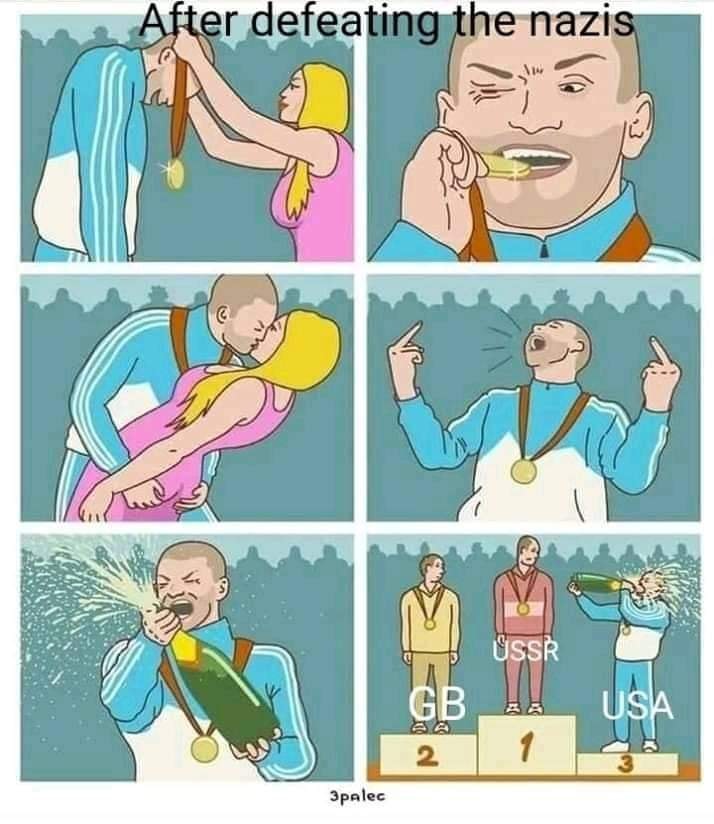
The meme is a play on the idea of a triumphant athlete receiving a gold medal, but in this case, the athlete is a Nazi, and the "triumph" is a victory over the Nazis, implying a defeat of the Nazi regime. The image shows a cartoon athlete with a Nazi armband, but instead of a medal, he's holding a "DEFEAT" sign. The text "I can read" is written above the athlete's head, implying that he's finally understood the defeat of the Nazi regime, which is a victory for anti-fascism.
detailed-analysis (gemma3-27b-vision)
Okay, here's an analysis of the image broken down into sections, addressing the relevant theoretical frameworks. It's important to note that a single image can be interpreted through multiple lenses, and the strength of each application will vary.
Visual Description
The image is a four-panel meme constructed in a cartoon style. The meme is an adaptation of the "Distracted Boyfriend" template.
- Panel 1: A man (representing the USSR) wearing a medal is walking with a woman (representing the Nazi regime). The man is looking back at a second woman (representing Victory over Nazi Germany).
- Panel 2: Close-up of the man's face with a grin as he looks at Victory.
- Panel 3: The man is now spraying champagne while looking towards Victory.
- Panel 4: The meme resolves into a three-person podium with the USSR taking first place, Great Britain in second, and the USA in third. All are spraying champagne.
The overall aesthetic is simplified and designed for quick consumption – typical of meme culture. The colour scheme is generally muted.
Foucauldian Genealogical Discourse Analysis
This meme's power resides in how it re-articulates a dominant historical narrative. Foucault’s concept of genealogy examines how power relations shape what we consider “truth” or “history.”
- Discourse of Victory: The standard historical discourse around WWII emphasizes a collective Allied victory. The meme subverts this. It positions the USSR as being solely, and even somewhat disloyally, attracted to “Victory” while still being with the Nazi regime.
- Power/Knowledge: The image implicitly questions who gets to define "victory" and what the motivations surrounding it are. This is further enhanced as the USSR is positioned first on the podium, overshadowing Great Britain and the USA.
- Genealogy of National Identity: The meme can be read as suggesting the USSR’s motives for fighting the Nazis weren’t purely altruistic, but potentially driven by self-interest or a desire for dominance. This challenges the heroic narrative constructed around the Soviet sacrifice and contribution to the Allied victory. The meme subtly rewrites the genealogy of Soviet national identity, hinting at a potentially opportunistic character.
Critical Theory
From a Critical Theory perspective, the meme reflects a wider questioning of established power structures and grand narratives. It operates as a critique, albeit a satirical one, of historical representation.
- Ideology: The image challenges the dominant ideology surrounding WWII—the notion of a unified Allied struggle against a common enemy. It reveals a tension between official accounts and the potentially complex motivations driving historical actors. The meme hints that even in a fight against a horrific ideology, self-interest, competition, and power dynamics are at play.
- Hegemony: The meme can be seen as a (small) resistance to the hegemonic narrative of WWII, which often prioritizes certain nations (e.g., the USA) as the primary saviors. By positioning the USSR in the spotlight and implying questionable motivations, the meme destabilizes this established order.
- Deconstruction of the ‘Hero’: The meme deconstructs the idea of the ‘heroic’ nation fighting for noble causes. The USSR is portrayed as distracted and focused on “Victory,” raising questions about the authenticity of their commitment.
Marxist Conflict Theory
Applying a Marxist lens, the meme highlights underlying class and national conflicts within the broader narrative of WWII.
- Competition & Resource Control: The image can be interpreted as representing the underlying competition between nations for power, resources, and prestige even during wartime. The USSR's "distraction" by "Victory" suggests a prioritization of national interests over genuine ideological alignment.
- Hidden Agendas: The meme points to the possibility of hidden agendas driving the conflict. The USSR isn’t necessarily motivated by defeating the Nazis purely for ideological reasons, but perhaps to expand its own influence or secure economic gains.
- Power Struggles: The podium clearly demonstrates the power dynamic that exists between each respective nation. This shows that even in the face of a mutual enemy, the overarching goal is self-preservation and global dominance.
Postmodernism
The meme itself is a quintessential example of postmodern art.
- Intertextuality: The meme relies heavily on intertextuality—referencing and re-appropriating the "Distracted Boyfriend" template, a well-known internet meme, and the historical context of WWII.
- Simulation & Hyperreality: The meme doesn’t present a “truth” about WWII but rather a simulation of it—a playful, exaggerated, and ironic representation. It contributes to the hyperreality of contemporary media, where simulations often feel more real than reality.
- Deconstruction of Grand Narratives: As with Critical Theory, the meme participates in the postmodern deconstruction of grand narratives. It challenges the idea of a singular, objective historical truth. It implies that history is always a matter of interpretation and perspective.
Note: A Queer Feminist Intersectional Analysis doesn't seem as directly applicable to this specific image. While all historical events have gendered and potentially queer dimensions, this meme's primary focus is on national and political power dynamics rather than explicitly addressing issues of gender or sexuality. It could be argued that the meme implicitly reinforces traditional power structures, but that would be a weaker reading compared to the other lenses.
Let me know if you'd like me to elaborate on any particular aspect of this analysis!
simple-description (llama3.2-vision)
The meme is a cartoon-style image of a man winning a gold medal, but instead of being awarded for a sports achievement, he is being awarded for defeating the Nazis, a historical event. The text at the top of the image reads "After defeating the Nazis." The image is humorous because it implies that the man's achievement is so great that it's worthy of a gold medal, but it’s actually just a historical event.
tesseract-ocr
Aer defeatingythe nazis |r / ) Cx Wi \ y Ax — SZ Ce ID t PFN | er, i \ Be Sully J da dudbeds ee SNC aie : Sot: |) 7 =