First Seen
2023-05-10T21:03:34+00:00
simple-description (llama3.2-vision_11b)
The meme is a humorous reference to a 2006 video game where a character's name is "Sargent" and he is known for saying "just like the sims" in response to a situation where a character is acting out of character. In this meme, the character's name is replaced with "Sargent" and the phrase "just like the sims" is used in a similar context. The meme is a play on words, using a phrase that is familiar to gamers to describe a situation that is absurd and unexpected.
detailed-analysis (gemma3-27b-vision)
Okay, let's break down this meme using the frameworks you've requested. It's a layered piece, leveraging existing cultural touchstones to make a point about the blurring of reality and simulation.
Visual Description
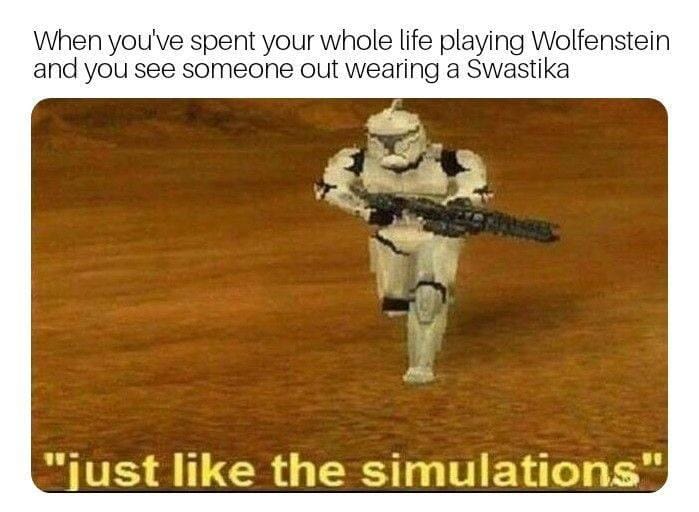
The image is a still frame from a video, likely taken from a low-resolution source, given the pixelated appearance. It depicts a figure dressed in what appears to be a Stormtrooper uniform (from Star Wars). However, it’s an oddly-posed, jerky, and somewhat comical rendition of the iconic character. The background is a blurred, warm-toned, indeterminate space. The text above the image reads: "When you've spent your whole life playing Wolfenstein and you see someone out wearing a Swastika." The text below the image reads: "Just like the simulations.”
Postmodernism
This meme is very deeply rooted in postmodern thought. Several hallmarks of postmodernism are present:
- Simulacra and Simulation (Baudrillard): This is arguably the core concept driving the meme. The phrase "just like the simulations" directly evokes Jean Baudrillard's work, specifically his idea that we live in a world of hyperreality where simulations have become more real than the real. The person who has spent years battling Nazi imagery in Wolfenstein then encounters it in the real world, triggering a sense of unreality. The "simulation" (the game) has bled into the "real," blurring the lines between them.
- Deconstruction of Grand Narratives: The meme subtly deconstructs the traditional “hero” narrative. Wolfenstein, at its core, is a game about fighting Nazis. By juxtaposing the game experience with the real-world encounter, the meme implies that the simple "good vs. evil" binary of the game doesn’t translate cleanly to the complexities of the real world.
- Pastiche and Irony: The image itself is a form of pastiche – a clumsy, intentionally awkward rendition of a familiar icon. The irony lies in the disconnect between the "heroic" fantasy of the game and the disturbing reality of seeing a swastika.
Foucauldian Genealogical Discourse Analysis
A Foucauldian approach focuses on the historical construction of power relations and how meaning is produced through discourse.
- Discourse on Nazism: The meme highlights how the discourse surrounding Nazism is mediated through popular culture (like Wolfenstein). For many, the primary exposure to Nazi imagery and ideology is through fictional representations. This can create a particular understanding of Nazism that is detached from its historical reality.
- Power/Knowledge: Foucault argues that power and knowledge are intertwined. The meme suggests that for someone immersed in the "knowledge" produced by a game like Wolfenstein, encountering a real swastika is jarring because it disrupts the established power dynamics of that simulation.
- Disrupting Normalization: The meme subtly questions the normalization of Nazi imagery within the context of entertainment. By juxtaposing the game with real-world context, it forces a re-evaluation of the ways in which this imagery is consumed and circulated.
Critical Theory
Critical theory examines power structures and their impact on society.
- Culture Industry (Adorno & Horkheimer): The meme can be read as a commentary on the culture industry. Wolfenstein is a product of the culture industry that provides a controlled, sanitized version of conflict. The meme suggests that this can create a disconnect between representation and reality.
- Commodification of Conflict: The meme can also point to the commodification of conflict. War and trauma are often turned into entertainment, which can desensitize us to their real-world consequences.
Marxist Conflict Theory
While not the primary framework, a Marxist interpretation could be applied:
- Ideological Control: Wolfenstein could be viewed as a form of ideological control, presenting a specific narrative about good vs. evil and justifying conflict. The meme subtly questions this narrative, suggesting that real-world power dynamics are more complex than the game portrays.
Regarding Queer Feminist Intersectional Analysis:
This meme does not lend itself well to a Queer Feminist Intersectional Analysis. There is no direct reference to gender, sexuality, race, or other elements of intersectionality in the meme.
In conclusion:
This meme is a layered comment on the impact of popular culture, the blurring of reality and simulation, and the complexities of confronting historical trauma. It is a darkly humorous commentary that encourages us to question the ways in which we consume and interpret representations of conflict. The meme's use of the “simulations” reference makes explicit the central concept of post-modernity that’s at play.
simple-description (llama3.2-vision)
The meme is a humorous take on the idea that someone has spent their entire life playing the video game "Wolfenstein" and has finally seen someone wearing a Swastika (a symbol of the Nazi party) in the game. The image is of a Stormtrooper character from the Star Wars franchise, but with a caption that says "Just like the simulations" in a sarcastic tone, implying that this is a typical scenario in the game. The meme is meant to be humorous and ironic, poking fun at the idea that someone would finally see something that they've been trained to expect in a game.
tesseract-ocr
When you've spent your whole life playing Wolfenstein and you see someone out wearing a Swastika rit 3 St e ‘ 4 "just like the simulations"