First Seen
2023-05-10T21:03:34+00:00
simple-description (llama3.2-vision_11b)
The meme is a screenshot from the movie "The Last of Us Part II" where Ellie is shown holding a gun to a character's head, captioned "I'm not a monster". The image is used to express a sarcastic tone, implying that someone is trying to justify their actions as not being a monster, similar to Ellie's character in the game.
detailed-analysis (gemma3-27b-vision)
Okay, let's break down this meme through various theoretical lenses. It's a dense image, leaning heavily into internet culture and arguably attempting to be ironic/meta.
Visual Description
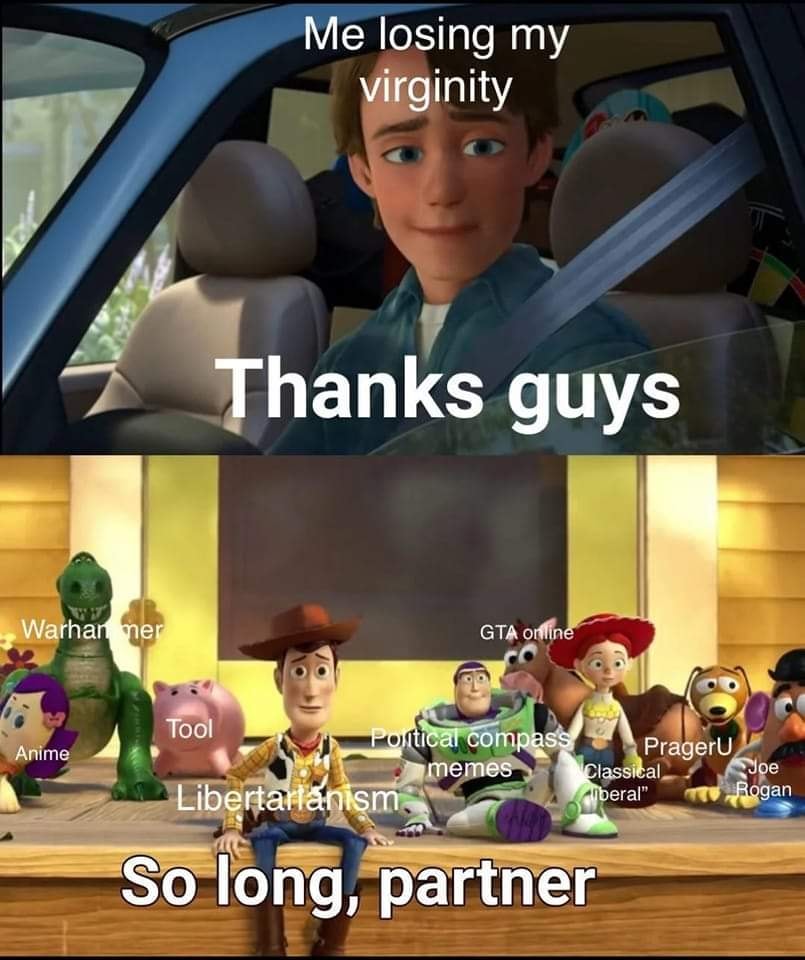
The image is a screenshot from Toy Story 3, specifically the scene where Andy is preparing to leave for college and is saying goodbye to his toys. The framing focuses on Woody, with a background of other Toy Story characters. However, the image has been heavily edited with text overlays and labels assigned to the characters.
- Text Overlay 1: "Me losing my virginity" – Placed at the top, implying the scene represents a symbolic transition.
- Text Overlay 2: "Thanks guys" – Positioned above Woody, likely meant as a farewell from the "protagonist" of this narrative.
- Text Overlay 3: "So long, partner" – Placed at the bottom, similar to Woody’s iconic line, reinforcing the thematic parallel to the movie scene.
- Character Labels: Several Toy Story characters are labeled with various internet culture/political/ideological terms:
- Warhammer (a miniature wargame)
- Anime
- Tool (the progressive metal band)
- Political Compass Memes
- "Classical Liberal"
- PragerU (a conservative media organization)
- Joe Rogan (a podcaster, often associated with conservative and contrarian viewpoints)
- GTA Online (A video game associated with a lot of meme content)
- Libertarianism
The overall visual effect is intentionally chaotic and absurdist, mixing childhood nostalgia with highly adult themes and internet subculture.
Foucauldian Genealogical Discourse Analysis
This meme is ripe for Foucauldian analysis. The image constructs a discourse around sexuality and the loss of virginity, but not in a straightforward way. The loss of virginity isn’t presented as a natural or beautiful event, but rather as a departure, a “leaving” akin to Andy leaving for college.
- Power/Knowledge: The labeling of the Toy Story characters with ideological terms reveals a construction of power/knowledge. The meme-maker is positioning these various subcultures/ideologies as "witnesses" or participants in the loss of virginity. The implicit message is that those ideologies have contributed to the individual's path to losing their virginity. It asserts a (likely satirical) relationship between these online interests/belief systems and sexual experience. The labeling creates a connection, not necessarily reflects an existing one.
- Genealogy: Tracing the “genealogy” of this imagery reveals a complex layering. The original Toy Story scene is about childhood, growth, and letting go. This meme disrupts that meaning, imposing a new layer focused on sexual experience. The genealogy also includes the internet meme culture, which thrives on repurposing and subverting existing images and narratives.
- Discourse and Subjectivity: The meme plays with the construction of subjectivity. The "Me" losing their virginity is positioned as a subject within a network of discourses (online subcultures, ideologies). It suggests that the individual’s identity and experience are shaped by these external forces.
Critical Theory
From a Critical Theory perspective, the meme can be read as a commentary on societal norms and the construction of masculinity and sexuality.
- Commodification of Experience: The meme, especially given its internet context, could be seen as an example of the commodification of experience. The deeply personal event of losing one’s virginity is reduced to a meme, stripped of its emotional weight and circulated for entertainment.
- Critique of Ideology: The labeling of the Toy Story characters with ideological terms suggests a critique of how ideologies shape our perceptions of sexuality and identity. The seemingly random assignment of ideologies could be seen as highlighting the arbitrary and often contradictory nature of these belief systems.
- Representation and Power: The meme’s reliance on internet culture and online subcultures points to the growing power of these spaces in shaping our understanding of the world. The meme-maker is attempting to insert their own interpretation into the cultural conversation.
Marxist Conflict Theory
A Marxist interpretation would see the meme as potentially reflecting or critiquing class-based anxieties surrounding sexuality and access to experience.
- Cultural Capital: The references to things like Warhammer, Tool, and anime can be seen as markers of “cultural capital” – knowledge and tastes that are valued within certain social groups. Losing one’s virginity within the context of these subcultures could be seen as a way of demonstrating status or belonging.
- Ideological Control: The labeling of the characters with political ideologies could be interpreted as highlighting the ways in which dominant ideologies attempt to control and shape our understanding of sexuality.
- Commodity Fetishism: The meme itself, as a piece of digital content, can be seen as an example of commodity fetishism. Its value lies not in its content but in its ability to generate engagement and attention.
Postmodernism
This meme is deeply rooted in postmodern principles.
- Intertextuality: The meme relies heavily on intertextuality, drawing on multiple sources (the Toy Story film, internet meme culture, various subcultures, political ideologies) and blending them together in a new, often ironic, way.
- Simulacra and Simulation: The meme creates a simulation of experience, replacing genuine emotion with a constructed narrative. The loss of virginity is not presented as a lived experience but as a representation of an experience.
- Deconstruction: The meme deconstructs the original meaning of the Toy Story scene, stripping it of its sentimental value and imposing a new, often subversive, interpretation.
- Irony and Parody: The meme’s use of irony and parody is a hallmark of postmodernism. It subverts expectations and challenges traditional norms.
Queer Feminist Intersectional Analysis
This is where things become more nuanced, and the meme is most problematic. While it's not explicitly a queer feminist text, the subtext and the implied association of various subcultures with sexuality invite intersectional scrutiny.
- The Heteronormative Framing: The meme centers on the loss of virginity, inherently framing sexuality within a heteronormative context. It reinforces the idea that "losing" virginity is a rite of passage, particularly for those identifying as male (given the often-associated culture of the labeled items).
- Representation and Exclusion: The meme’s exclusive focus on one sexual experience (heterosexual, presumably) reinforces the invisibility of other sexualities and gender identities.
- Intersection of Identity and Subculture: The labeling of the characters with different subcultures could be seen as an attempt to create a complex intersectional identity. However, this is done in a superficial and potentially essentializing way.
- The Male Gaze: The imagery and the framing of the meme strongly suggest a male gaze, focusing on sexual experience from a male perspective. The implication is of male experience and the labeling of the subcultures around that experience.
Important Note: It's crucial to remember that memes are often complex and ambiguous. They can be interpreted in multiple ways, and their meaning is often dependent on the context and the audience. This analysis is just one possible interpretation. The meme's intent is difficult to fully ascertain.
I hope this breakdown is comprehensive and helpful! Let me know if you'd like me to elaborate on any of these points.
simple-description (llama3.2-vision)
The meme is a screenshot from the movie "Toy Story" where a toy character named Buzz Lightyear is saying goodbye to his friends. The text on the image reads: "So long, partner" and "Thanks guys" which are said by Buzz Lightyear in the movie. The meme is likely used to express a sense of parting or goodbye, and is often used in a humorous or ironic way to say goodbye to someone or something.
tesseract-ocr
a ‘ e losing my - Vice TATA Gioid*. W fo fi BU Uh | ear ib ert ae * = Oi Guay CORK a pes ae ~% Kee in 7 aes AS a ys wl eRe es ———— ~_9010ng, partner