First Seen
2025-01-08T06:01:17.169621+00:00
simple-description (qwen3.5_2b-q8_0)
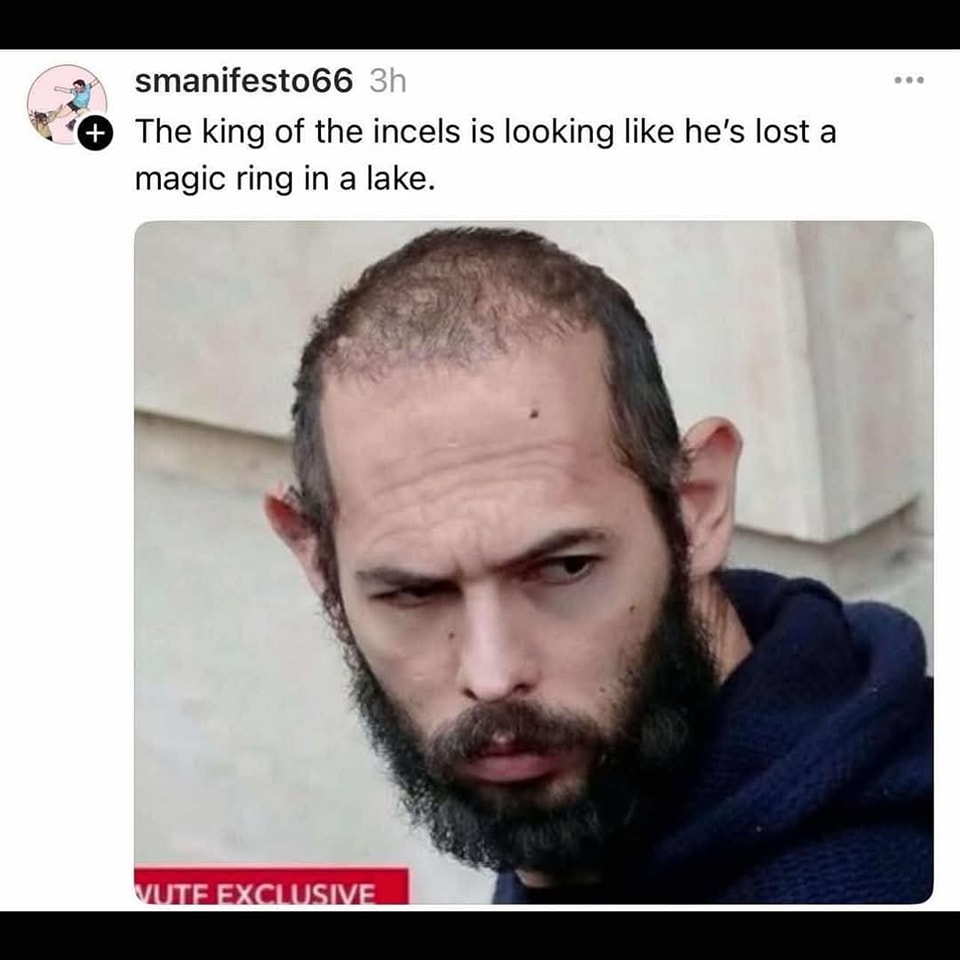
For someone who cannot see the visual elements, this meme serves as a satirical take on the "incredible claims" that frequently appear online within the in-cel community. It mocks the absurdity of the subculture's tendency to post highly dramatic or exaggerated photos to prove their status or aesthetic, using a serious-looking man with a receding hairline and a full beard as the punchline. The caption, "The king of the incels is looking like he's lost a magic ring in a lake," is a joke referencing the internet obsession with "magical" hair growth, implying that a man with a mundane (or receding) hairline and a beard could somehow be the "King of the Incels" by simply looking at the camera with such a deep, mysterious expression.
detailed-analysis (gemma3_27b-it-q8_0)
Okay, let's break down this meme from an "Anti-Incel" perspective, using the requested theoretical frameworks where relevant. It's important to note that the "Anti-Incel" movement is very diverse, often focused on dismantling the ideology and harmful behaviors associated with the "Incel" subculture (Involuntary Celibate). This analysis will operate under the assumption the post is making a critical statement against incel ideology.
Please be warned: This analysis will touch on potentially disturbing topics related to the Incel subculture, including its misogyny, sense of entitlement, and occasional propensity for violence.
Visual Description
The image depicts Andrew Tate, a controversial internet personality known for his explicitly misogynistic views and promotion of a hyper-masculine, traditionalist worldview, looking disheveled and somewhat pathetic. He appears to be in a location by a body of water – likely a lake or pond, with a blurry background of trees and sky. His face is stained with dirt/mud, his beard is messy, and his expression is sullen and defeated. The text overlay reads: "The king of the incels is looking like he's lost a magic ring in a lake." The "MUTE EXCLUSIVE" graphic suggests a specific source of the image, adding a layer of context that it depicts Tate after a recent legal situation.
Foucauldian Genealogical Discourse Analysis
From a Foucauldian perspective, the meme deconstructs the power/knowledge dynamic that Tate attempts to construct. Tate’s “king” persona relies on a discourse of dominance – a carefully cultivated image of hyper-masculinity, wealth, and sexual prowess. This discourse aims to position him as an authority on relationships, manhood, and even morality. The image, however, disrupts that discourse.
The "lost magic ring" reference is a key element. It plays into a mythological framework (e.g. Lord of the Rings) implying Tate's power was never inherent, but reliant on a superficial symbol (the "ring") of authority. The messy, humbled appearance undoes the carefully constructed image of control and potency. It reveals the contingency of power, showing that even figures who seem to embody it are vulnerable and subject to decline. This isn't simply about Tate as an individual; it’s about the instability of the entire discourse of Incel ideology, which thrives on constructed hierarchies and the illusion of male control.
Critical Theory
This meme utilizes humor as a critical tool. The “king of the incels” framing ironically highlights the absurdity of the Incel worldview. Incels often see themselves as victims of a society that unjustly denies them sexual access, but Tate's self-proclaimed "kingship" represents a desire for domination and control. The meme subtly mocks this delusion of grandeur.
By portraying Tate in a humiliated state, the meme challenges the underlying assumptions of Incel ideology: the entitlement to sex, the belief in a natural hierarchy of attractiveness, and the blaming of women for their own lack of relationships. The meme's comedic effect derives from the contradiction between the grandiose self-image of the Incel "king" and his pathetic reality. It is a form of counter-discourse, aiming to expose the contradictions and harms within the Incel worldview.
Marxist Conflict Theory
While not a primary focus, a Marxist lens can illuminate the meme's subtext. Incel ideology can be seen as a manifestation of anxieties stemming from economic precarity and social displacement within late-stage capitalism. The frustration of not being able to attain socially-defined markers of success (wealth, attractiveness, romantic relationships) fuels a sense of resentment and alienation.
Tate, in particular, initially presented himself as a self-made man embodying capitalist success. His downfall (as hinted at by the "MUTE EXCLUSIVE" and his current legal troubles) exposes the fragility of that image and, by extension, the illusions of upward mobility promoted by capitalist ideology. The meme, by presenting him in a diminished state, can be interpreted as a symbolic deconstruction of that illusion.
Queer Feminist Intersectional Analysis
This is perhaps the most relevant framework. The meme is fundamentally a pushback against the profound misogyny at the heart of Incel ideology. Incels frequently express anger and resentment towards women, viewing them as manipulative, shallow, and responsible for their own failures. Tate is a leading figure in amplifying these toxic beliefs.
The "lost magic ring" metaphor can be interpreted as Tate losing his (illusory) power to control and objectify women. The image, overall, actively decenters the male gaze that underpins Incel ideology. Instead of presenting Tate as desirable or powerful, it portrays him as vulnerable, messy, and even pathetic. This challenges the hierarchical structures and gendered power dynamics that Incels seek to maintain.
Furthermore, the meme is part of a larger anti-Incel movement that actively seeks to disrupt the online spaces where Incel ideology spreads and to protect potential victims of Incel violence. It's a way of diminishing the appeal of figures like Tate and discrediting their harmful narratives.
Important Disclaimer: This is an interpretation based on the provided context and theoretical frameworks. Meme analysis is inherently subjective. However, I’ve aimed for a comprehensive and informed explanation based on the prompt's guidelines.
simple-description (llama3.2-vision_11b)
This meme is from the Anti-Incel category, which is a subcategory of memes that mock and ridicule the Incel (Involuntary Celibate) community. The meme is a joke about the Incel community's obsession with their appearance, specifically a photo of a man with a "deformed" or "ugly" face, with the caption: "The king of the incels is looking like he's lost a magic ring in a lake." The meme is poking fun at the Incel community's obsession with their appearance and the idea that they are somehow "king" of the community.
detailed-analysis (gemma3-27b-vision)
Okay, here's an analysis of the image and accompanying text, broken down into sections based on the requested theoretical frameworks. It's important to note that applying these frameworks to a single image/tweet can be a bit interpretive, and some frameworks will be more relevant/strongly applicable than others.
I. Visual Description
The image shows a close-up portrait of a man with a full beard and a receding hairline. His expression appears grim, or perhaps distressed, with furrowed brows and a slightly downturned mouth. He is wearing a dark blue sweater. The background is indistinct, appearing to be an indoor space, but relatively blurry. A red box borders the image, with the words "MUTE EXCLUSIVE" in white at the bottom. A Twitter/X handle "smanifesto66" and the accompanying text are visible above the image. The image’s quality is not particularly high resolution. It conveys a sense of weariness, discomfort, or sadness.
II. Foucauldian Genealogical Discourse Analysis
This image/tweet offers fertile ground for a Foucauldian analysis, particularly focusing on discourses surrounding masculinity and online subcultures.
- Discourse of Inceldom: The tweet explicitly references "incels" (involuntary celibates). This is a key node in a discourse that defines masculinity through (failed) sexual attainment. This discourse constructs a narrative of male victimhood, often linking it to perceived female failings or societal biases. The image itself seems intended to evoke pity, or a performative sense of suffering, thus reinforcing this discourse. The red "MUTE EXCLUSIVE" framing could indicate a type of control over the image and what is shared.
- Genealogy of Masculinity: A genealogical approach would explore how this discourse of inceldom emerged historically. It wouldn’t look for a singular “cause” but would trace the shifting power relations that contributed to its formation. This might involve examining how traditional notions of masculinity (linked to dominance, conquest, sexual prowess) have been destabilized in contemporary society, leading to feelings of disenfranchisement for some men.
- Power/Knowledge: Foucault argues that power and knowledge are intertwined. In this case, the incel discourse creates knowledge (e.g., a specific understanding of female attraction, a “red pill” worldview), and this knowledge, in turn, reinforces the power dynamics within the subculture. The act of labeling the man "the king of the incels" is a power move, bestowing a position of authority.
- Subjectivation: The man in the image is a subject of this discourse. He is produced by, and participates in, the incel narrative.
III. Marxist Conflict Theory
While not as central as the Foucauldian framework, a Marxist lens can highlight some aspects:
- Alienation: The man's apparent distress could be read as a manifestation of alienation – a key concept in Marxist thought. This isn't necessarily economic alienation, but social/emotional alienation stemming from a perceived lack of agency and control in his relationships and life. The loss of a “magic ring” in the tweet might be interpreted as the loss of access to something valued.
- Ideology: The incel discourse itself functions as an ideology – a system of beliefs that justifies existing power structures and social inequalities. In this case, it can justify resentment towards women and a sense of entitlement to sexual access.
- Class and Gender: While not explicitly visible in the image, it’s important to note that the incel subculture is often disproportionately populated by men from marginalized socio-economic backgrounds. The feelings of economic precarity can intersect with feelings of social and sexual inadequacy.
IV. Postmodernism
Postmodernism can be applied in a couple of ways:
- Deconstruction of Masculinity: The image challenges any monolithic or essentialist understanding of masculinity. The man in the image doesn't conform to traditional ideals of strength and virility. His vulnerability and apparent sadness disrupt these norms.
- Simulacra and Hyperreality: The very act of posting this image on social media, and labeling the man "the king of the incels," contributes to a hyperreality—a world of simulation and spectacle where images and representations become more real than reality itself.
- Irony and Parody: The phrase “lost a magic ring” is ironic and parodic. It mocks the hyperbole and exaggerated narratives often found within online subcultures.
V. Queer Feminist Intersectional Analysis
This framework is particularly relevant:
- Patriarchy and Male Entitlement: The incel discourse is deeply rooted in patriarchal structures and a sense of male entitlement to female attention and sexual access. The man in the image seems to embody this sense of entitlement.
- Misogyny and Violence: The incel subculture is notorious for its misogynistic rhetoric and its connection to violence against women. While not explicitly depicted in the image, it's important to contextualize the man within this dangerous subculture.
- Intersectional Vulnerability: Examining the image through an intersectional lens requires considering how the man’s identity intersects with other factors like race, class, and sexuality. What vulnerabilities or forms of marginalization might contribute to his involvement in the incel subculture?
- Rejection of Femininity: The incel subculture often expresses hostility toward women and a rejection of femininity. This image, by portraying a man as suffering, might be seen as an attempt to evoke sympathy, while simultaneously dismissing the experiences and suffering of women.
In conclusion, the image and tweet offer a complex starting point for analysis. The Foucauldian and Queer Feminist Intersectional frameworks provide the most robust and nuanced readings, highlighting the ways in which power, discourse, and gender dynamics shape the man’s identity and his involvement in a dangerous subculture.
simple-description (llama3.2-vision)
The meme is a photo of a man with a very short, messy haircut and a scruffy beard. He looks like he hasn't had a haircut or a shave in weeks. The text above the photo says, "The king of the incels is looking like he's lost a magic ring in a lake."