First Seen
2023-05-10T20:59:59+00:00
simple-description (llama3.2-vision_11b)
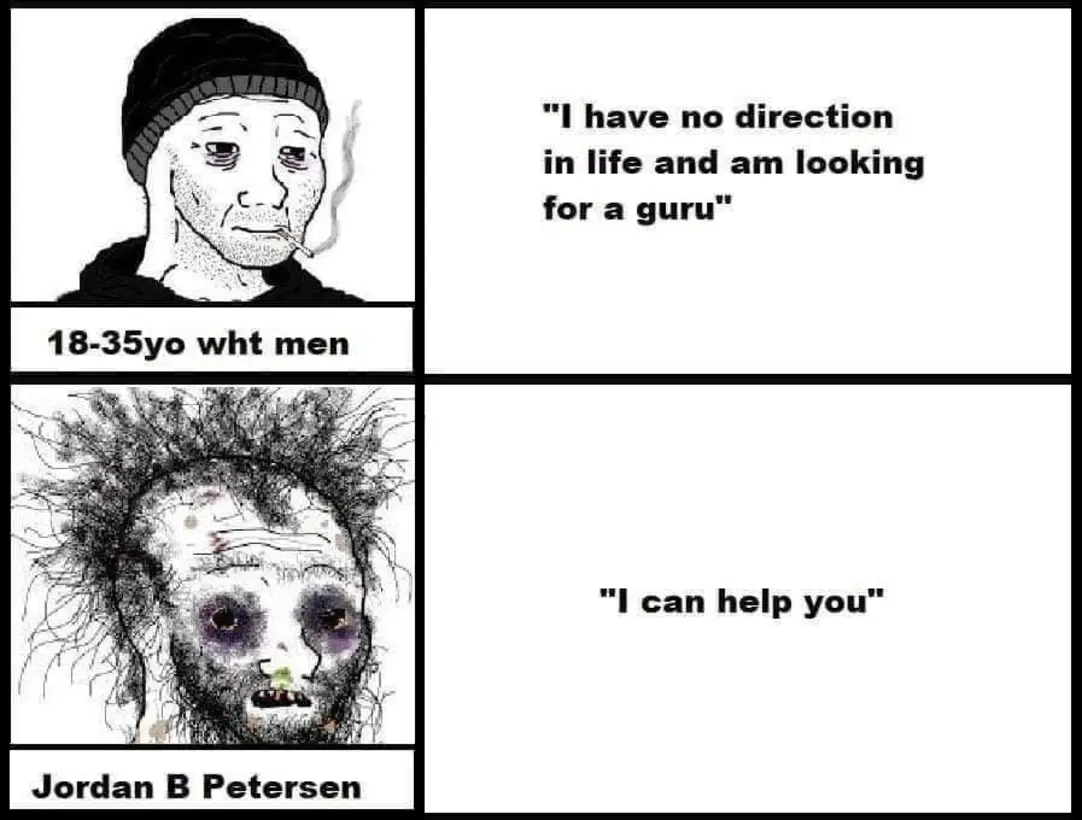
The meme is a commentary on the stereotype that incels (involuntarily celibate individuals) are often self-absorbed and lack empathy. The image depicts a young man with a smug expression, captioned "18-35yo who has never had a job" and "18-35yo who has never had a job but thinks they're a genius". The text is a quote from the Reddit user "Jordan Peterson" who is known for his philosophical and psychological insights, but in this context, the quote is being used ironically to highlight the absurdity of the character's self-aggrandizing and lack of empathy.
detailed-analysis (gemma3-27b-vision)
Okay, let's break down this meme, addressing the requested theoretical lenses where applicable. It's a fairly loaded image, so there's quite a bit to unpack.
Visual Description
The image is a four-panel meme constructed using intentionally crude and stark digital drawings.
- Panel 1: Depicts a simplistic, cartoonish rendering of a young man (described as 18-35 years old "wht men") appearing distressed. He is wearing a beanie, has visible tear tracks on his face, and is smoking a cigarette. The style is reminiscent of Wojak, a character often used to represent online archetypes.
- Panel 2: Contains text stating, "I have no direction in life and am looking for a guru." This text is displayed against a neutral gray background.
- Panel 3: Features a severely distorted and exaggerated depiction of Jordan Peterson. His face is drawn as gaunt, with wild hair, deeply sunken eyes, and a generally unkempt appearance. This presentation is significantly more grotesque than the first panel.
- Panel 4: Simply states, "I can help you," also against a neutral gray background.
The layout follows a classic meme format: a problem/statement presented, followed by a proposed (often ironic or satirical) solution.
Foucauldian Genealogical Discourse Analysis
This meme lends itself strongly to a Foucauldian analysis. The image reveals power dynamics through the construction of discourses.
- Discourse of Meaninglessness/Existential Crisis: The first panel initiates a discourse around the modern experience of feeling lost, directionless, and the search for meaning. This is a discourse that has been constructed over decades, fueled by existentialist philosophy, anxieties about modern life, and a perceived lack of traditional structures.
- Construction of the "Guru": The search for a "guru" reveals a need for authority, someone who can provide a framework for meaning and guidance. The figure of the guru is itself a historically constructed category with specific power dynamics embedded within it.
- Jordan Peterson as Constructed Authority: The meme deconstructs the authority of Jordan Peterson. Instead of presenting him as a respectable intellectual, the image portrays him as grotesque, disheveled, and even slightly frightening. This presentation questions the basis of his authority. The meme suggests that the "help" offered by Peterson is not necessarily restorative or beneficial, but potentially damaging or disorienting. The grotesque rendering is a disruption of the "sovereign" image Peterson often cultivates.
- Power/Knowledge: The meme suggests that Peterson’s power (as a self-help guru) is reliant on the construction of a problem (lack of direction) and a corresponding solution (his teachings). This highlights Foucault's idea that power and knowledge are inseparable.
Critical Theory
From a Critical Theory perspective, the meme can be seen as a critique of ideology and the commodification of self-help.
- False Consciousness: The first panel represents individuals grappling with genuine anxieties. However, the image suggests that these anxieties are often channeled into seeking answers from figures like Peterson, whose teachings may serve to reinforce existing power structures rather than challenge them.
- Commodification of Meaning: The self-help industry (and figures like Peterson within it) can be seen as commodifying the search for meaning. Anxiety and existential angst are turned into a market opportunity.
- Culture Industry: The meme implies that Peterson, as a public intellectual, is part of a larger "culture industry" that manufactures consent and reinforces dominant ideologies.
- Critique of Individualism: Peterson’s work often emphasizes individual responsibility and self-improvement. The meme could be read as a critique of this emphasis, suggesting that the real sources of meaninglessness are systemic rather than individual.
Marxist Conflict Theory
While not the primary focus, a Marxist reading is possible.
- Alienation: The sense of directionlessness depicted in the first panel can be linked to the concept of alienation under capitalism. Individuals feel disconnected from their labor, from each other, and from their own potential.
- Ideology as False Consciousness: Peterson’s teachings (implied by the meme) can be seen as an ideology that obscures the underlying causes of alienation. He offers individual solutions to systemic problems.
- Class Implications: It is notable the first panel specifically identifies the person as "wht men", hinting that a specific demographic is most likely to seek out Peterson’s advice.
Postmodernism
The meme embodies several postmodern characteristics:
- Irony and Parody: The meme relies heavily on irony and parody. It's not a sincere endorsement of Jordan Peterson, but a satirical commentary on his influence and the dynamics of seeking guidance.
- Deconstruction of Authority: The grotesque portrayal of Peterson is a deliberate act of deconstruction, undermining his claims to authority and expertise.
- Fragmentation and Playfulness: The meme's crude drawing style and simplistic format reflect a postmodern rejection of grand narratives and a preference for fragmentation and playfulness.
- Simulacra and Simulation: The meme can be seen as a simulacrum of both the individual’s existential crisis and Jordan Peterson’s public image. It's a copy of a copy, a representation of a representation.
Queer Feminist Intersectional Analysis
This lens is less directly applicable but can still yield insights.
- Masculinity and Vulnerability: The first panel depicts a young man expressing distress, challenging traditional notions of masculinity that discourage vulnerability. The meme implies that this vulnerability is being exploited by a figure like Peterson.
- Dominant Masculinity: Peterson’s appeal is often linked to his emphasis on traditional gender roles and a specific model of masculinity. The meme can be read as a critique of this model and its potential to reinforce patriarchal power structures.
- Whiteness and Authority: The specific identification of "wht men" suggests that Peterson’s appeal is disproportionately strong among this demographic, potentially reinforcing existing racial and gender power imbalances.
In Conclusion
This meme is a surprisingly complex piece of internet commentary. It’s a potent mix of satire, critique, and social commentary. It doesn’t offer simple answers but raises questions about power, authority, ideology, and the search for meaning in the modern world. It’s a great example of how memes can be used to express and analyze complex social and political issues.
simple-description (llama3.2-vision)
The meme is a humorous comparison between two different types of people. The top image shows a young man in his 20s who is struggling to find direction in life, and is looking for a guru to help him. The text reads, "I have no direction in life and I'm looking for a guru." The bottom image shows a man who is completely uncoordinated and disheveled, with a wild look in his eyes. The text reads, "I can help you."
tesseract-ocr
a “| have no direction “'S ns in life and am looking ENS CP Ff fi . 17 | ‘or a guru Ko 4 g Ae y \ 18-35yo wht men Ry Bie RR rR? ~ eg ase Z - eat ae ee EE >See” a ee 6 BS ee ae Sa mie is a 3 oe Any vas | [77s & I "I can help you" Ae ee (A MDa ! al ee ss ~ Ae 1 Rat nay : ey Resa Jordan B Petersen