First Seen
2023-05-10T20:59:59+00:00
simple-description (llama3.2-vision_11b)
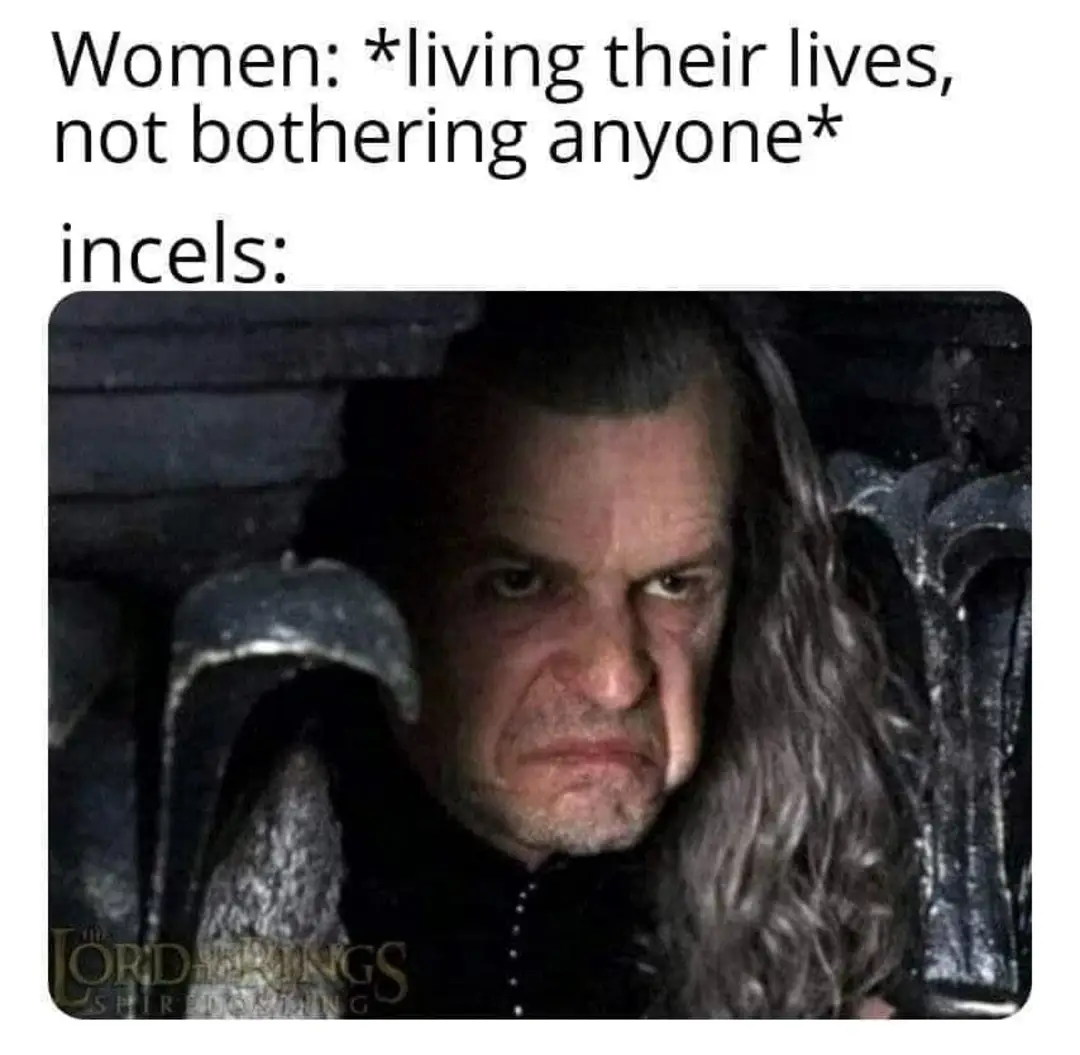
The meme is a humorous take on the "involuntary celibate" (involuntarily celibate) or "incel" subculture, which is known for its misogynistic and anti-social tendencies. The image shows a character from the Lord of the Rings, specifically the villainous Sauron, with a caption that reads "Women: living their lives, not bothering anyone / Incels: staring at the wall, wondering why they're still single". The meme pokes fun at the stereotype that incels are often bitter and resentful of others' success, and that they're unable to form relationships or live a fulfilling life.
detailed-analysis (gemma3-27b-vision)
Okay, let's break down this meme through the requested theoretical lenses. It's a complex image, and some lenses will be more applicable than others.
Visual Description
The meme consists of text layered over an image. The text reads: "Women: living their lives, not bothering anyone," followed by "incels:" The image underneath this text is a close-up of the character Grima Wormtongue from The Lord of the Rings, looking intensely resentful and menacing. Grima is depicted with a shadowed face, conveying a feeling of darkness, bitterness, and malice. The lighting emphasizes his furrowed brow and the intensity of his gaze. The visual effect is that of an individual who is consumed by negative emotion, especially envy and hostility.
Foucauldian Genealogical Discourse Analysis
This meme embodies a critical commentary on the discourse surrounding gender and entitlement. A Foucauldian approach would examine how power dynamics are produced through language and imagery.
- Power/Knowledge: The meme highlights the perceived “threat” of women simply existing and living their lives—a threat constructed by the incel subculture. This perception isn’t inherent but produced through the articulation of specific discourses (e.g., victim narratives, entitlement to sexual access).
- Genealogy of Resentment: The use of Grima Wormtongue, a character known for whispering poison into the ears of kings and causing unrest, is important. This suggests a genealogy of resentment. The meme implies that the animosity towards women isn’t accidental but a historically-shaped mode of thinking and feeling within the incel community. The roots of this resentment may lie in broader cultural discourses about masculinity, sexuality, and societal expectations.
- Disciplinary Power: The meme subtly implicates the incel community in a kind of self-imposed disciplinary power. They police the behavior of women, interpret their actions as inherently threatening, and justify their own anger and hostility.
Critical Theory
This meme can be understood through the lens of Critical Theory, specifically concerning the ideology of gender roles and the construction of ‘otherness.’
- Ideology: The meme exposes the underlying ideology driving the incel worldview. The very premise – that women existing without catering to male desire is somehow ‘bothering’ – is rooted in the belief that women's primary purpose is to fulfill male needs. This is a patriarchal ideology that denies women agency and autonomy.
- The 'Other': The meme positions women as the 'Other'– as the group defined in opposition to the incel's perceived identity and needs. This ‘othering’ facilitates dehumanization and justifies resentment. The incel views the independent existence of women as a rejection of their presumed entitlement.
- Domination: The meme implicitly connects this resentment with a desire for domination. The anger stems from a perceived loss of control over women and a yearning to reassert patriarchal authority.
Marxist Conflict Theory
While not a primary lens, Marxist Conflict Theory can offer some insights.
- Power Dynamics: The meme reflects a power struggle, albeit not primarily economic. It highlights the perceived loss of power by the incel community regarding their relationship with women.
- Alienation: The incel community experiences a form of alienation—a disconnection from what they perceive as their ‘rightful’ place in the social order. This alienation manifests as anger and hostility toward the group they believe is denying them what is ‘owed.’
- False Consciousness: One could argue that the incel worldview represents a form of false consciousness. They misidentify the root cause of their dissatisfaction, attributing it to women rather than to systemic inequalities, patriarchal structures, or personal factors.
Postmodernism
Postmodernism applies less directly, but we can see elements.
- Deconstruction of Meaning: The meme deconstructs the notion of ‘innocent’ behavior. It reveals how the seemingly harmless act of women living their lives can be interpreted as a hostile act based on the perspective of the incel community.
- Subjectivity of Truth: The meme highlights the subjective nature of reality. The perception of being “bothered” isn’t an objective truth but a product of the incel’s worldview.
- Simulacra: The meme itself is a simulacrum – a copy without an original. It's a representation of a complex social phenomenon reduced to a simplified image and text, highlighting the detachment of signs from reality.
Queer Feminist Intersectional Analysis
This is a powerful lens for understanding the meme.
- Patriarchy & Misogyny: The meme directly embodies patriarchal and misogynistic attitudes. It illustrates the belief that women's lives should be centered around satisfying male desires, and any deviation from this is seen as an act of aggression.
- Incel Ideology as a Threat: Incel ideology is understood as a direct threat to gender equality and women's safety. The meme demonstrates how this ideology is rooted in entitlement, resentment, and the dehumanization of women.
- Intersectionality: While the meme focuses on the gender dynamic, it's important to acknowledge the intersectionality of oppression. Incel ideology often intersects with other forms of prejudice, such as racism, homophobia, and transphobia, further marginalizing vulnerable communities.
- Deconstructing Masculinity: The meme implicitly critiques toxic masculinity, revealing how rigid gender roles and expectations can lead to anger, resentment, and violence. The incel's inability to accept women's autonomy is a direct result of their adherence to these harmful norms.
I hope this provides a thorough and nuanced analysis of the meme through these different theoretical frameworks. Let me know if you'd like me to elaborate on any particular point!
simple-description (llama3.2-vision)
This meme is a humorous commentary on the stereotype that women are more empathetic and concerned about others' feelings, while men are more self-focused. The image shows a character from the Lord of the Rings, Boromir, who is known for his intense and brooding personality. The text "Women: living their lives, not bothering anyone / Incels: " says that women are living their lives without causing trouble, while "incels" (short for "involuntary celibates," a term referring to people who struggle with dating and relationships) are a group of men who are often self-focused and self-obsessed, as exemplified by the image of Boromir.
tesseract-ocr
Women: *living their lives, not bothering anyone* incels: , és + Mma P "4 , * My By a ‘ ee