First Seen
2023-05-10T21:03:34+00:00
simple-description (llama3.2-vision_11b)
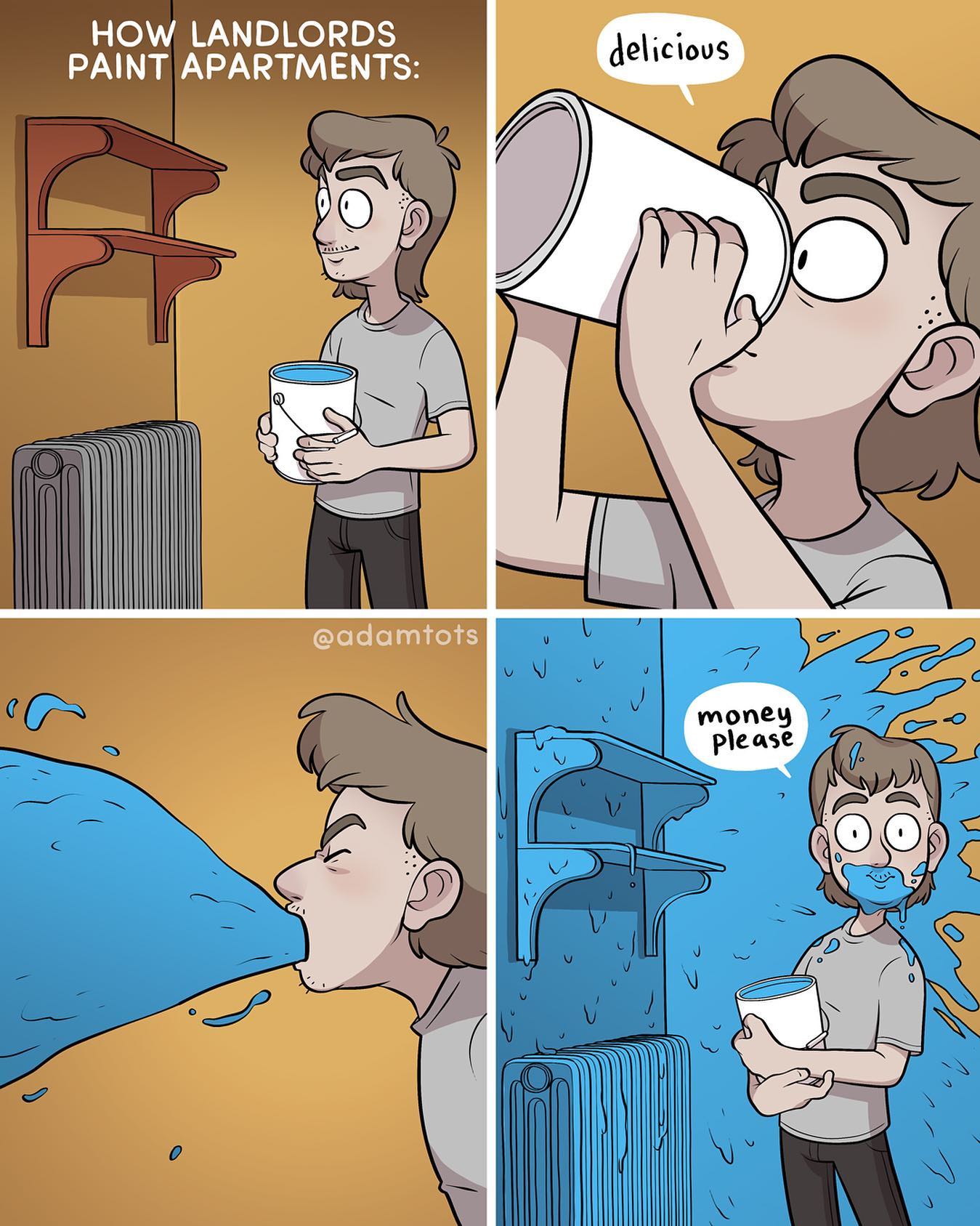
The meme is a humorous commentary on the relationship between landlords and tenants, specifically the former's tendency to prioritize their own interests over the well-being of their tenants. The image depicts a landlord who is delighted by the idea of painting their apartment, but only if it's done at the expense of the tenant's safety and well-being. The text "I'm not the one painting the walls, I'm just here for the free paint" is a sarcastic commentary on the landlord's lack of concern for the tenant's well-being.
In the image, a landlord is shown happily drinking paint, with the caption "I'm not the one painting the walls, I'm just here for the free paint". The image is a satirical commentary on the landlord's lack of concern for the tenant's well-being, implying that they are only interested in the free paint, not the actual painting process.
detailed-analysis (gemma3-27b-vision)
Okay, here’s an analysis of the comic titled “How Landlords Paint Apartments” broken down into sections addressing the requested theoretical frameworks. I'll indicate when a section isn't applicable.
Visual Description
The comic is a four-panel cartoon in a simple, slightly anxious style. Each panel features a young man in a grey t-shirt depicted as being splattered with bright blue paint.
- Panel 1: The man stands in a sparsely furnished room, holding a can of blue paint. He appears startled, with wide eyes.
- Panel 2: The man's face is now fully splashed with paint, and a speech bubble above his head contains the word “delicious” implying a satirical, ironic comment on the situation.
- Panel 3: The entire room (walls, radiator, and floor) is being engulfed in a torrent of blue paint. The man stands amidst the deluge, looking exasperated.
- Panel 4: The room is completely blue, and the man is thoroughly drenched. A speech bubble says "money please". The radiator is visible in blue. The artist's Instagram handle (@adamtots) is visible in the lower center.
The visual style emphasizes the overwhelming and messy nature of the "renovation" process, and the man's implied helplessness. The consistent, vibrant blue dominates the image.
Marxist Conflict Theory
This comic functions as a potent visual metaphor for the exploitative relationship between landlords and tenants under capitalism.
- Conflict: The central conflict is not explicit but implied – the landlord benefits from "improvements" (painting) while the tenant bears the inconvenience, mess, and implied cost (both financial and emotional).
- Class Struggle: The comic exposes the inherent power imbalance. The landlord holds the economic power, dictating the "improvements" while the tenant is subjected to them. The “money please” speech bubble reinforces that the cost is ultimately passed on to the tenant.
- Exploitation: The depiction of the chaotic and messy painting suggests a disregard for the tenant’s living space and wellbeing. It's a symbolic representation of how landlords prioritize profit (increased rental value) over the comfort and dignity of their tenants.
- Alienation: The man's increasingly distressed expression and immersion in the blue paint suggest a sense of alienation – a loss of control over his own environment and a feeling of being overwhelmed by forces beyond his control.
The comic subtly critiques the commodification of housing, where the tenant’s home is treated as an asset to be maximized for profit, rather than a space for living and wellbeing.
Critical Theory
The comic embodies a critical commentary on the nature of power, control, and the construction of "improvement" within the context of rental housing.
- Power Dynamics: The comic demonstrates an asymmetrical power dynamic. The landlord possesses the power to dictate the aesthetic of the tenant’s space and to extract financial resources in the name of “improvement.”
- Construction of Reality: The term “improvement” itself is deconstructed. The chaotic and messy nature of the painting suggests that what is presented as an improvement is in fact a disruptive and potentially damaging act, imposed upon the tenant.
- Control & Surveillance: While not explicitly shown, the act of painting can be seen as a form of control. The landlord is imposing their aesthetic vision on the tenant’s space, thereby exerting control over their environment.
- Critique of Rationality: The man's expression and the overwhelming blue paint satirize the idea that renovations are always rational or beneficial. It highlights the absurdity of prioritizing cosmetic changes over genuine tenant wellbeing.
Foucauldian Genealogical Discourse Analysis
This framework can be applied by examining the "discourse" of housing and renovation.
- Discourse of "Improvement": The comic exposes the discourse of “improvement” in rental housing. The landlord frames the painting as a positive change, but the visual depiction reveals its disruptive and potentially exploitative nature.
- Power/Knowledge: The landlord’s power is linked to the knowledge they possess regarding housing maintenance and market value. They use this knowledge to justify the “improvements” and extract rent increases.
- Discipline: The act of renovation can be seen as a form of subtle discipline. By imposing their aesthetic vision, the landlord reinforces their authority and control over the tenant's space.
- Genealogy: We could trace the historical genealogy of "renovation" in rental housing, examining how it has evolved from a genuine attempt to maintain properties to a tool for increasing profit and controlling tenants.
Postmodernism
The comic plays with irony and the deconstruction of meaning.
- Irony: The use of “delicious” is deeply ironic, contrasting with the messy, inconvenient, and potentially exploitative situation.
- Deconstruction: The comic deconstructs the idea of “improvement” by revealing its disruptive and potentially negative consequences for the tenant.
- Simulacra & Simulation: The blue paint can be seen as a simulacrum – a copy without an original. The focus is on the aesthetic surface, rather than genuine quality or functionality.
- Subjectivity of Experience: The comic highlights the subjective nature of experience. What the landlord perceives as an “improvement” is experienced by the tenant as a disruption and inconvenience.
Queer Feminist Intersectional Analysis
While not the primary lens, an intersectional reading could add depth:
- Power Dynamics & Vulnerability: The tenant’s vulnerability is exacerbated by the power imbalance with the landlord. Vulnerability intersects with class, and potentially other marginalized identities (race, gender, etc.), impacting their ability to negotiate or resist the “improvements.”
- Space & Control: Control over space is a critical component of safety and agency. The landlord’s imposition of their aesthetic vision can be seen as a denial of the tenant’s agency over their own living space.
- Disruption of Home: For marginalized individuals, "home" is often a particularly important space for safety, identity, and community. The disruption of "home" through unwanted renovations can be deeply damaging.
Note: It's important to recognize that these are interpretive frameworks, and the comic can be read from multiple perspectives. The strength of the piece lies in its ability to evoke a range of interpretations and to spark critical thinking about the power dynamics inherent in rental housing.
Let me know if you’d like me to elaborate on any of these points or to explore additional theoretical frameworks.
simple-description (llama3.2-vision)
The meme is a humorous take on how landlords often paint apartments with a "paint that doesn't dry" or "paint that's too expensive to use" that has a tendency to get everywhere, even on the tenant. The image shows a person drinking paint, with the caption "How landlords paint apartments:".
tesseract-ocr
HOW LANDLORDS Jeliciovs PAINT APARTMENTS: - — cw | 7 V¥A\( t — $e, y min | “) / Me 7 See Cas : J money | 7_7 2 S please —<—~, = ae CF i. oes OO = 2» fur , a SS ¥ ia YB S ( a | ~ RG = 4 MAM me | coe Hil ‘ ;