First Seen
2023-05-10T21:03:34+00:00
simple-description (llama3.2-vision_11b)
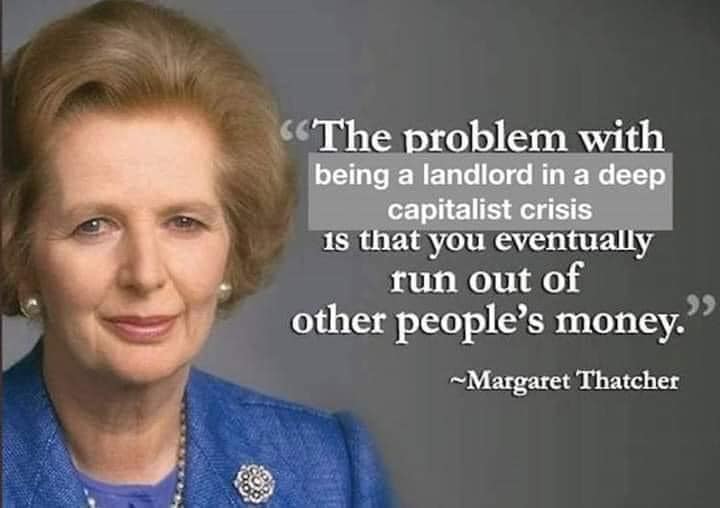
The meme features a photo of Margaret Thatcher with a quote that reads: "The problem with capitalism is that you can't buy a decent house unless you're rich enough to buy one." The image is captioned with a quote from Thatcher, implying that she is criticizing the idea of buying a home as a capitalist issue.
detailed-analysis (gemma3-27b-vision)
Okay, here's an analysis of the image and quote, broken down by the requested theoretical frameworks. I'll only include sections where the frameworks significantly apply.
Visual Description
The image is a head-and-shoulders portrait of Margaret Thatcher, former Prime Minister of the United Kingdom. She is depicted in a formal setting, likely a photograph taken during her time in office. Thatcher is wearing a blue suit and a pearl necklace, conveying a sense of authority and respectability. Her expression is subtly smug, perhaps even amused, with a slight upturn of her lips. The background is blurred and dark, drawing attention to her face. A text box with a quote attributed to her is superimposed over the image. The overall presentation is designed to establish Thatcher as a speaker of this provocative statement.
Foucauldian Genealogical Discourse Analysis
This image and quote provide an excellent case study for a Foucauldian analysis. The statement reveals a discourse of power and capital.
- Power/Knowledge: The quote isn’t merely about the inconvenience of a landlord running out of rental income. It reveals a cold, pragmatic understanding of the relationship between capital accumulation and the exploitation of others. The "other people's money" is not seen as earned income but as a resource to be extracted. This highlights the power/knowledge relationship: knowledge about financial systems and exploitation grants those in power the ability to maintain that power.
- Genealogy of the Concept of "Crisis": The phrase "deep capitalist crisis" invokes a history of economic upheaval and the ideological responses to it. A genealogical approach would investigate how the concept of "crisis" has been defined and used throughout history, particularly in relation to capitalism, to justify certain policies and to maintain existing power structures. Thatcher's statement implies that even during a crisis, the priority remains preserving the flow of capital.
- Disciplinary Power: The statement, if taken as an honest reflection of Thatcher's thinking, demonstrates a disciplinary mode of thinking that is deeply embedded in the capitalist system. It doesn't view people as individuals with needs, but as a source of revenue, whose exploitation is acceptable until the revenue runs out.
Critical Theory
This image and quote are ripe for Critical Theory analysis, particularly within the Frankfurt School tradition.
- Domination & Instrumental Reason: The quote exemplifies instrumental reason—the use of logic and calculation not for ethical or humanistic purposes, but solely to achieve a desired outcome (in this case, wealth accumulation). It demonstrates how the logic of capitalism can eclipse any concern for the well-being of others. This logic leads to domination—the systemic control and exploitation of one group (tenants) by another (landlords/capitalists).
- Ideology and False Consciousness: The statement could be seen as an instance of ideology at work. It reveals a worldview where the accumulation of wealth is normalized and presented as a natural outcome, masking the inherently unequal power dynamics involved. The ‘other people’s money’ is presented as a given, without acknowledging the labor and resources that created it.
- Critique of Enlightenment Rationality: The statement challenges the ideal of Enlightenment rationality by demonstrating how reason can be used to justify exploitation and indifference.
Marxist Conflict Theory
This image and quote are central to a Marxist analysis.
- Class Struggle: The statement is a blunt articulation of the inherent conflict between the capitalist class (landlords) and the working class (tenants). The "other people's money" clearly represents surplus value extracted from the labor of others. The quote essentially reveals that the landlord’s concern is not the well-being of the tenants, but the continued extraction of profit.
- Exploitation & Alienation: The statement highlights the process of exploitation inherent in the landlord-tenant relationship. Tenants provide labor and money (rent), while the landlord appropriates the surplus value. This creates alienation, separating tenants from the fruits of their labor and reinforcing their dependence on the landlord.
- Capital Accumulation: The quote directly addresses the central dynamic of capitalism – capital accumulation. The landlord's concern is not about providing housing but about maintaining the flow of capital, even if it means exploiting others. The statement shows how the system perpetuates itself by prioritizing profit over people.
Postmodernism
While not a primary lens, postmodern analysis could be applied by deconstructing the authority of the speaker and the apparent neutrality of the statement.
- Deconstruction of Authority: The image positions Thatcher as an authority on economic matters. A postmodern reading would question this authority, highlighting how her statements are shaped by her class position and political agenda.
- The "Truth" of the Statement: Postmodernism would challenge the notion that the statement represents a universal truth. It would emphasize that it is merely one interpretation of economic reality, constructed from a specific perspective. It would also point out the constructed nature of the statement, challenging the idea of objectivity.
I hope this comprehensive breakdown is helpful! Let me know if you'd like me to elaborate on any of these points.
simple-description (llama3.2-vision)
This meme features a photo of Margaret Thatcher, the former Prime Minister of the United Kingdom. The text next to her image reads: "The problem with being a landlord in a capitalist crisis is that you eventually run out of other people's money."
tesseract-ocr
PSG U hosel) emwstisy - |being a landlord in a deep | ' Ie M crane hg 4 fun out of + other people’s money. é ~Margaret Thatcher Recent)